
侧边栏

宋代木雕彩绘水月观音菩萨(香港佳士得)
尺寸:高156 cm
年代:宋代
质地:木雕彩绘
风格:中原
来源:拍卖会
成交:10,180,000港元(2010.05)
参阅:外部链接
鉴赏:
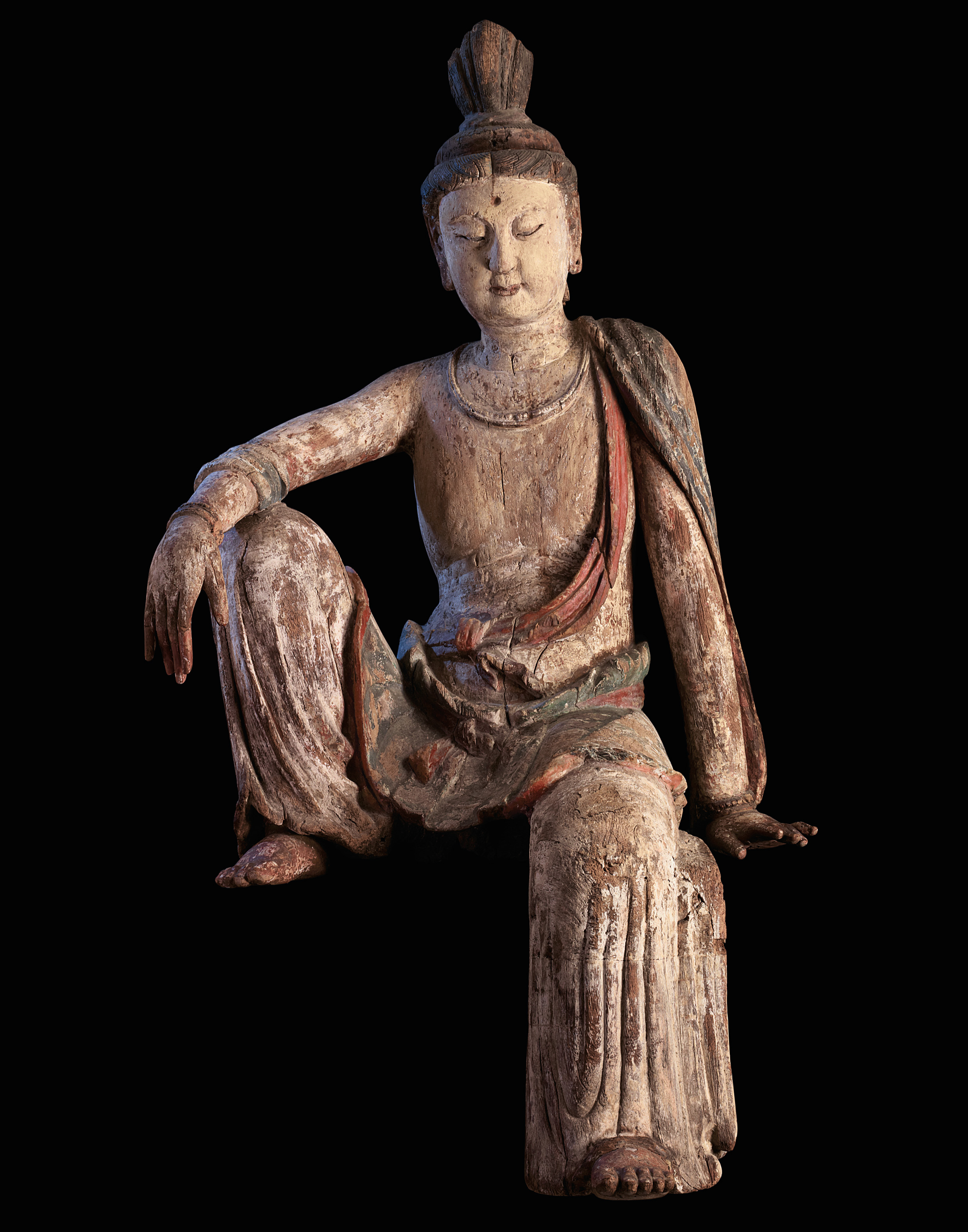 AN IMPORTANT LARGE POLYCHROME WOOD FIGURE OF THE WATERMOON GUANYIN
SONG DYNASTY (960-1279)
神像庄严地呈游戏坐(Lalitasana),即放松之姿,右臂放松地搭在抬起的右膝上,左臂伸直,在垂放的左腿上方支撑身体。身披简约的帔帛,袒露胸口,宽袍在前打结,佩戴珠串项链与手镯。面容安详沉静,头发盘成精致的发髻。残留石膏打底与颜料痕迹。
来源:
C. T. Loo, New York
Sotheby's New York, 19 November 1982, lot 96
Christie's Hong Kong, 18 March 1991, lot 343
The Aurora Foundation
The Dexingshuwu Collection
著录:
Gugong Wenwu Yuekan, The National Palace Museum of Chinese Art, Taipei, Issue No. 189, April 1997 (front cover)
展览:
National Palace Museum, Taipei, The Art of Contemplation: Religious Sculptures from Private Collections, 1997, p. 194, no. 84
世界各地博物馆收藏中可见数尊此类略大于真人大小的木雕造像,均以这种游戏坐(lalitasana)的闲适姿态端坐。大英博物馆由National Art-Collections Fund所赠的一尊与此尊尺寸相近的大型造像,收录于W. Zwalf编《Buddhism: Art and Faith》一书(伦敦,1985年,第206页,第296号)。另一尊较小者(高109.2厘米)藏于大都会艺术博物馆,收录于《海外遗珍·中国艺术在海外收藏·佛教雕塑II》(台北,1990年,第147页,第142号)。此类大型木雕佛教造像制作于10至14世纪,出自中国北方太原和五台山这两个重要的佛教中心(均位于山西省)。就本像而言,其饱满的四肢和写实的面部特征为宋代所特有,不同于唐代造像中四肢纤细的神像。
本像左腿垂放、闲适而坐的造型,常被称为“水月观音”或“南海观音”。这两个名称均指观音菩萨居住于印度南海岸的普陀洛迦山(Mount Potalak)。这一图像母题随着5世纪初《华严经》(Avatamsaka sutra)的汉译而传入中国。
A number of these slightly larger than life-size wood figures, seated in this form of lalitasana posture of relation, are known in museum collections around the world. A close example of this remarkably large size given to the British Museum by the National Art-Collections Fund is illustrated in Buddhism: Art and Faith, ed. by W. Zwalf, London, 1985, p. 206, no. 296. Another smaller example (109.2 cm. high) in the Metropolitan Museum of Art is illustrated in Hai-wai Yi-Chen, Chinese Art in Overseas Collections, Buddhist Sculpture II, National Taipei, 1990, p. 147, no. 142. Large wood Buddhist sculptures of this type were produced between the 10th to 14th centuries in northern China's two pre-eminent Buddhist centres of Taiyuan and Wutai Mountain, both in Shanxi province. In this instance, the fleshed out limbs and naturalistic facial features of the present sculpture are distinctive of the Song period, and differ to the delicate-limbed deities of the earlier Tang dynasty.
The modelling of the present figure seated at ease with the left leg pendent is often termed by the name of Watermoon Guanyin or Nanhai Guanyin (the Avalokitesvara of the Southern Seas). Both names refer to the Guanyin residing at Mount Potalak on the southern coast of India, and the imagery was introduced into China with the translation of the Avatamsaka (Huayan) sutra in the early 5th century.

