
侧边栏

10世纪日本木雕彩绘六臂如意轮观音菩萨坐像(奈良国立博物馆)
尺寸:H 94.9cm
年代:9-10世纪
质地:一木整雕
风格:日本
来源:奈良国立博物馆
参阅:外部链接
鉴赏:
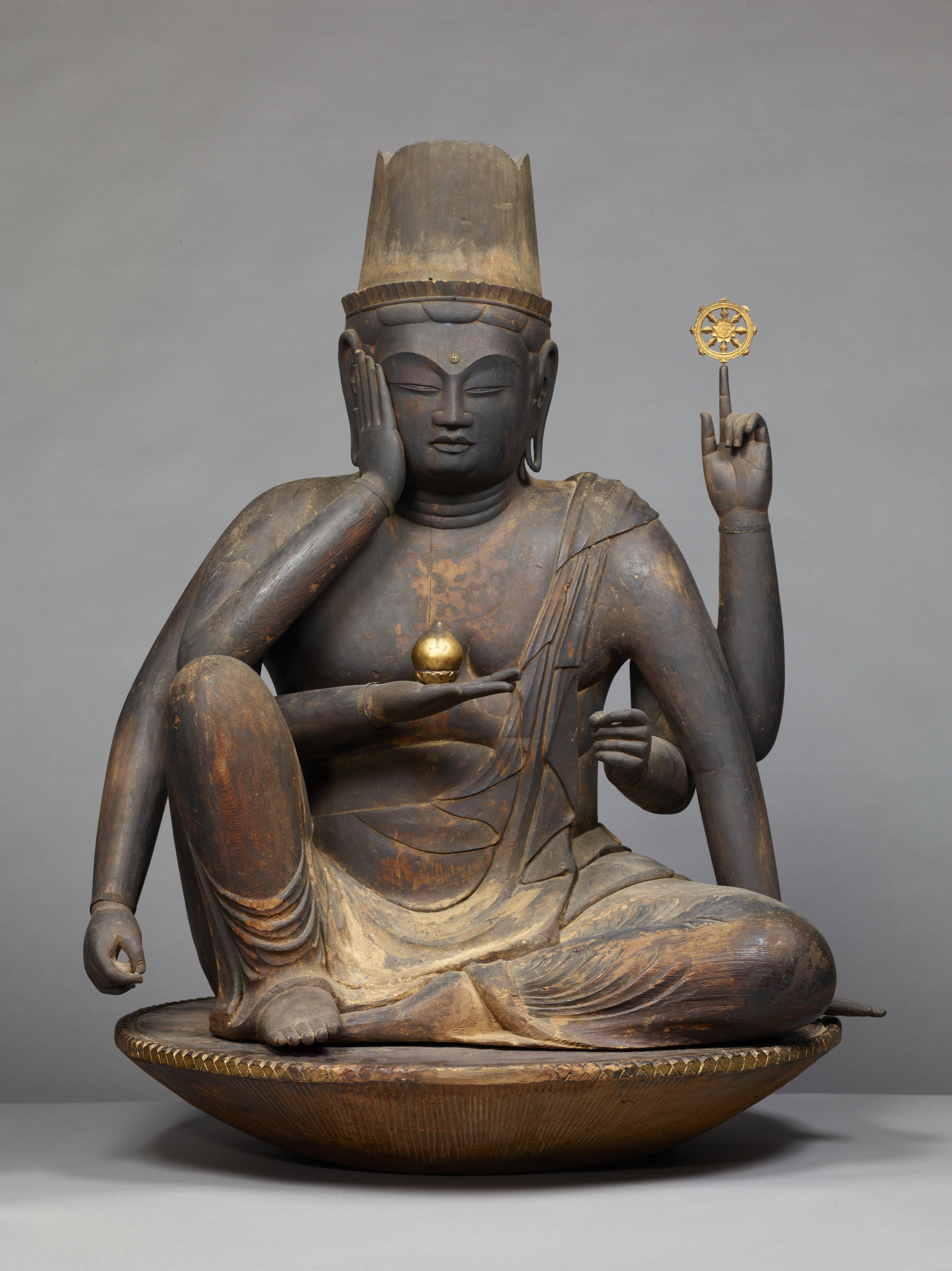 Bodhisattva Cintāmaṇicakra
Holding such attributes as a wish-fulfilling jewel and a dharma wheel, this six-armed emanation of the bodhisattva Kannon (Skt. Avalokiteśvara) is known as Nyoirin (Skt. Cintāmaṇicakra). There is a profound sense of volume to its form, which has been shaped from a single block of Japanese nutmeg. The statue seems to reflect the stylistic influence of works from beyond East Asia, for instance in its connected eyebrows carved to form long and sharp lines.
Buddhist Art Paradise: Jewels of the Nara National Museum. Nara National Museum, 2021.7, p.343, no.97.
如意轮观音
此尊六臂观音菩萨化身,持如意宝珠与法轮,是为如意轮观音。像身以单块榧木雕造,体量感深沉厚重。眉眼相连,线条修长锐利,可见东亚以外地区造像风格之影响。
——《佛教美术 paradise:奈良国立博物馆珍宝展》,奈良国立博物馆,2021年7月,第343页,第97号
The legend said that this statue was discovered in the sea of Tango region. The carving technique of the early Heian period can be seen on the stern face with connected eyebrows, as well as the thick and broad body structure. The scarf-like cloth (jōhaku) was draped widely which is rare to see, it leads a theory that this statue belongs to the Tendai sect.
Masterworks from the Nara Buddhist Sculpture Hall at the Nara National Museum. Nara National Museum, 2010, p.141, no.133.
据传此像发现于丹后海中。面部表情严肃,眉眼相连,体态厚实宽硕,可见平安时代初期之雕造技法。帔帛宽大,形制罕见,由此推测此像或与天台宗有关。
——《奈良国立博物馆佛教雕刻馆名品选》,奈良国立博物馆,2010年,第141页,第133号
“This is a statue of Nyoirin-kannon (Cintāmaṇicakra) with six arms. The head and the body were carved from a single piece of kaya wood (Japanese nutmeg). The left leg was made of a single piece of wood that includes the tree's center core, cut transversely. The right leg, which is drawn up, was made of a wooden piece which was cut vertically from a tree. Triangular wooden pieces were attached to the body and in turn the thighs were attached to those triangular pieces. Small wooden pieces were used for making details such as toes. Bronze ornaments still remain on the bottom part of the crown. Pupils of the eyes were made of wood and inserted: the kind of the wood for the pupils were different from the wood for the body. There is a trace of lacquer foil covering the crown. The body was originally colored, but the color has come off.”, “ The posture of the statue with its upright head facing the front indicates the classic style of this statue. The characteristic aspect of the modeling is the body's stoutness which is in contrast to the relatively slender arms and legs. The descriptions of continuing eye-brows, outlines of ears and breast are also characteristic. The date of production is thought to have been between the end of the 9th and the 10th centuries. This is the second best masterpiece sculpture of Nyoirin-kannon next to the one in Kanshin-ji temple in Osaka.”
Masterpieces of Nara National Museum. Nara National Museum, 1993, p.18, no.7.
此为六臂如意轮观音像。头与身由单块榧木雕成。左腿采用包含树芯的横切木材,右腿(屈起)采用纵切木材。像身连接三角形木块,再与大腿相接。足趾等细部以小木块雕造。冠下部尚存铜制装饰。瞳孔为木质嵌眼,所用木材与像身不同。冠部残留漆箔痕迹。像身原有彩绘,现已脱落。
头部端正、面向前方之姿态,彰显此像之古典风格。造型特征为身躯敦实厚重,与相对纤细之手足形成对比。眉眼相连、耳廓及胸部之线条刻画亦具特色。制作年代推定在9世纪末至10世纪之间。此像为仅次于大阪观心寺如意轮观音之杰作。
——《奈良国立博物馆名品选》,奈良国立博物馆,1993年,第18页,第7号
这是真人等高的六臂如意轮观音坐像。据称曾被安置于京都市上京区回向院内的如意轮观音堂。回向院建于江户时代(1603-1867),据寺传记载本像是宽永5年(1628)在丹后国海中发现的二尊如意轮观音像中的一尊,另一尊现存于京都市内的善福寺(10世纪)。本像自肩部拼接各只手臂,两脚前半部分采用其他材料制作和拼接,除此之外头部和躯体部用整根榧材制作并且避免了木芯朝前,内部不挖空。除了这种旧式构造之外,从用同木料雕成的大筒形宝冠、双眉平齐的严肃表情、头部进深较宽,宽阔的躯体形态等特征都可看出该作品制作于平安时代(794-1185)中期之后。另外造像头部不倾斜,竖直站立这一点也近似于日本最早的六臂如意轮观音雕像作品——大阪观心寺像。但因造像手臂的一部分是后补上去的,因此整体略显失衡,有些可惜。本像在表现手法上的另一个特征是,披在左肩上的条帛宽宽的盖住整个腹部,同时向背面扩展接近台座。这种表现手法实属罕见,但在天台系中可以找到类似作品的实例,因此有人推测本像可能是根据天台系图像制作而成。

