
侧边栏

元代宫廷铜鎏金观音菩萨坐像(空行观音)(香港佳士得)
尺寸:高31 cm
年代:元代
质地:铜鎏金
风格:元代宫廷
来源:拍卖会
成交:24,900,000港元(2025.11)
参阅:外部链接
鉴赏:
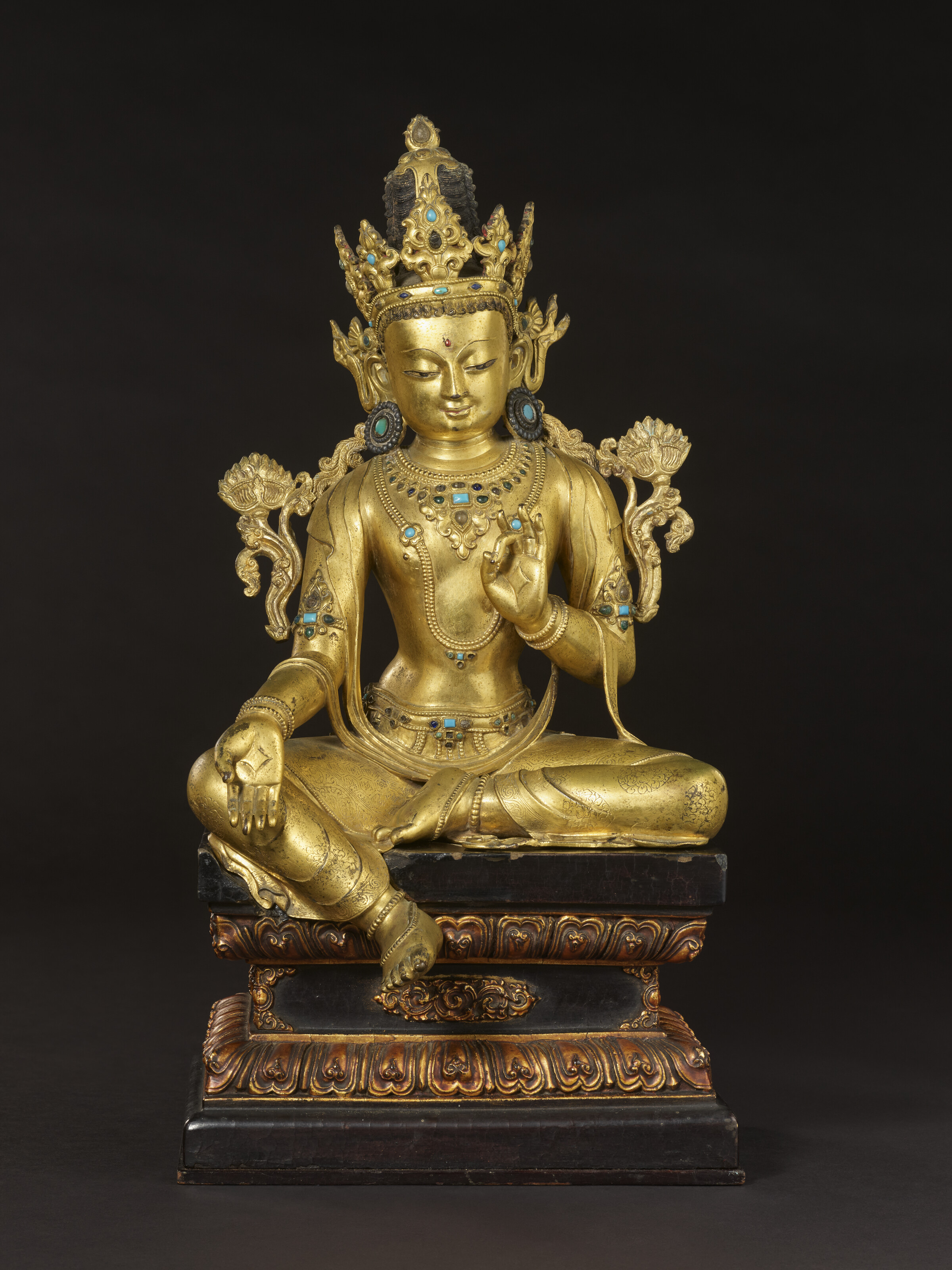
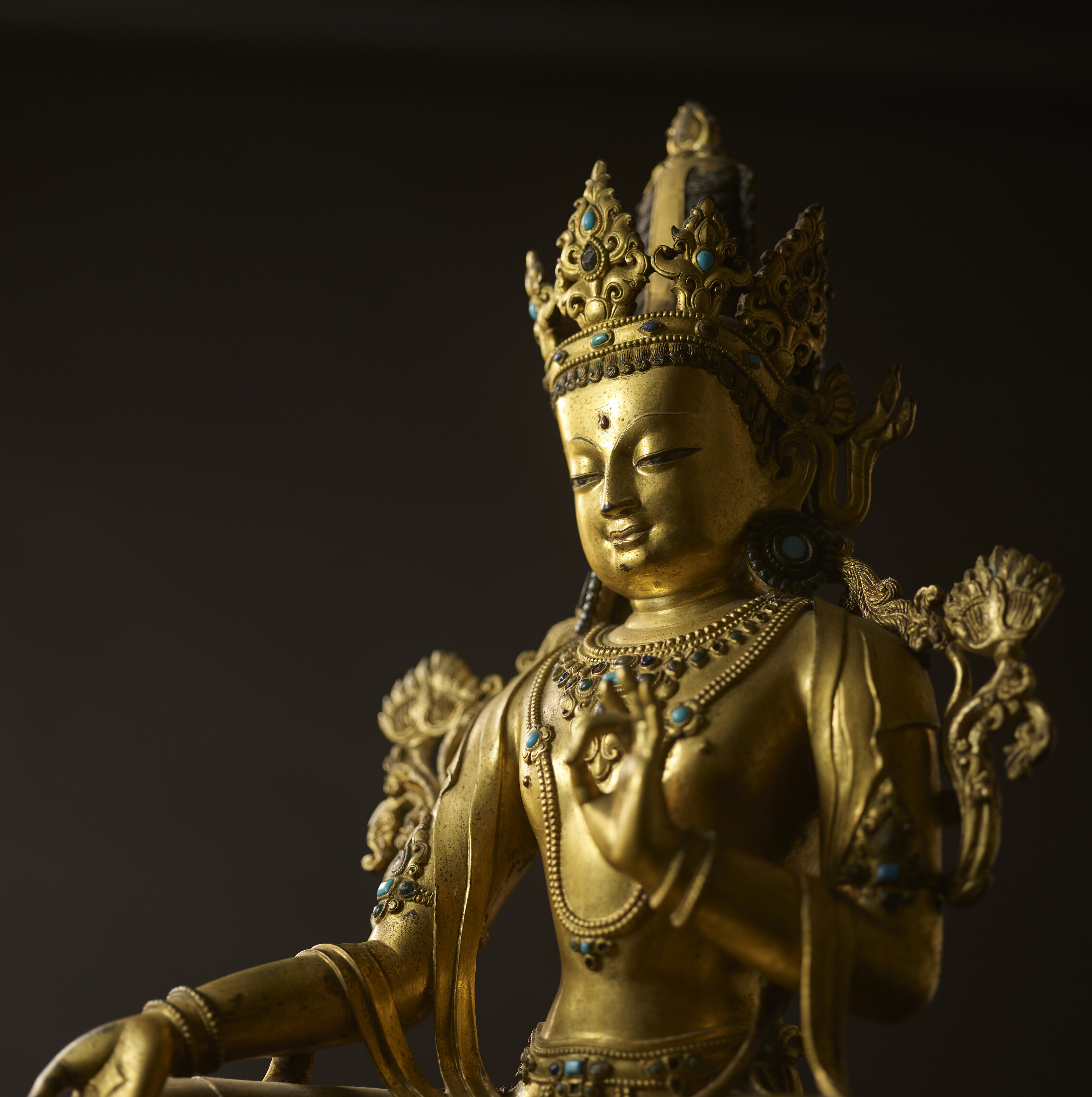
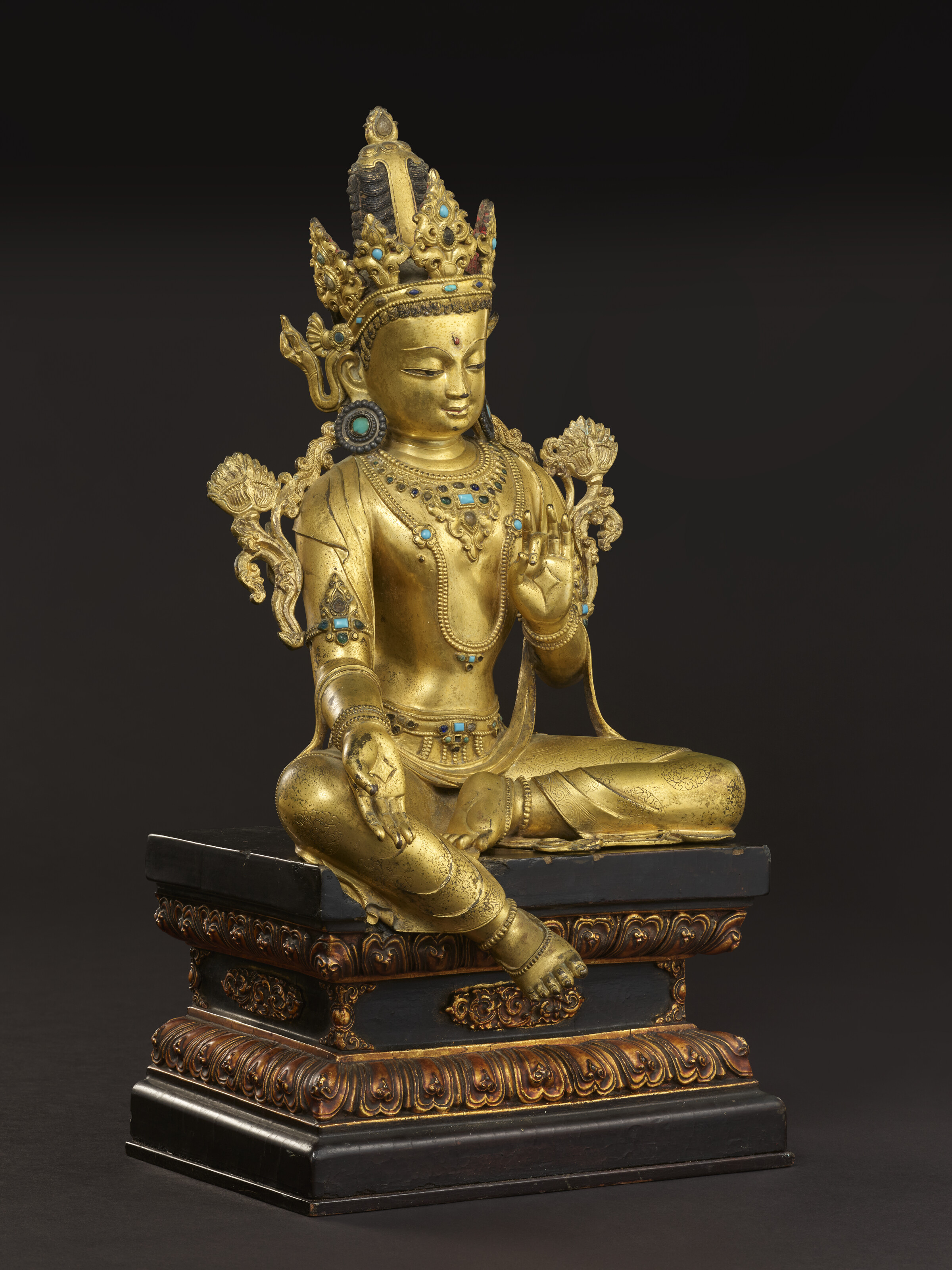
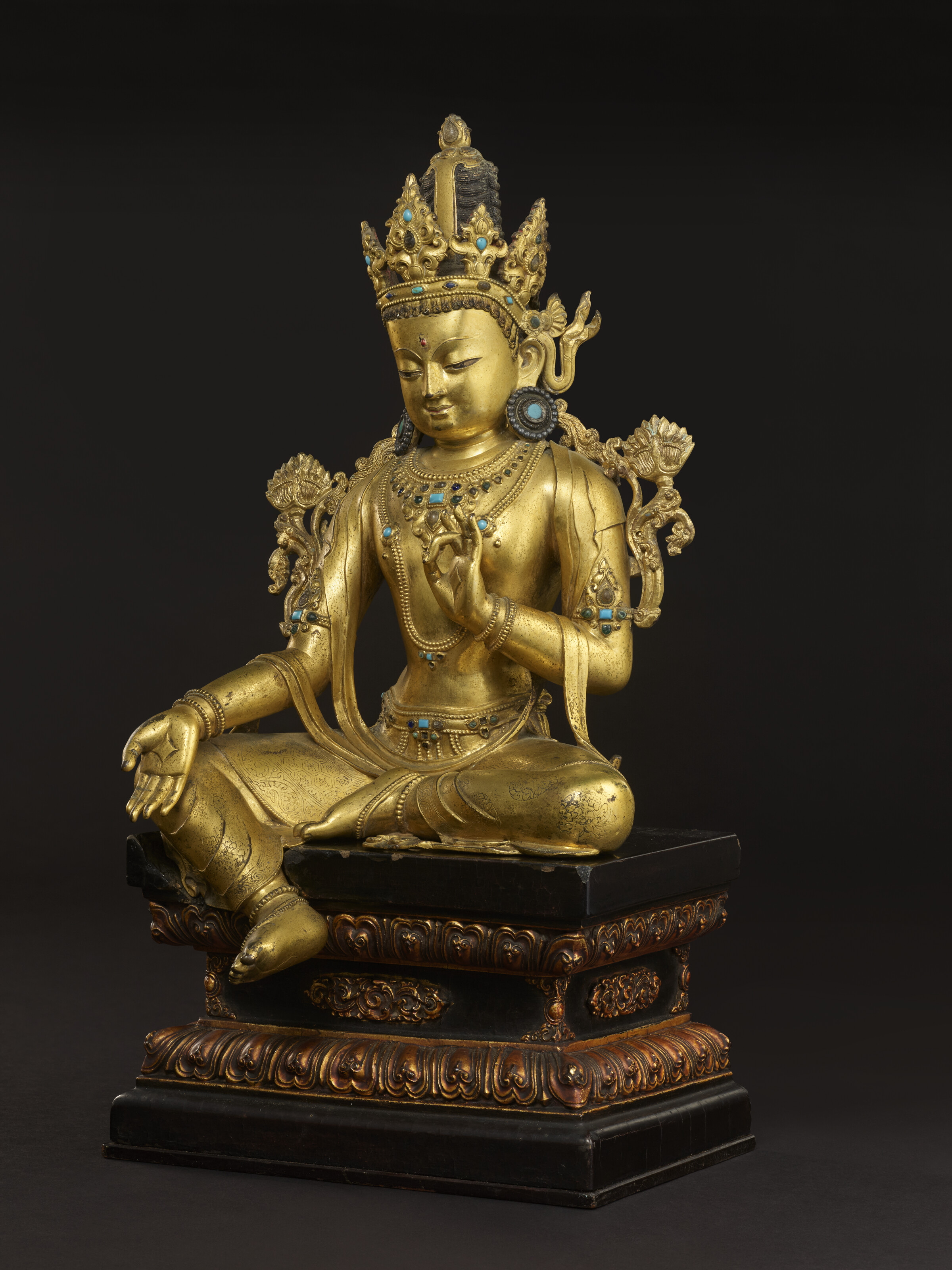
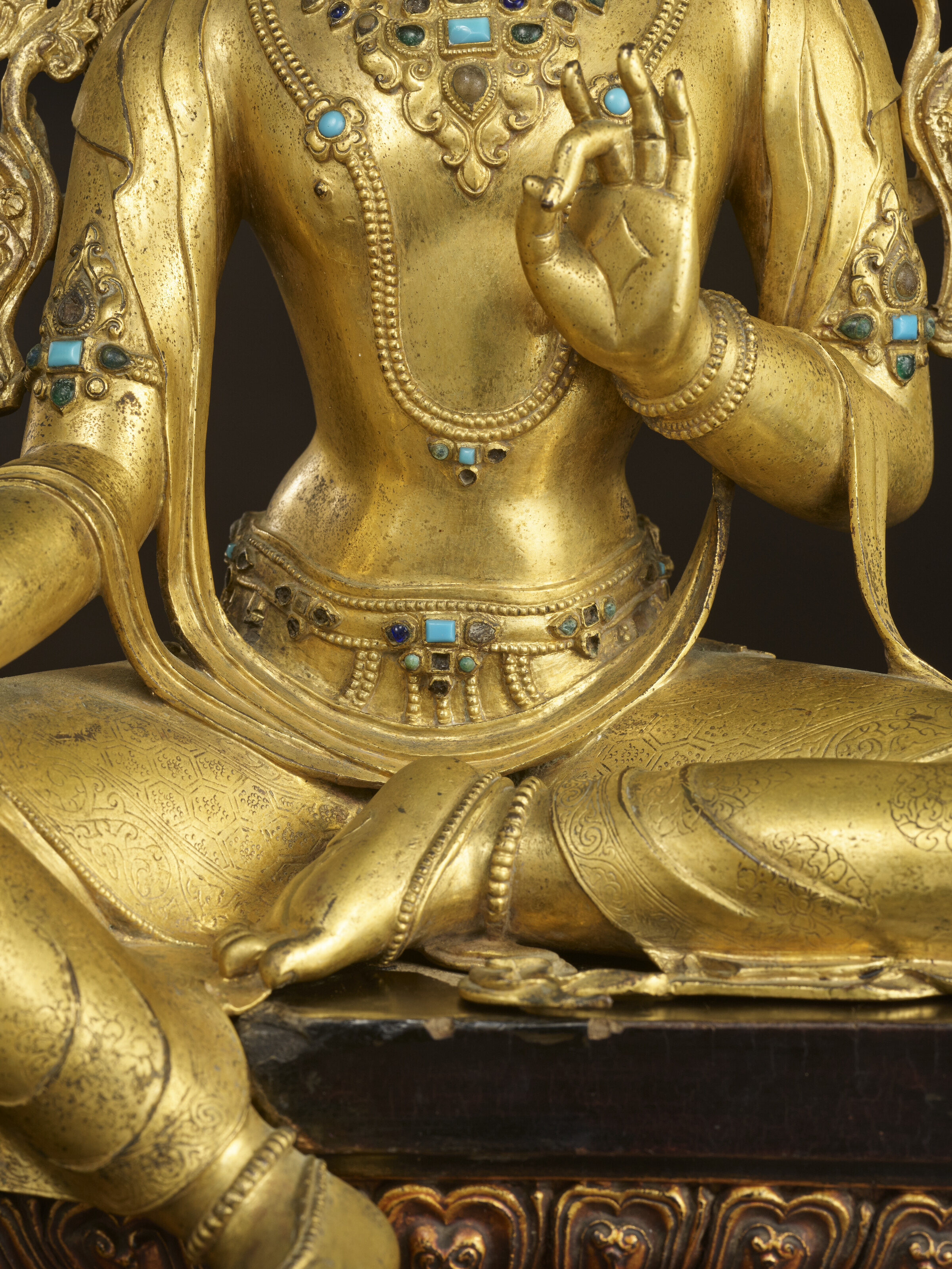
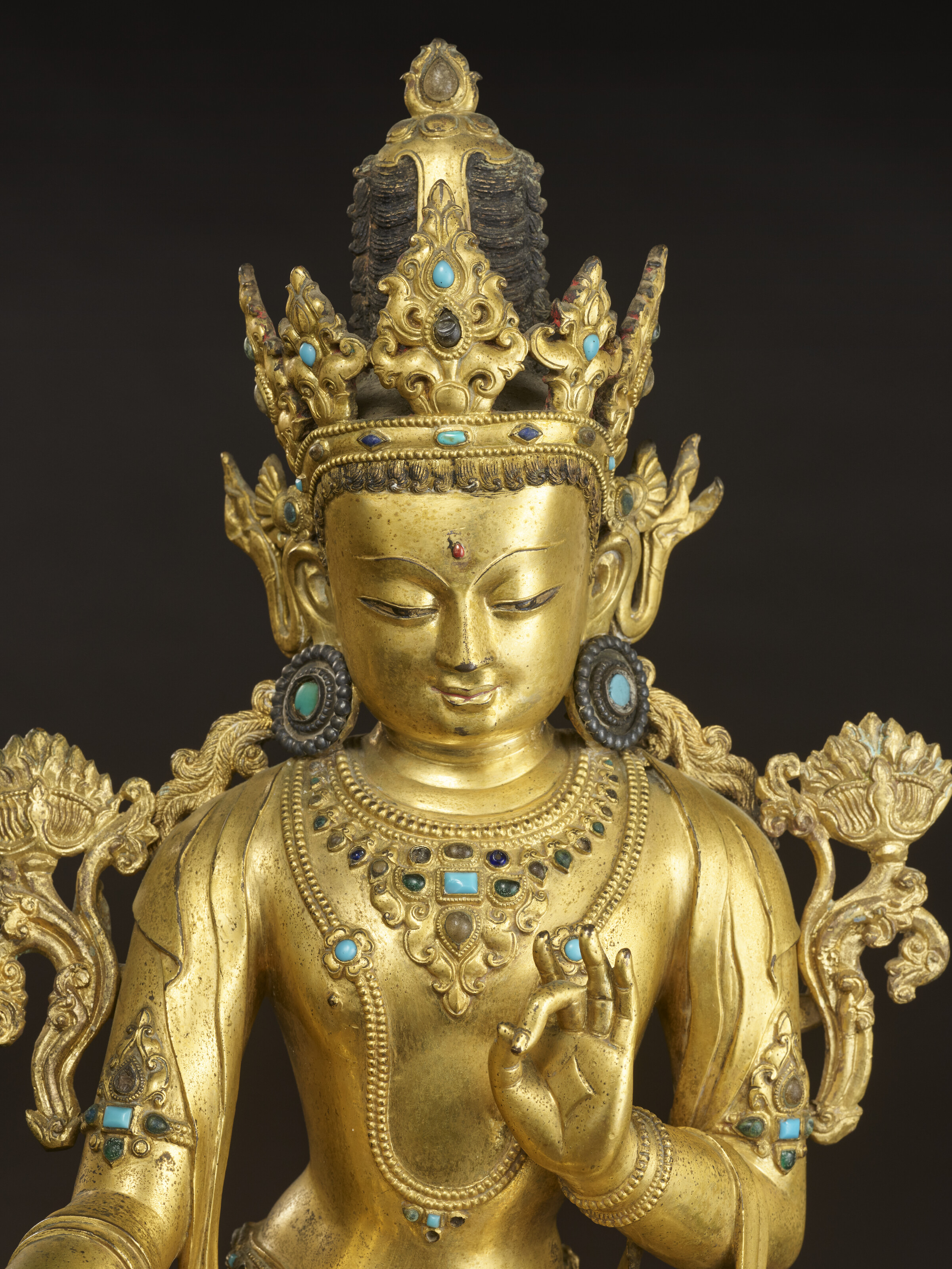
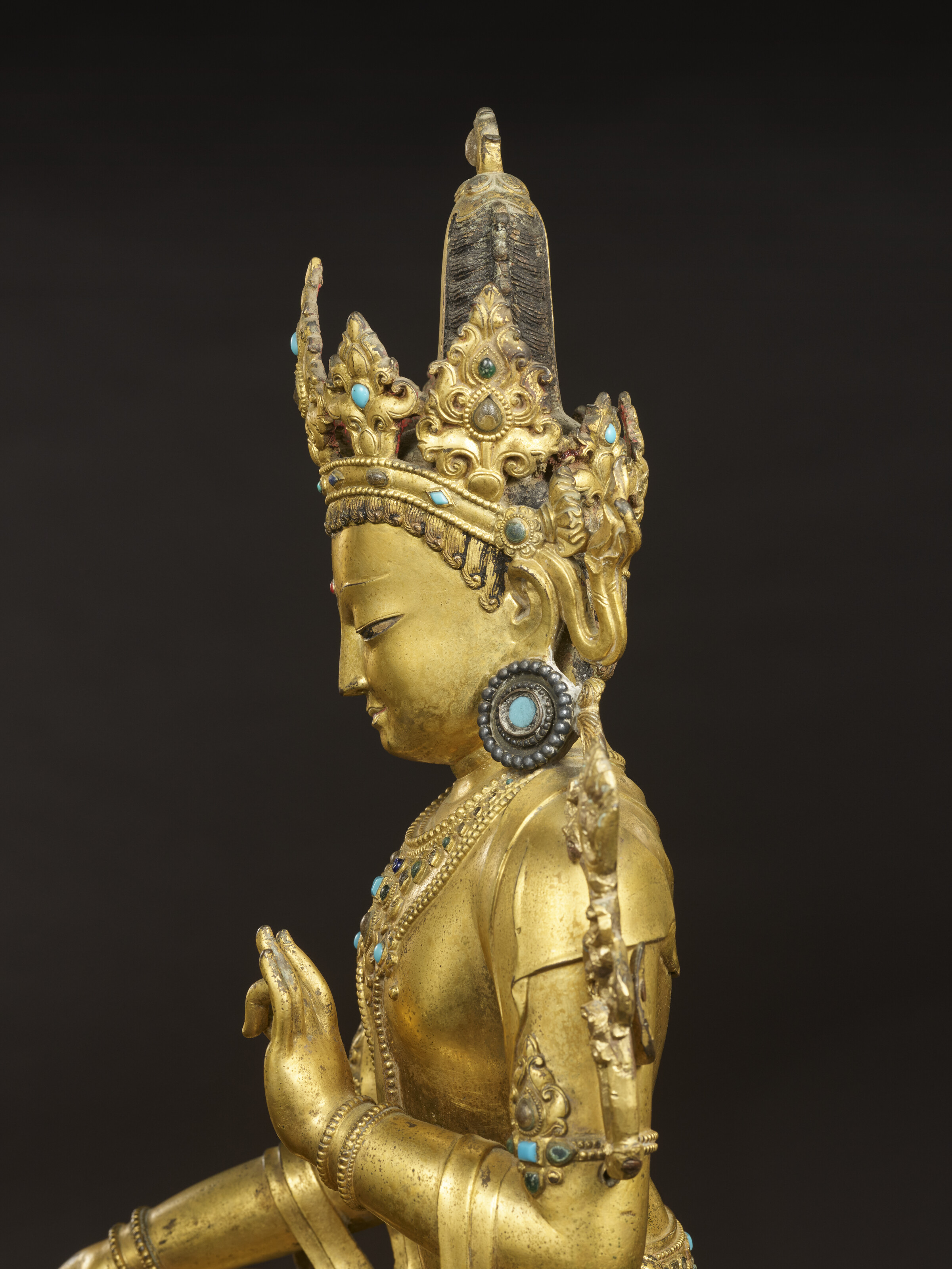
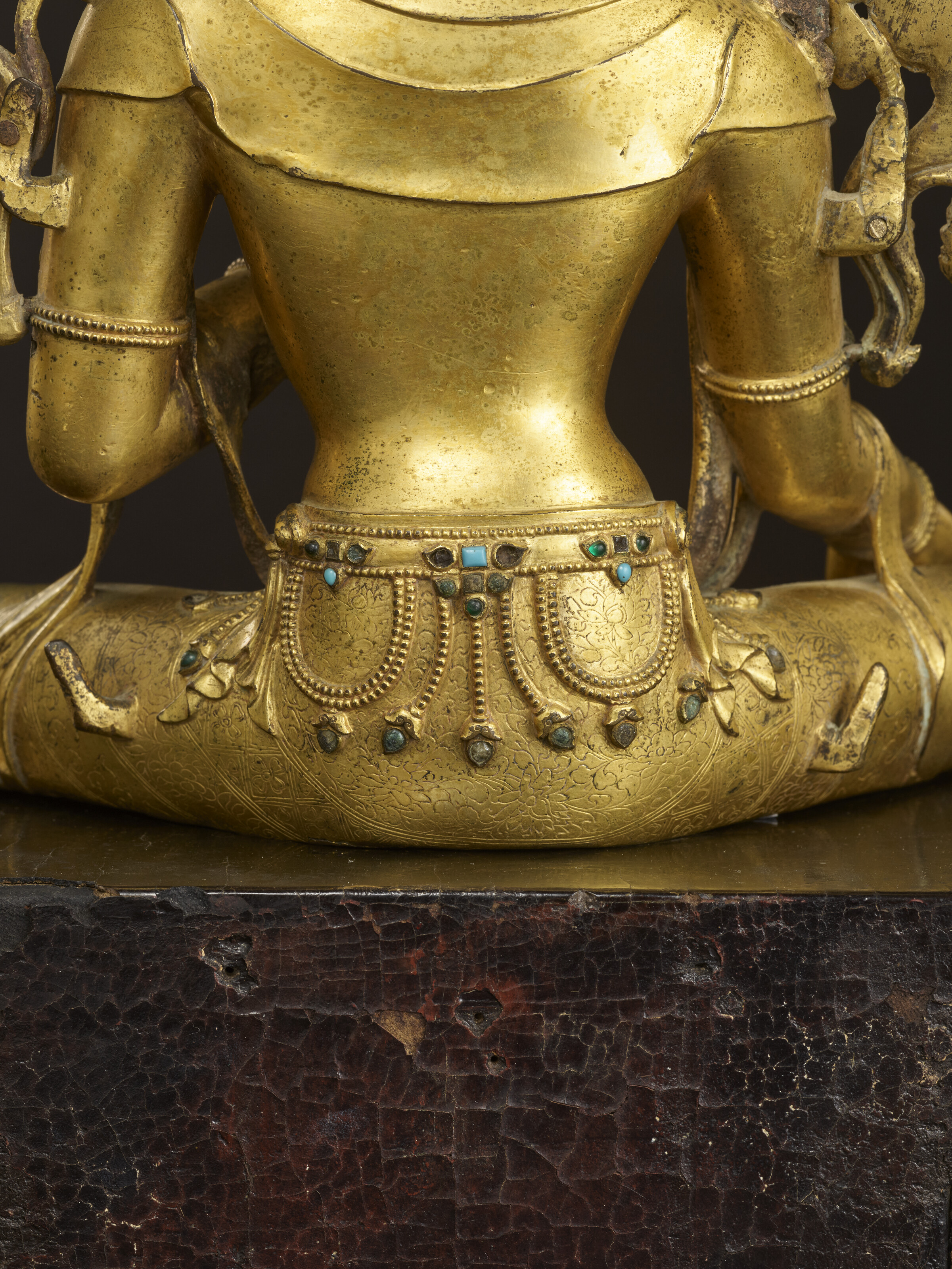
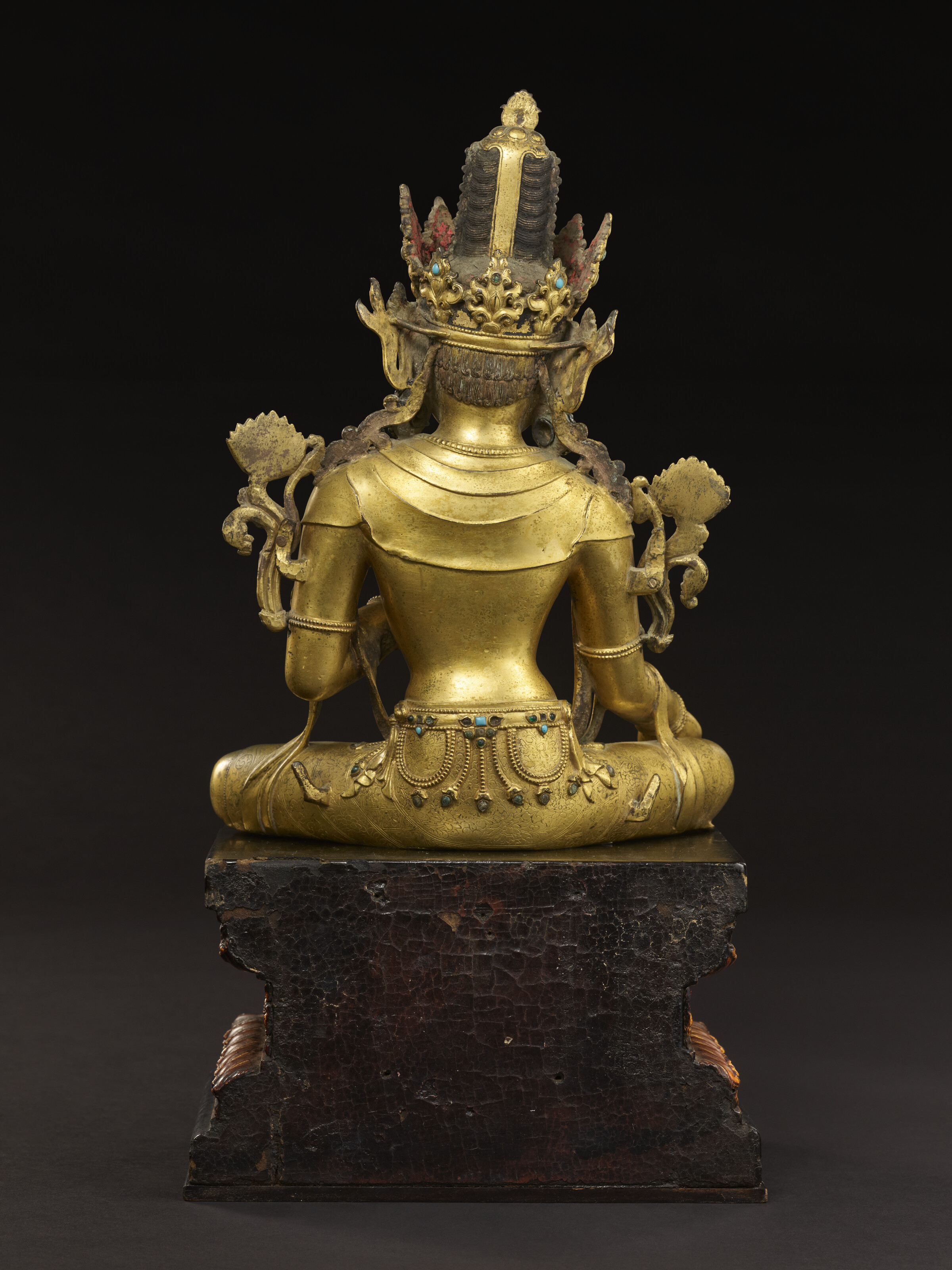
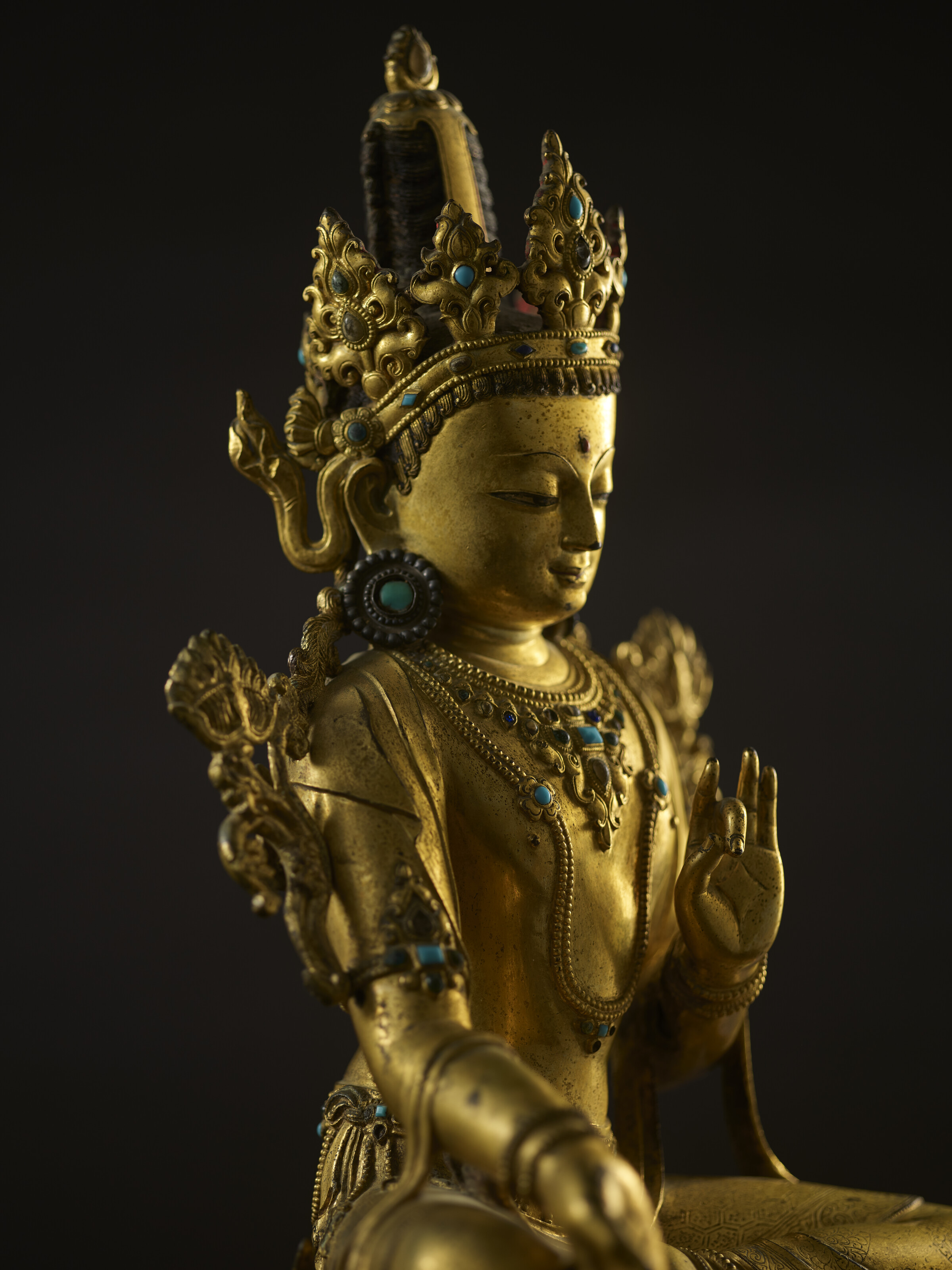 AN IMPERIAL GILT COPPER ALLOY FIGURE OF AVALOKITESHVARA
YUAN DYNASTY, LATE 13TH/EARLY 14TH CENTURY
12 1⁄4 in. (31 cm.) high (15 1⁄4 in. on parcel-gilt lacquered wood base)
Avalokiteshvara: A Synthesis of Empires — The Pinnacle of Imperial Yuan Buddhist Sculpture
Within the vast artistic continuum of Indo-Himalayan and Chinese Buddhist sculpture, this figure of Avalokiteshvara stands as a singular masterpiece, embodying a harmonious synthesis of Pala, Newar, and Classical Chinese elements. Produced in the early 14th century, likely at Dadu (modern Beijing), the capital of the Yuan dynasty, this sculpture marks a defining moment in the evolution of Sino-Tibetan Buddhist art. Its remarkable stylistic fusion became the foundation for the next two centuries of Buddhist artistic production across the Asian plateau.
At the heart of this sculpture’s brilliance is the artist’s sensitive rendering of Avalokiteshvara’s youthful, semi-wrathful expression, imbued with both compassion and latent power. The plump cheeks, small mouth with well-defined lips, and finely inset urna relate directly to the Newar and Xi Xia aesthetic, distinguishing this face from earlier Tibetan and Pala precedents. The forelocks, neatly arranged in radiating curls, and the double-banded hair across the back of the head, display meticulous craftsmanship characteristic of Yuan court commissions.
The sculpture’s ornamentation further confirms its exceptional status. The strap over the chignon, five-leaf crown, triple-strand necklace, and armbands all reflect 12th–13th century Pala models transmitted through Tibet and refined by Newar artisans. The central pendant, featuring a rectangular gem surrounded by six insets within a triangular frame, echoes the same foliate scrolls seen on the crown leaves, a direct reference to earlier Pala masterpieces such as the black stone figure of Lokanatha Avalokiteshvara sold by Christie's New York, 15 March 2017, lot 233. The long necklace, with its double strands of pearls secured by quatrefoil turquoise-set clasps, extends across the chest and terminates in a trefoil gem at the navel, while the pearl swags draped across the hips and over the finely incised lower garment mimic Yuan textiles preserved in museum collections such as the Cleveland Museum of Art (1994.293).
Distinct from the simplified treatment seen in smaller Yuan bodhisattva figures, such as the 1305-dated Manjushri, this sculpture displays a fully realised three-dimensionality, particularly in the torso, which follows a more naturalistic Nepalese model. The hands and feet are similarly well-articulated, while struts at the shoulders and thighs, intended to support flower stems, are features unique to Yuan bronzes.
The base, with its single rectangular consecration opening and traces of red lacquer on the plate, follows Newar casting traditions, and three tang holes suggest it was originally secured into a separately cast pedestal. The later Kangxi-period parcel-gilt wooden stand, with its lotus petals and recessed cartouches, reflects Qing reverence for earlier Yuan religious art.
This Avalokiteshvara is likely a proto-type for the famed Yongle-period sculpture that would follow in the 15th century. The exceptional quality of the casting, along with its imperial scale and refinement, strongly suggests production under Yuan court patronage, potentially linked to Qubilai Khan’s sponsorship of Sakya Pandita and Phagpa, and the presence of Newar artists such as Aniko (Aiko), who were invited to Dadu during this era. While attribution to a specific hand remains speculative, the sophistication of the modelling indicates the work of a master sculptor, either Aniko himself or a leading artist from his workshop.
While scholars such as Yury Khokholov have argued for a stylistic lineage rooted in the Xi Xia and Hexi corridor, and not solely in the Tibetan-Newar tradition, this sculpture reconciles both theories. Regardless of the precise transmission route, it exemplifies a new imperial aesthetic, drawing together strands from India, Nepal, and China to form a distinctly Yuan style —one that would dominate Buddhist sculpture across East and Central Asia for the next two centuries.
In terms of provenance, scale, stylistic innovation, and state of preservation, this Avalokiteshvara is the finest imperial Yuan Buddhist sculpture to appear on the market. It offers not only a window into the religious and artistic life of the early 14th century, but also stands as a touchstone of pan-Asian artistic synthesis at the highest level.
元代宫廷铜鎏金合金观音像
元代,13世纪末/14世纪初
观音:帝国之融合——元代皇家佛教造像之巅峰
在印度-喜马拉雅与中国佛教造像的宏大艺术连续体中,此尊观音像堪称独一无二的杰作,体现了帕拉、纽瓦尔与中国古典元素的和谐融合。此像制作于14世纪初,可能出自元大都(今北京),标志着汉藏佛教艺术演变中的一个决定性时刻。其卓越的风格融合,为此后两个世纪亚洲高原上的佛教艺术创作奠定了基础。
此像的核心精妙之处,在于艺术家对观音菩萨少年面容及半忿怒表情的细腻刻画——兼具慈悲与内在力量。面颊丰腴,小口唇形分明,眉间白毫镶嵌精细,这些特征与纽瓦尔和西夏的美学传统直接相关,使其面容区别于更早的西藏及帕拉样式。额前整齐排列的辐射状螺发,以及脑后双层束发,展现了元代宫廷造像的精湛工艺。
此像的装饰进一步印证了其非凡地位。发髻上的束带、五叶宝冠、三股项链及臂钏,均反映了经由西藏传入、并由纽瓦尔工匠加以精炼的12至13世纪帕拉范式。中央坠饰——三角形框架内嵌一矩形宝石、周围环绕六颗嵌饰——与宝冠叶片上相同的蔓草纹相呼应,直接追述了更早的帕拉杰作,如纽约佳士得2017年3月15日拍卖的黑色石雕世间尊观音像(拍品233号)。长项链为双股珍珠串,以四叶形绿松石搭扣固定,横贯胸前,止于脐部三叶形宝石处。而垂挂于臀部、覆盖于精细刻纹下裙之上的珍珠璎珞,与克利夫兰艺术博物馆(1994.293)等博物馆收藏的元代纺织品遥相呼应。
与小型元代菩萨像(如1305年款文殊菩萨)简化的处理方式不同,此像呈现出充分实现的三维立体感,尤以躯干为甚,遵循了更为写实的尼泊尔范式。手足同样刻画精到,而肩部和腿部的支撑梁(原本用以支撑花枝)则是元代铜像独有的特征。
底座采用单矩形封藏开口,封板残留红漆痕迹,遵循纽瓦尔铸造传统;三个插孔表明其原先固定于一个别铸的台座之上。后配康熙时期局部鎏金木座,饰莲瓣及开光,反映了清代对更早期元代宗教艺术的尊崇。
此尊观音像很可能是15世纪著名的永乐时期造像的原型。其卓越的铸造品质,连同其皇家规格与精致程度,强烈表明此像出自元代宫廷赞助,可能与忽必烈汗对萨迦班智达及八思巴的护持,以及阿尼哥等纽瓦尔艺术家应召至大都的时代背景相关。虽然将其归于某位特定艺术家之手仍属推测,但其造型之精妙表明出自一位大师级雕塑家之手——或为阿尼哥本人,或其作坊中的顶尖匠人。
尽管Yury Khokholov等学者已论证此像风格可追溯至西夏及河西走廊,而非仅源自藏-纽瓦尔传统,但此尊观音像恰恰调和了这两种理论。无论其确切的传播路径如何,此像体现了一种新的帝国美学——汇聚印度、尼泊尔与中国之脉络,形成了独特的元代风格,这种风格将在其后两个世纪里主导东亚及中亚的佛教造像。
就来源、体量、风格创新及保存状态而言,此尊观音像是市场上出现的最精美的元代皇家佛教造像。它不仅为我们打开了一扇通往14世纪初宗教与艺术生活的窗口,更是一块最高水平的泛亚艺术融合的试金石。
来源:
Mayuyama & Company, Ltd., Tokyo, mid 1960s
Ellsworth and Goldie, New York, before 1971
Christian Humann, Pan-Asian Collection, before 1977
Christie's New York, 2 June 1989, lot 110
Private West Coast Collection
Christie's New York, 21 March 2008, lot 616
Private Asian Collection
著录:
Phillip Adams, “Imperial Yuan Gilt-Metal Buddhist Sculptures: Stepping Stones to the early Ming,” Orientations, (Nov/Dec 2014), pp. 93, 96-98, figs. 1, 9a, 10c, 11a.
Golden Form, Celestial Grace Appreciation of an Imperial Yuan Avalokiteshvara Bodhisattva (Guanyin) Figure
Huang Chunhe, Capital Museum Researcher
In August 2014, Australian independent scholar Phillip Adams contributed an article to the Hong Kong journal Orientations, titled Imperial Yuan Gilt-Metal Buddhist Sculptures: Stepping Stones to the Early Ming, in which he examined five imperial Yuan sculptures. The following year, in March 2015, Swiss scholar Dr. Robert R. Bigler published an exhibition catalogue, Before Yongle—Chinese and Tibetan-Chinese Sculptures of the 13th and 14th Centuries, illustrating over ten examples of imperial Yuan sculptures. These seminal publications lifted the veil on the once-enigmatic imperial Yuan Buddhist sculptures and signalled the beginning of serious academic research and collecting interest both in China and internationally. Over the past decade, through the efforts of scholars, collectors, and connoisseurs worldwide, imperial Yuan sculptures have surfaced in remarkable numbers. Their stylistic features and craftsmanship have become more clearly understood, while public recognition and appreciation have also deepened significantly. The current gilt-bronze Avalokiteshvara figure, to be offered at Christie’s Hong Kong this October, stands as the largest, most stylistically representative, and finest in artistic quality among imperial Yuan sculptures to ever grace the market. It is poised to become a highlight and new focal point within the field of imperial Yuan sculpture.
The figure wears a floral crown, a high bun neatly bound atop the head, with long braids cascading over both shoulders. A jewel appears at the summit of the coiffure, while fluttering ribbons frame the ears, beneath which hang large, purple-black circular earrings. The face is broad and squarish, rendered with exquisite and delicate features: the forehead high and expansive, the brows arched upward with a teardrop-shaped urna set between them. The downcast almond-shaped eyes, their pupils radiating profound compassion, balance the high, straight nose that joins the brows in an elegant 'Y' shape. The lips are gently closed, the lower lip fuller, with the corners subtly upturned to suggest a serene, benevolent smile. The face is at once handsome and serene, embodying the Guanyin Bodhisattva’s dharma countenance that harmoniously unites compassion with wisdom. The figure’s sturdy physique and well-defined musculature convey the bearing of an upright and dignified male form. The upper body is bare, adorned with a collar necklace, from which large pendant petals hang below, and a long chain across the torso. Two bead bracelets encircle each of the wrists and ankles, while petal-shaped armlets embellish the arms. A sash is draped gracefully over the shoulders, its ends crossing the abdomen to rest upon the opposite arms, while the hanging part passes under the body and spreads out in front of the seat—an arrangement that reflects a style both distinctive and refined. He is clad in a long skirt, secured at the waist with a belt knotted elegantly at both sides. The skirt is light and finely rendered, clinging naturally to the body. On the thighs and calves, incised and raised lines articulate the texture of the fabric, while the spaces between are intricately decorated with motifs of scrolling vines, cloud motifs, roundels, tortoise-shell patterns, and patch-grid patterns, all arranged with precise layering and clarity. Particularly striking are the delicate, ripple-like folds at the calves and the back, executed with such refinement as to evoke admiration. The treasure belt, both front and back, is further embellished with bead-like yingluoornaments. The adornments across the figure—the crown, earrings, bracelets, and belt—are inlaid with an array of gemstones, including turquoise, lapis lazuli, emerald, sapphire, red coral, crystal, and rose quartz, producing a vividly colourful and resplendently magnificent brilliance. Seated in a half-lotus pose, with the left leg folded and the right leg extended downward, the head gently tilted to the right, and the waist subtly twisted to the left, the figure conveys a posture that is both graceful and lively. The left hand forms a tarjani mudra(gesture of vigilance) at the chest, right hand rests on the right knee forming a varada mudra (gesture of wish-granting), with a fully blooming utpala flower on each shoulder at shoulder level. Although the pedestal is now lost, a square base plate remains on the underside of the figure, indicating that its original consecratory contents are still preserved. The figure’s form is grand and well-proportioned, its image imbued with solemnity. The craftsmanship is of the highest refinement, the adornment sumptuous, and the condition remarkably well-preserved, altogether exemplifying the distinctive style and superb artistry of imperial Yuan sculpture.
Present lot illustrated (detail)
Imperial Yuan sculptures were Tibetan Buddhist works produced by imperial workshops under direct imperial patronage, characterised by Tibetan themes and stylistic influences. They were intimately tied to the religious and political strategies of the Yuan rulers, who revered and promoted Tibetan Buddhism. Historical records note that, in order to promote the spread of Tibetan Buddhism in the Central Plains, the Yuan emperors constructed numerous temples across regions such as Dadu (today's Beijing), Shangdu, and Jiangnan. In Dadu alone, more than ten imperial temples were built, including Da Huguo Renwang Si (Great Protecting Benevolent King Temple) and Da Shengshou Wanan Si (Great Temple of Eminent Longevity and Myriad Peace). These temples enshrined a great number of Buddhist statues, all produced by the imperial workshops—specifically the All Artisan Classes in the Imperial Workshops and its subordinate Superintendency for Buddhist Icons (fanxiang yiju si). Yuan dynasty sources referred to such works as fanxiang (Indian icons) or xitian fanxiang (Indian icons from the Western Heaven). Nepalese craftsman Anige (Aniko) (1244-1306) initially worked for these institutions, playing a vital role in the production of Buddhist statues for imperial temples, as ‘many of the statues in the temples of both capitals were made by his hands.’ He ultimately rose to the prestigious positions of Director of All Artisan Classes and Controller of the Imperial Manufactories Commission (Jiangzuoyuan). In the generations that followed, his disciples, such as Liu Yuan, and his sons, Asengge and Ashula, likewise served in these institutions, contributing to the creation of numerous Buddhist sculptures for imperial temples. The Record of Yuan Dynasty Painting and Sculpture (Yuan Dai Hua Su Ji), compiled by the Qing scholar Wen Tingshi, preserves nearly thirty entries documenting Anige, his disciples, and his sons in the production of sculptures for imperial temples. These records provide concrete historical evidence of the close relationship between court-sponsored sculpture-making institutions and the supply and demand of imperial temple sculptures, offering an important foundation for understanding the prominence of imperial Yuan sculpture. While most imperial temples and their sculptures from the Yuan dynasty no longer survive, they remain well documented in historical sources, preserving the rich historical and religious context that underpinned the once-glorious tradition of imperial Yuan sculpture.
Since the recognition of imperial Yuan sculptures in 2014, new examples have continued to surface each year. Some have appeared on the art markets, others have entered the collections of public and private museums in China and internationally, while still others remain enshrined in temples and monasteries in Tibet and beyond. According to incomplete statistics, more than one hundred exemplary imperial Yuan sculptures have been identified to date. In addition, a number of related works of similar style, perhaps referred to as 'quasi-imperial Yuan sculptures', are also known. These sculptures encompass a remarkably rich range of themes and types, including gurus, tutelary deities, Buddhas, Bodhisattvas, Prajnaparamita, luohan, and dharmapalas (protector of the dharma), virtually the full pantheon of Tibetan Buddhist worship. As such, they possess exceptional breadth and representativeness in their design. Although these sculptures vary in theme and form, their style and craftsmanship remain strikingly consistent. Collectively, they embody a distinctive Han-Tibetan synthesis: the Tibetan style draws upon Indian Pala, Nepalese, and indigenous Tibetan traditions, while the Han style integrates elements from Chinese, Mongolian, and Western Xia art. Their shared features are evident in the dignified postures and robust physiques, the broad faces with high, expansive foreheads, the standardised lotus pedestals encircled with full petals, the refined use of metal alloys, and the sumptuous adornment with gemstone inlays across the body. These shared characteristics define the unified stylistic identity of Yuan imperial sculpture, all of which ultimately trace back to a single source: the Yuan Dynasty’s imperial sculpture workshops. Today, these works serve as vital material evidence for the study and authentication of Yuan imperial sculpture, providing an essential foundation for defining their stylistic parameters.
When compared with the established standards of Yuan imperial sculptures, this current figure exemplifies the tradition in four key respects, the first of which is its material alloy bronze, a form of copper combined with zinc. This kind of bronze is of fine, dense quality, with a yellowish tone, thus commonly referred to as huang tong(yellow bronze or brass). It may be said that the Yuan courts marked the beginning of the large-scale production of alloy bronze statues. Prior to this period, most sculptures were cast in bronze, and although alloy bronze works did exist, none attained the level of refinement achieved under the Yuan Dynasty. During the same period, bronze sculptures produced in Tibet, Nepal, and other regions were most often cast in red brass. Alloy bronzes were also popular in Tibet, particularly in the western regions, though their composition differed from that of Yuan imperial sculptures. Tibetan alloy bronzes were made from copper containing natural traces of zinc, whereas Yuan imperial bronzes were deliberately synthesised from copper and zinc. This demonstrates that the use of alloy bronze is a key criterion for identifying Yuan imperial sculptures.
The second is the body form. The figure features a large head, broad shoulders, a high chest, and a narrow waist—sculptural characteristics clearly influenced by the consistent Indian-style sculptures inherited from India’s Pala tradition through Nepal to Tibet. At first glance, the surface bears some resemblance to contemporary Malla sculptures of Nepal, as well as Sakya and Densatil sculptures of Tibet; yet upon closer examination, it reveals distinct characteristics that set it apart, reflecting its unique artistic identity. The face is square and flat, unlike the more pointed faces seen in some foreign sculptural works; the shoulders slope naturally, rather than being raised as in other foreign traditions; and though the head appears large, giving an impression of disproportion, it in fact reflects the transitional sculptural characteristics of imperial Yuan sculptures, bridging inherited traditions with newer expressions. These distinctive features reflect a unique aesthetic sensibility, clearly shaped by the traditional artistic tastes of the Central Plains.
The third aspect pertains to the headwear, clothing ornaments, and sculptural expressions. Head ornaments featuring floral crowns and hair buns are the most characteristic. The floral crown consists of eight petals: five at the front and three at the back. Each petal has a sturdy stem adorned with abundant branches and leaves. At the front, three large and two smaller petals are arranged at varying heights, while the three rear petals are of equal size. This expressive form is exceptionally distinctive, yet it was widely employed in imperial Yuan Bodhisattva sculptures, with numerous examples for comparison—such as a gilt-bronze figure of Marici (goddess of dawn) housed in the Three Gorges Museum in Chongqing (fig. 1). The hair bun consists of rows of braids arranged into a flat, elevated form atop the head, secured by hairbands at the front and back. A precious jewel ornaments the crown of the bun. The intricate braiding is executed with great refinement, resulting in an elegant and striking coiffure. This coiffure clearly derives from Indian Pala sculpture, yet it was equally favoured in imperial Yuan Bodhisattva sculpture. A representative example is a gilt-bronze Bodhisattva figure formerly in the collection of Dr. Robert R. Bigler in Switzerland (fig. 2).
Figure 1 Gilt-bronze Marici figure in the Three Gorges Museum in Chongqing, height 25 cm. Figure 2 Gilt-bronze Bodhisattva figure formerly in the collection of Dr. Robert R. Bigler in Switzerland, height 20.6 cm.
The attire consists of the sash and the monk’s skirt, both in form and execution that reflect influence from the Central Plains. This influence is well attested in numerous extant imperial Yuan sculptures. The sash's style, with its naturalistic drapery folds, had already appeared in the Feilai Peak stone sculptures dating from the 19th to 29th years of the Zhiyuan era (1282–1292) (figs. 3 and 4), while the decorative treatment of the monk’s skirt is likewise evident in many gilt-bronze imperial Yuan sculptures. Although the forms and motifs of head ornaments and garments are relatively complex and derived from diverse sources, this imperial Yuan sculpture was rendered in a cohesive manner that consistently reflects the shared stylistic characteristics of its counterparts.
Figure 3 Four-armed Shadakshari Lokeshvara stone carving at Hangzhou Feilai Peak from Yuan Dynasty, 19th year to 29th year of Zhiyuan era (1282-1292), height 123 cm. Figure 4 Manjushri Bodhisattva stone carving at Hangzhou Feilai Peak from Yuan Dynasty, 19th year to 29th year of Zhiyuan era, height 160 cm.
Fourth is the craft of gemstone embellishment. Its crown, earrings, bracelets, belt, and jewelled chains are all inlaid with gems—turquoise, red coral, and other precious stones—embodying the Buddhist auspicious symbolism of qi bao zhuang yan (seven treasures adornment). The brilliance of jewels and gemstones converges upon the figure, amplifying its dignity and magnificence. The tradition of gem inlay and its associated craftsmanship demonstrably originated in the sculpture-making practices of Tibet and Nepal, as reflected in its frequent appearance in Nepalese Malla and Tibetan Densatil sculptures. This artistic expression is also a defining feature in imperial Yuan sculptures. In the subsequent Ming dynasty, imperial sculptures largely abandoned this intricate practice, with jewelled decorations typically cast integrally with the body (fig. 5). Nonetheless, a very small number of imperial Ming sculptures preserved the tradition of gemstone inlay. Similarly, select Ming sculptures continued Yuan-inspired forms and techniques in crowns, hairstyles, and drapery, collectively attesting to the inseparable artistic lineage linking Yuan and Ming imperial sculpture.
Figure 5 Capital Museum’s collection of Ming Yongle gilt-bronze Vajrasattva figure, height 21.5 cm.
I have previously used both imperial Yuan sculptural remnants in the Central Plains and those discovered across various sites to delineate the development of imperial Yuan sculpture into three stages—early, middle, and late—while summarising the distinct artistic characteristics of each period. The early period, circa 1262–1300, represents a transitional phase in which artistic styles shifted from Indian, Nepalese, and Tibetan sculptures toward Central Plains forms. Representative works include the Tibetan-style stone Buddha sculptures at Feilai Peak in Hangzhou, carved between the 19th and 29th years of the Zhiyuan era (1282–1292). The middle period, circa 1300–1340, saw the consummate fusion of Nepalese and Tibetan styles with Central Plains art, marking the standardisation of the imperial Yuan aesthetic. A typical example is the gilt-bronze Manjushri Bodhisattva figure from the 9th year of the Dade era (1305), now preserved in the Palace Museum (fig. 6). The late period, circa 1340–1368, exhibits stylistic variations, characterised by a stronger emphasis on Central Plains elements and a general decline in artistic refinement. Representative examples include the bronze Shakyamuni Buddha figure from the 2nd year of Later Zhiyuan era (1336) in the Palace Museum (fig. 7) and the relief Buddhas at the Cloud Platform at Juyong Pass, Beijing, dating from the 2nd to 5th years of the Zhizheng era (1342–1345) (fig. 8). This current figure exhibits flawless form, exceptional craftsmanship, and elaborate adornment. Its details, including the facial features, sash, monk’s skirt, and musculature, are rendered with remarkable precision. The carving demonstrates fine, strong, and fluid lines, reflecting techniques far superior to those of ordinary sculptures. Based on its superior artistic execution, this sculpture can be dated to the early or early-middle period of the Yuan dynasty.
Figure 6 Gilt-bronze Manjusri Bodhisattva figure from the 9th year of Dade (1305) in the Yuan Dynasty, housed in the Palace Museum, height 18 cm. Figure 7 Bronze Shakyamuni Buddha figure from the 2nd year of the Later Zhiyuan era (1336), housed in the Palace Museum, height 21.5 cm.
Figure 8 Stone Buddha at the Cloud Platform at Juyong from the Yuan Dynasty, 2nd year to 5th year of Zhizheng era (1342-1345).
In this past June, I had the privilege of examining a stone Buddha pagoda at Jinshan Temple in Laishui County, Hebei. This pagoda dates to the fourth year of the Yuan's Dade era (1300). On the stone stele Qian fo she li bao ta ji (Record of the Thousand Buddha Sarira Treasure Pagoda) erected beside it, an inscription reads 'The main patron of the temple is Grand Master of the Court and Grand Administrator over the Masses, Anige,' linking the construction of the pagoda to the renowned Nepalese craftsman. To date, this is the only known remains from the Yuan Dynasty with clear documentation connecting Anige to both architectural and Buddhist sculptural activity. The body of the pagoda is carved with nearly a thousand Buddha sculptures across its eight sides, most exhibiting a synthesis of Han and Tibetan artistic features. For instance, the four-sided Buddhas within the line engraved Thousand Buddha motifs display broad, flat faces and naturalistic drapery, clearly demonstrating how the imperial Yuan sculpture style, led by Anige, was influenced by Central Plains art at an early stage (figs. 9 and 10). These Buddha sculptures were carved shortly after the statues at Feilai Peak in Hangzhou, predating the Manjushri Bodhisattva in the Palace Museum by five years, and are closely associated with Anige. They provide important reference points for studying the Sinicization of Anige’s sculptural style, the development and evolution of imperial Yuan sculpture, and the dating and stylistic analysis of the current Avalokiteshvara figure.
Figure 9 Thousand Buddha Sarira Treasure Pagoda at Jinshan Temple in Laishui County, Hebei, dated to the fourth year of Dade (1300) of the Yuan Dynasty. Figure 10-1 Buddha figures on the Thousand Buddha Sarira Treasure Pagoda.
Figure 10-2 Detail of Buddha figures on the Thousand Buddha Sarira Treasure Pagoda
Figure 10-3 Line drawing of Buddha figures on the Thousand Buddha Sarira Treasure Pagoda (by Huang Wenlan)
Finally, we turn to the subject matter depicted in this figure. Australian scholar Phillip Adams once identified this figure as Green Tara; however, this attribution is clearly mistaken. Although its posture and pose closely resemble those of Green Tara, it lacks the feminine characteristics typical of that deity. All known imperial Yuan Green Tara sculptures display prominently raised breasts (fig. 11), indicating that this figure does not represent Green Tara, but rather a different subject. Fortunately, this type of Buddha sculpture is documented in Sadhana-mala (A Garland of Means for Attainment), an early Sanskrit compendium of iconographic descriptions, and the Indian Museum preserves extant Pala-period sculptures of the same style (fig. 12). It is consistently identified as Avalokiteshvara Bodhisattva, providing reliable iconographic evidence for the proper designation of this figure. Imperial Yuan sculptures inherited numerous artistic elements from Indian Pala, including the high, flat hair bun and large circular earrings seen on this figure—features directly traceable to Pala art. Based on this artistic lineage, the subject of this figure can be confidently attributed to Pala sculpture.
Figure 11 Gilt-bronze Green Tara figure formerly in the collection of Dr. Robert R. Bigler, height 23 cm. Figure 12 12th-century gilt-bronze Avalokiteśvara figure in the Patna Museum, India.
Among known imperial Yuan sculptures, in addition to this figure, there is another Avalokiteshvara Bodhisattva figure that appeared at China Guardian’s Spring Auction in May 2024 (fig. 13). In the subsequent Ming Dynasty court, this style of Avalokiteshvara became especially popular (fig. 14). Thus, establishing the iconographic identity of this figure provides important historical evidence for the origins of the Bodhisattva Avalokiteshvara sculpture in imperial Ming sculpture and for the continuity of sculptural themes from the Yuan to the Ming Dynasty.
Figure 13 lmperial Yuan gilt-bronze Avalokitesvara figure, in an English private collection, height 16 cm. Figure 14 Ming Yongle gilt-bronze Avalokiteshvara figure, housed in Potala Palace, Tibet, height 80 cm.
Golden Autumn October is a season of harvest. And in this auspicious timing, we are delighted to see this large-size, elegantly designed, and exquisitely crafted imperial Yuan gilt-bronze Avalokiteshvara Bodhisattva figure at Christie’s Hong Kong auction. May this rare and magnificent sculpture achieve a resounding success in this golden season.
金身梵相 皇家风范——元代宫廷观音菩萨像赏析
首都博物馆研究员 黄春和
2014年8月,澳大利亚独立学者菲利普·亚当斯(Phillip Adams)为香港《Orientations》杂志撰文《元代宫廷铜鎏金佛教造像:通往明初的基石》,考察了五尊元代宫廷造像。次年3月,瑞士学者罗伯特·R·比格勒博士(Dr. Robert R. Bigler)出版展览图录《永乐之前——13至14世纪中国与汉藏风格造像》,收录了十余尊元代宫廷造像。这些开创性的出版物揭开了曾经神秘的元代宫廷佛教造像的面纱,标志着中外学术界严肃研究和收藏兴趣的开端。过去十年间,通过世界各地学者、藏家和鉴赏家的努力,元代宫廷造像大量涌现,其风格特征与工艺技法已渐趋明晰,公众的认知与欣赏水平亦显著提高。今秋十月将于香港佳士得上拍的这尊铜鎏金观音像,是市场上所见体量最大、风格最具代表性、艺术品质最高的元代宫廷造像,必将成为元代宫廷造像领域的焦点与新里程碑。
此像头戴花冠,头顶束高髻,发髻整齐利落,发辫分披两肩。发髻顶端饰宝珠,飘带于耳际翻卷,耳下坠大而圆的黑紫色耳珰。面容方阔,五官刻画精致细腻:额头高广,双眉上挑,眉间饰水滴形白毫;双目俯视,眼睑低垂,瞳孔中流露出深沉的悲悯,与高挺的鼻梁相连,呈优美的“Y”字形;双唇轻合,下唇饱满,嘴角微扬,现慈悲恬淡之笑意。整张面容英朗而沉静,完美体现了观音菩萨慈悲与智慧双运的法相。躯体健硕,肌肉线条分明,呈现出挺拔端庄的男性身姿。上身袒露,饰项圈,项圈下悬垂大花瓣,胸前挂长链。手腕、脚腕各戴双道珠串,手臂饰花瓣形臂钏。帔帛自双肩自然垂下,两端于腹部交叉后搭于对侧手臂,下垂部分从身下穿过,铺展于座前——此种处理方式别具一格,精致考究。下身著长裙,腰系宝带,带结于两侧,造型优美。裙裳轻薄,贴体自然。大腿及小腿处以阴刻与凸起线条表现衣纹,线条之间满饰卷草纹、云纹、团花、龟背纹、格纹等,层次分明,清晰可见。尤其小腿及背部呈现的细密水波状衣褶,细腻入微,令人赞叹。腰带前后亦饰珠串璎珞。全像之宝冠、耳珰、手镯、宝带等处,镶嵌绿松石、青金石、祖母绿、蓝宝石、红珊瑚、水晶、芙蓉石等各色宝石,色彩斑斓,璀璨夺目。半跏趺坐姿,左腿盘曲,右腿下垂,头微右倾,腰肢略向左扭,姿态优美而富有动感。左手于胸前结期克印,右手抚右膝结施愿印,双肩侧各有一朵盛开的乌巴拉花。虽莲座已佚,但像底仍保留方形底板,表明原初装藏依然完好。此像造型大气,比例匀称,法相庄严,工艺精湛,装饰华丽,品相完好,集中体现了元代宫廷造像的独特风格与高超艺术水准。
(本拍品局部图)
元代宫廷造像是元代皇室直接赞助下,由宫廷作坊制作的藏传佛教造像,具有藏传佛教主题与风格特征,与元朝统治者推崇藏传佛教的宗教政治策略密切相关。据文献记载,为推广藏传佛教在中原的传播,元朝皇帝在大都(今北京)、上都、江南等地兴建了大量寺庙。仅大都一地,就修建了大护国仁王寺、大圣寿万安寺等十余座皇家寺院。这些寺庙供奉了大量佛教造像,均由宫廷作坊——尤其是“诸色人匠总管府”及其下属“梵像提举司”制作。元代史料称此类作品为“梵像”或“西天梵像”。尼泊尔工匠阿尼哥(Aniko,1244-1306)最初即供职于这些机构,在皇家寺院造像中发挥了至关重要的作用,“两京寺观之像,多出其手”。他最终升任诸色人匠总管府总管及将作院院使。其后代,弟子刘元,以及儿子阿僧哥、阿述腊等,亦供职于这些机构,参与创作了大量皇家寺院佛教造像。清代学者文廷式编纂的《元代画塑记》中,记录了近三十条阿尼哥及其弟子、子嗣为皇家寺院塑像的记载。这些记录为宫廷造像机构与皇家寺院造像供需之间的密切关系提供了具体的历史证据,为理解元代宫廷造像的兴盛提供了重要基础。尽管元代皇家寺院及其造像大多已不存世,但文献中记载详实,为我们保留了曾经辉煌的元代宫廷造像传统背后丰富的历史与宗教背景。
自2014年元代宫廷造像被认识以来,新见作品年年迭出,有的现身艺术市场,有的入藏国内外公私博物馆,有的则仍供奉于西藏内外的寺庙之中。据不完全统计,至今已确认的具有代表性的元代宫廷造像已逾百尊。此外,还有一批风格相近的所谓“准元代宫廷造像”亦为人所知。这些造像涵盖的主题与类型极为丰富,包括上师、本尊、佛、菩萨、般若佛母、罗汉、护法,几乎囊括了藏传佛教供奉的全部神祇。因此,它们在题材上具有非凡的广度与代表性。尽管这些造像主题与形式各异,但其风格与工艺却惊人的一致。它们共同体现了一种独特的汉藏融合风格:藏式风格吸收了印度帕拉、尼泊尔及西藏本土传统,而汉式风格则融合了中国、蒙古及西夏艺术元素。其共同特征体现在:端庄的姿态与健硕的体格、宽阔方阔的面庞与高广的额头、环绕莲座且莲瓣饱满的标准化莲座、精炼的合金配比,以及周身镶嵌宝石的华丽装饰。这些共同特征定义了元代宫廷造像统一的风格身份,其源头均可追溯至元代的宫廷造像作坊。今日,这些作品成为研究与鉴定元代宫廷造像的重要实物证据,为界定其风格参数提供了坚实基础。
与已确立的元代宫廷造像标准相比,此像在四个方面体现了这一传统。其一是材质。此像为合金铜,即铜锌合金。此种铜材质地精细致密,色泽黄润,故常被称为“黄铜”。可以说,元代宫廷开启了合金铜造像大规模生产的先河。在此之前,多数造像以青铜铸造,虽已有合金铜作品,但均未达到元代宫廷的精致程度。同一时期,西藏、尼泊尔等地的铜造像多为红铜铸造。合金铜在西藏亦颇流行,尤以西部的拉达克地区为著,但其配比与元代宫廷造像不同。西藏合金铜使用天然含锌的铜料,而元代宫廷造像则有意以铜锌合成。这表明合金铜的使用是识别元代宫廷造像的关键标准之一。
其二是体态。此像头大、肩宽、胸厚、腰细——这些造型特征明显受到经由尼泊尔传入西藏的印度帕拉传统雕塑风格的影响。乍看之下,其表面与尼泊尔同时期的马拉王朝造像以及西藏的萨迦寺、丹萨替寺造像有所相似;然细加审视,则能辨识其独特之处,反映出独特的艺术个性。面庞方阔扁平,不同于一些外来造像中较为尖削的面容;双肩自然斜下,而非如其他外来传统中高耸;头部虽显硕大,略有不匀之感,实则反映了元代宫廷造像承上启下的过渡性造型特征。这些独特特征体现了一种独特的审美意识,显然受到了中原传统艺术趣味的塑造。
其三是头饰、衣饰及造像表现。以花冠与发髻为特征的头饰最具代表性。花冠由八瓣组成:前五后三。每瓣均有粗壮花茎,枝叶繁茂。正面三瓣大瓣、两瓣小瓣,高低错落,背面三瓣大小相等。此种表现形式极为独特,却在元代宫廷菩萨造像中广为使用,有多例可比——如重庆三峡博物馆所藏一尊摩利支天铜鎏金像(图1)。发髻由数排发辫编成扁平高耸状,以发带前后固定。髻顶饰宝珠。繁复的编发技艺极为精湛,营造出优雅动人的发型。此种发型显然源自印度帕拉造像,亦同样为元代宫廷菩萨造像所青睐。代表性例证可见瑞士罗伯特·R·比格勒博士旧藏一尊铜鎏金菩萨像(图2)。
图1 重庆三峡博物馆藏铜鎏金摩利支天像,高25厘米。图2 瑞士罗伯特·R·比格勒博士旧藏铜鎏金菩萨像,高20.6厘米。
衣饰包括帔帛与僧裙,其形制与表现均体现了中原影响。此种影响在众多存世元代宫廷造像中皆有明证。帔帛自然飘逸的衣褶风格,已在至元十九年至二十九年(1282-1292)开凿的杭州飞来峰石刻造像中出现(图3、图4);而僧裙的装饰手法亦见于诸多铜鎏金元代宫廷造像。尽管头饰与衣饰的形制纹样相对复杂,来源多元,此尊元代宫廷造像仍以统一的手法呈现,始终与其同类造像的共同风格特征保持一致。
图3 杭州飞来峰元代至元十九年至二十九年(1282-1292)石刻四臂六字大明观音像,高123厘米。图4 杭州飞来峰元代至元十九年至二十九年石刻文殊菩萨像,高160厘米。
其四是宝石镶嵌工艺。此像之冠、耳珰、手镯、宝带、璎珞皆镶嵌宝石——绿松石、红珊瑚等,体现了佛教“七宝庄严”的吉祥寓意。珠光宝气汇聚于像身,更增其庄严华美。宝石镶嵌传统及其工艺,显然源于西藏与尼泊尔的造像实践,这在尼泊尔马拉王朝与西藏丹萨替寺造像中频繁出现。此种艺术表现亦是元代宫廷造像的定义性特征。至明代,宫廷造像大多放弃了这一繁复工艺,珠宝装饰通常与像身一体铸成(图5)。然亦有极少数明代宫廷造像保留了宝石镶嵌传统。同样,部分明代造像在宝冠、发式及衣饰上延续了元代形制与技法,共同见证元明宫廷造像不可分割的艺术渊源。
图5 首都博物馆藏明永乐铜鎏金金刚萨埵像,高21.5厘米。
笔者曾利用中原地区及各地发现的元代宫廷造像遗存,将其发展划分为早、中、晚三期,并总结了各时期的艺术特征。早期,约1262-1300年,为艺术风格从印度、尼泊尔、西藏造像向中原形式转变的过渡期。代表作品为至元十九年至二十九年(1282-1292)间雕造的杭州飞来峰藏式石雕佛像。中期,约1300-1340年,尼泊尔、西藏风格与中原艺术完美融合,元代宫廷审美范式确立。典型例证为故宫博物院所藏大德九年(1305)铜鎏金文殊菩萨像(图6)。晚期,约1340-1368年,风格出现变化,中原元素更加强化,艺术表现整体趋于衰落。代表作品包括故宫博物院藏后至元二年(1336)铜释迦牟尼佛像(图7)及北京居庸关云台至正二年至五年(1342-1345)浮雕佛像(图8)。此尊观音像造型完美,工艺超群,装饰繁复,其五官、帔帛、僧裙、肌肉等细节刻画精准,线条细劲流畅,技艺远胜普通造像。据此卓越艺术表现,可将其年代定为元代早期或早中期。
图6 故宫博物院藏元代大德九年(1305)铜鎏金文殊菩萨像,高18厘米。图7 故宫博物院藏后至元二年(1336)铜释迦牟尼佛像,高21.5厘米。
图8 北京居庸关云台元代至正二年至五年(1342-1345)石雕佛像。
今年六月,笔者有幸考察了河北涞水金山寺的一座石佛塔。此塔建于元大德四年(1300)。塔旁所立《千佛舍利宝塔记》碑文中记载:“本寺功德主大司徒大监领诸路释教总统都总管阿尼哥”,将此塔的营建与那位著名的尼泊尔工匠联系起来。至今,这是所知唯一一处有明确文献将阿尼哥与建筑及佛教造像活动联系起来的元代遗存。塔身八面雕刻近千尊佛像,大多呈现汉藏艺术特征之融合。例如,线刻千佛图案中的四面佛像,面容宽扁,衣纹自然,清晰展示了阿尼哥主导下的元代宫廷造像风格早期即受中原艺术影响的实例(图9、图10)。这些佛像的雕刻时间晚于杭州飞来峰造像,而早于故宫博物院藏文殊菩萨像五年,且与阿尼哥密切相关,为研究阿尼哥造像风格的汉化进程、元代宫廷造像的发展演变,以及此尊观音像的年代与风格分析提供了重要参照。
图9 河北涞水金山寺千佛舍利宝塔,元大德四年(1300)。图10-1 千佛舍利宝塔上的佛像。
图10-2 千佛舍利宝塔佛像局部
图10-3 千佛舍利宝塔佛像线描图(黄文兰绘)
最后,论及此像的题材。澳大利亚学者菲利普·亚当斯曾将此像定为绿度母,然此说显为误判。尽管其姿态与绿度母极为相似,但缺乏该尊神祇通常具有的女性特征。所有已知元代宫廷绿度母像皆具明显隆起的双乳(图11),表明此像并非绿度母,而是另有其尊。幸运的是,此类佛像在早期梵文图像学文献《成就法鬘》(Sadhana-mala)中有所记载,印度博物馆亦藏有相同样式的帕拉时期造像(图12),均明确标识为观音菩萨,为此像的正确定名提供了可靠的图像学证据。元代宫廷造像继承了印度帕拉艺术的诸多元素,包括此像所见的高而扁平的发髻及大圆耳珰——这些特征均可直接追溯至帕拉艺术。基于此艺术渊源,此像的题材可有把握地归入帕拉造像范畴。
图11 瑞士罗伯特·R·比格勒博士旧藏铜鎏金绿度母像,高23厘米。图12 印度巴特纳博物馆藏12世纪铜鎏金观音像。
在已知元代宫廷造像中,除本像外,另有一尊观音菩萨像曾现身中国嘉德2024年春季拍卖会(图13)。至明代宫廷,此类观音像尤为盛行(图14)。因此,确认此像的图像学身份,为明代宫廷造像中观音菩萨像的渊源以及元明两代造像题材的延续性提供了重要的历史依据。
图13 元代宫廷铜鎏金观音像,英国私人收藏,高16厘米。
图14 西藏布达拉宫藏明永乐铜鎏金观音像,高80厘米。
金秋十月,是收获的季节。值此吉时,我们欣喜地于香港佳士得秋拍见到这尊体量硕大、设计优雅、工艺精湛的元代宫廷铜鎏金观音菩萨像。愿此稀有而庄严的造像在这金色的季节取得辉煌佳绩。

