8-9世纪西藏或尼泊尔铜鎏金释迦牟尼佛(牛津大学阿什莫林博物馆)
尺寸:9.5 x 8.1 x 5 cm
年代:8-9世纪
质地:铜鎏金
风格:西藏 尼泊尔
来源:牛津大学阿什莫林博物馆
参阅:外部链接
鉴赏:
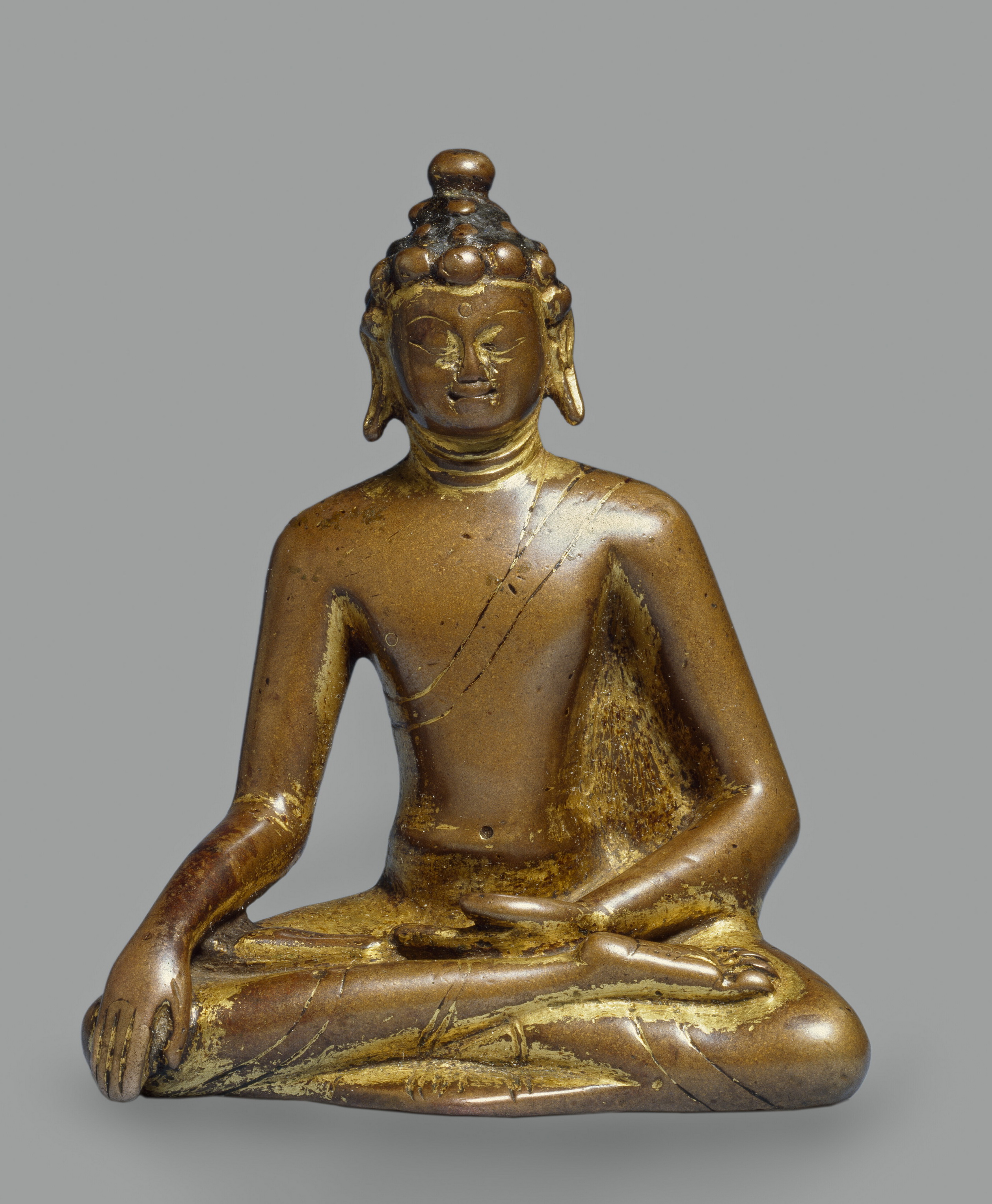
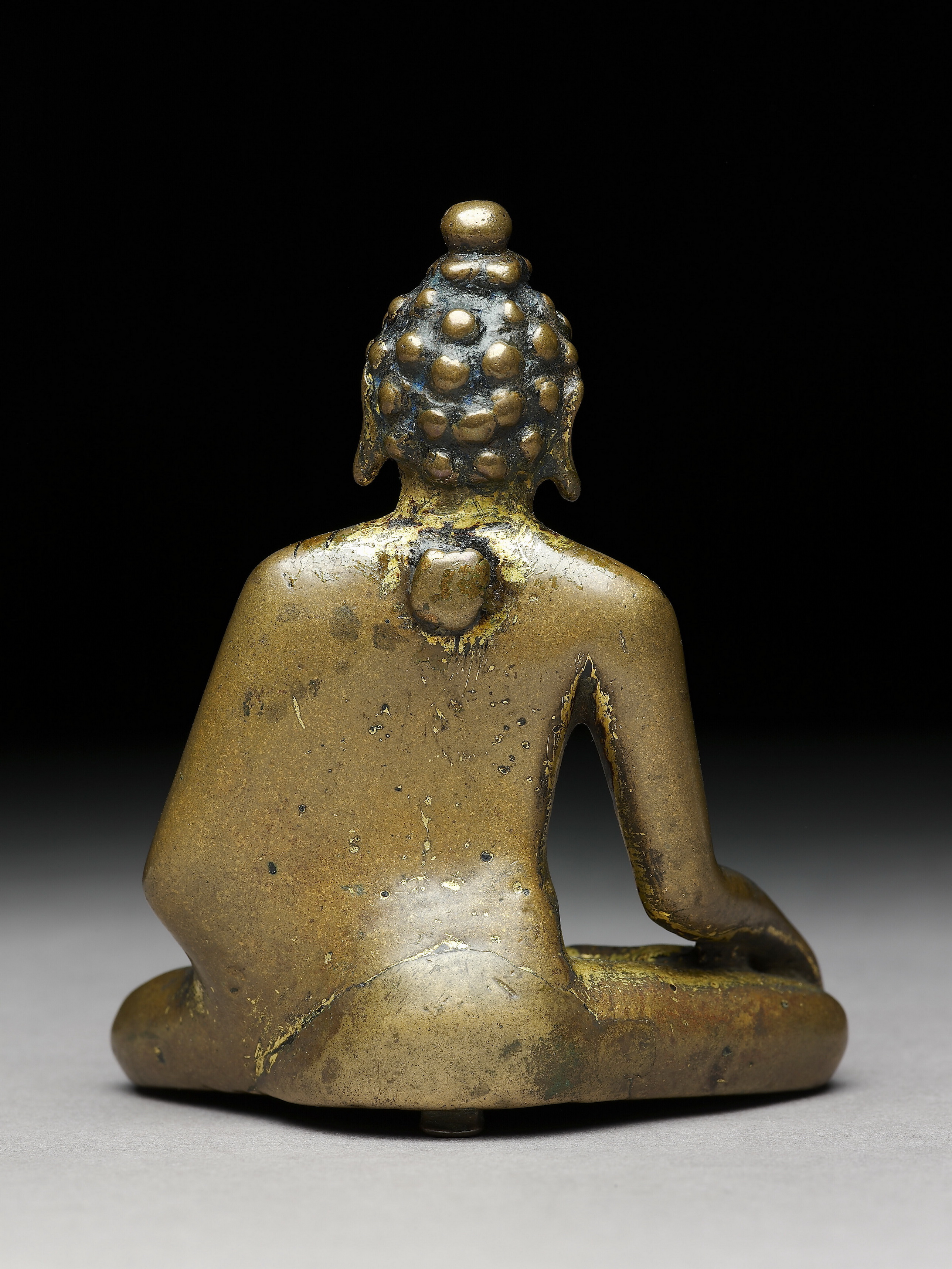 参看相似的一尊: 8-9世纪西藏或尼泊尔铜鎏金释迦牟尼佛(苏黎世Rietberg博物馆)
可能制作于尼泊尔, 然后被带到了西藏; 也可能是当时在西藏的尼泊尔工匠制作的.
This Buddha was formerly completely gilt, with blue pigment applied over the hair. Its metal is now somewhat reddish in colour, indicating a very high copper content in the alloy. This high copper level has made the surface of the sculpture soft, resulting in much surface wear to the facial features. The statue is heavy and appears to be solid cast, as there is a cavity under the Buddha's legs. On the back above the shoulder-blades there is a tang for attachment to a prabha, and again beneath the buttocks. This would have connected the Buddha to his lotus pedestal, separately cast and now missing. Examination of the underside reveals that the shell of the statue is quite thick: there is a rim which is 1 cm wide, upon which the square tang is positioned.
The Buddha has a spherical jewel finial above the dome of his ushnisha, formed by four copper beads. The hair curls also are formed by spherical copper beads of irregular size. The ears are quite stylized, for instead of the long lobes hanging naturalistically, the lower lobes protrude laterally at a pronounced angle. This curious treatment of the lobe is found on many Buddha images now found in Tibet which are dated to around the ninth century [1]. It also recalls the Buddha figures in the carved lintels of the Lhasa Jokhang, of the eighth to ninth century. The square hairline, full cheeks, and rounded face with a slightly square jaw are characteristic of sculpture of the Licchavi period, as are the fine facial features, with small almond eyes and small mouth with full lips. The nose now appears flat and wide at the nostrils but this is due to wear, while the bridge of the nose is narrow. The face looks straight ahead.
The body proportions are strong yet slender. The abdomen is just rounded at the waist, and the navel is punched in recess. These elegant proportions are characteristic of the Licchavi aesthetic [2]. The samghati clings so closely to the body that its edge is merely indicated by incised lines marking the edge of the hem as a diagonal line at the level of the chest and shoulder. Two hems are visible on the legs: one robe-edge at mid-calf and another near the ankles. This unusual treatment of the robe may also be observed on the seated Buddha from Nepal (cat. 5), and another seated Buddha from Nepal, attributed to the tenth to eleventh century, in the Ford Collection [3]. The facial f e a t u res of the Ashmolean Buddha are closer to c i rc a ninth-century Buddha images now in Tibet. The strong right hand forms the bhumisparsha (earth-touching) mudra; the fingers are elongated. The palm of the left hand, resting in the lap, and the soles of the feet have the sacred circular markings. The mood of this Buddha is gentle and alert.
In many respects this Buddha corresponds perfectly to the taste of the Licchavi period in Nepal, due to the casting in copper alloy, the proportions, and the facial features. A provenance from Nepal or Tibet in the eighth to ninth century may be suggested, as this sculpture also has similar proportions and hair to the Buddha figures carved in the wooden lintels of the earliest Buddhist sanctuary in Tibet, the Lhasa Jokhang. In view of the presence of Newar artists and artisans working in Tibet at this time, it was possibly made in Tibet; otherwise it could have been cast in Nepal and then brought to Tibet, where the blue pigment was applied to the hair in accordance with Tibetan consecration practices.
这尊佛像原先通体鎏金,发髻处施有蓝色颜料。其金属材质现今略显红褐色,表明合金中铜含量极高。高含铜量导致造像表面质地较软,因此面部五官磨损严重。此像沉重,似为实心铸造,但佛像双腿下方有一空腔。背部肩胛骨上方及臀部下方各有一榫头,用以连接背光(prabha)及莲座——莲座为分铸,现已缺失。对底部的检查显示,佛像外壳相当厚实:边缘处有一圈宽约1厘米的边沿,方形榫头即设于其上。
佛陀肉髻(ushnisha)顶端有一球形宝珠顶严,由四颗铜珠构成。发螺亦为球形铜珠,大小不甚规整。双耳造型颇为程式化:耳垂并非自然下垂呈长条状,而是向两侧明显外展,形成突出角度。这种耳垂的特殊处理方式,可见于今藏于西藏的诸多约九世纪佛像[1],亦令人联想到拉萨大昭寺门楣浮雕中八至九世纪的佛陀形象。方形发际线、饱满的双颊、略呈方形的下颌及圆润的面庞,均为梨车毗(Licchavi)时期造像的特征;细部五官亦如是——杏仁状小眼、小口丰唇。鼻子因磨损现今鼻头扁平、鼻孔宽大,但鼻梁原本较窄。佛像面朝正前方。
身体比例健硕而修长,腹部于腰际微显圆润,肚脐以凹刻表现。这种优雅的比例正是梨车毗时期审美之典型[2]。僧伽梨(samghati)紧贴身体,衣缘仅以阴刻线示意,在胸部和肩部高度形成一条斜向边线。腿部可见两道衣缘:一道位于小腿中部,另一道靠近脚踝。这种罕见的衣袍处理方式,亦见于尼泊尔的一尊坐佛(图录第5号)及福特收藏中另一尊约为十至十一世纪的尼泊尔坐佛[3]。阿什莫林博物馆这尊佛像的面部特征更接近现存于西藏的约九世纪佛像。右手结降魔触地印(bhumi-sparsha mudra),手指修长;左手掌心朝上置于膝上,双足掌及左掌内皆刻有吉祥轮相。整尊佛像神态安详而警觉。
此像在诸多方面与尼泊尔梨车毗时期的审美趣味完全吻合,包括铜合金铸造、比例及面部特征。其来源或可推定为八至九世纪的尼泊尔或西藏,因其比例与发式亦与西藏最早佛教圣地——拉萨大昭寺木雕门楣上的佛像相近。鉴于彼时已有尼泊尔工匠在西藏活动,此像或有可能为西藏本地制作;亦有可能铸于尼泊尔后携入西藏,再依据西藏的开光仪轨于发髻上施以蓝色颜料。
[Footnotes:]
1 von Schroeder, Buddhist Bronzes in Tibet, vol. 1, pls. 137-9.
2 Compare the 8th-9th-century Amoghapasa in the Nyingjei Lam collection: Weldon and Singer, The Sculptural Heritage of Tibet, pl. 9, and another Licchavi Amoghapasa from a private collection: Heller, 'Eighth- and Ninth-century Temples and Rock Carvings of Eastern Tibet', pl. 82.
3 Pal, Desire and Devotion, pl. 105.
In: Heller, Amy, Early Himalayan Art (Oxford: Ashmolean Museum, 2008)