
侧边栏

12世纪大理国铜鎏金阿嵯耶观音菩萨立像(纽约佳士得)
尺寸:高45.7 cm
年代:12世纪 大理国时期
质地:铜鎏金
风格:大理
来源:拍卖会
成交:1,935,000美元(2019.03)
参阅:外部链接
鉴赏:
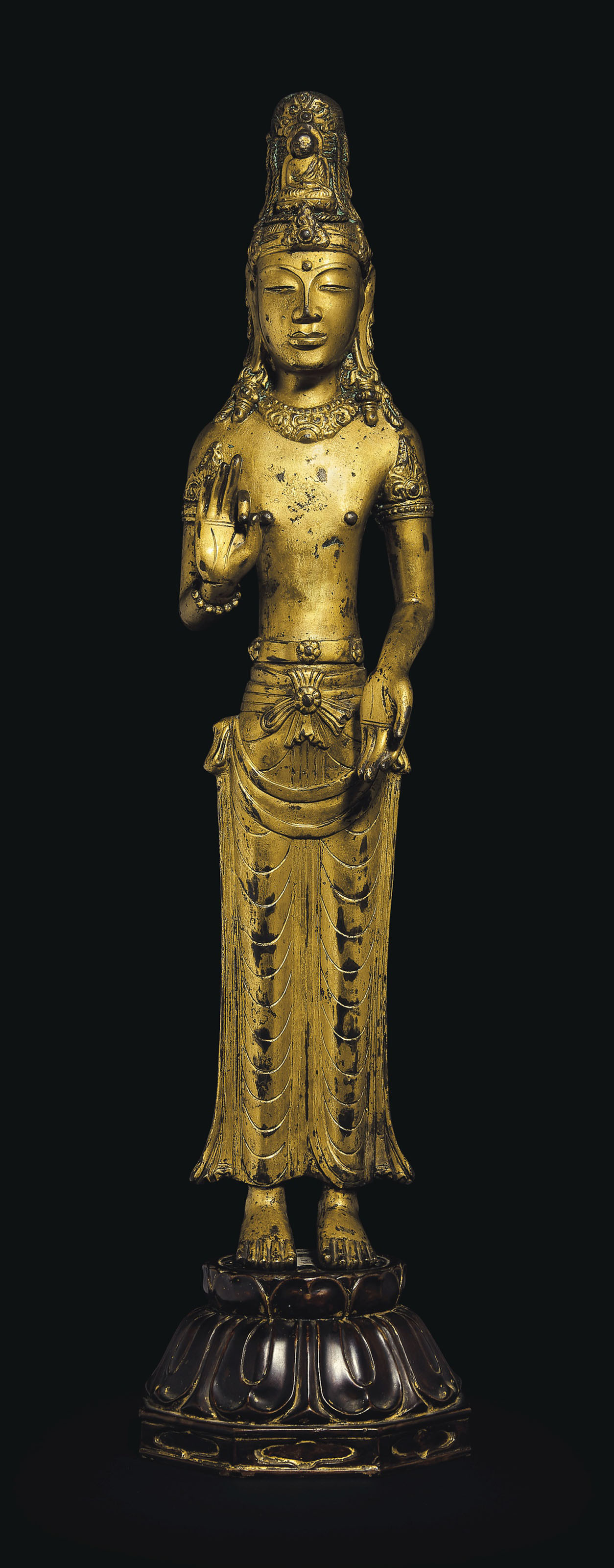
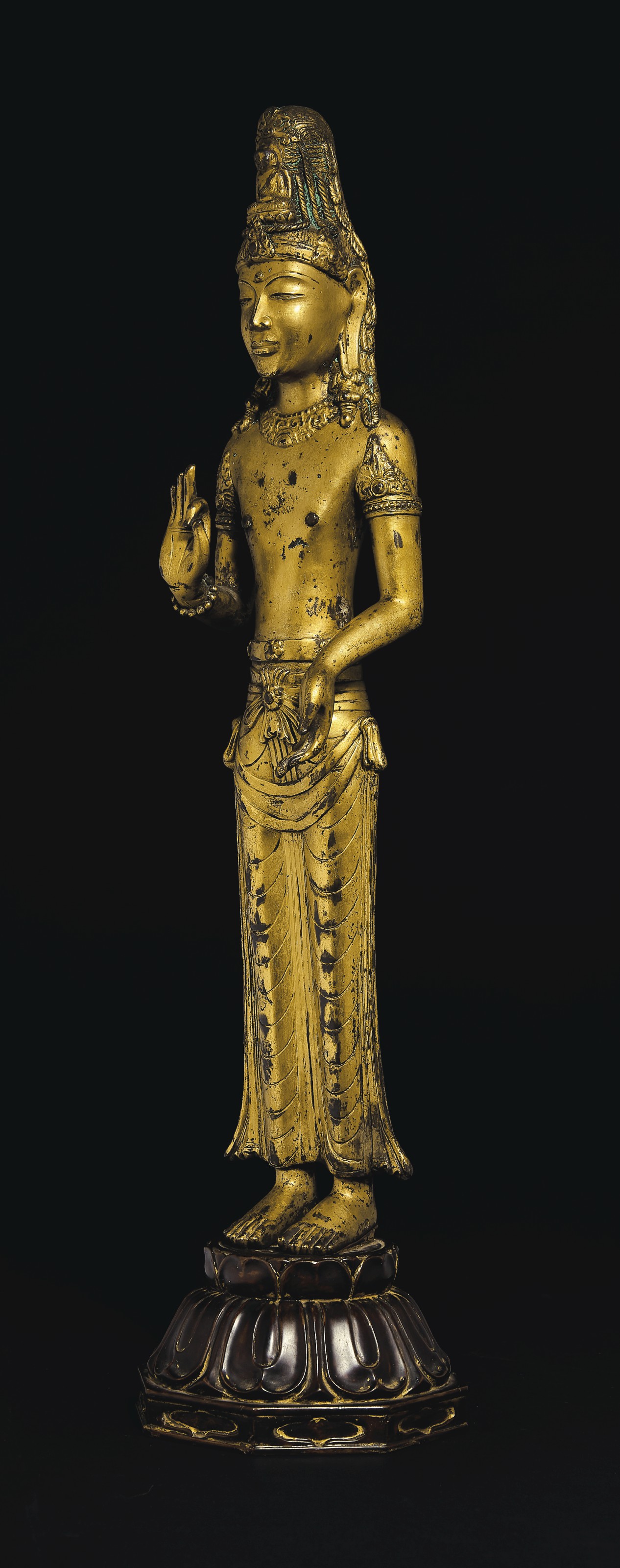
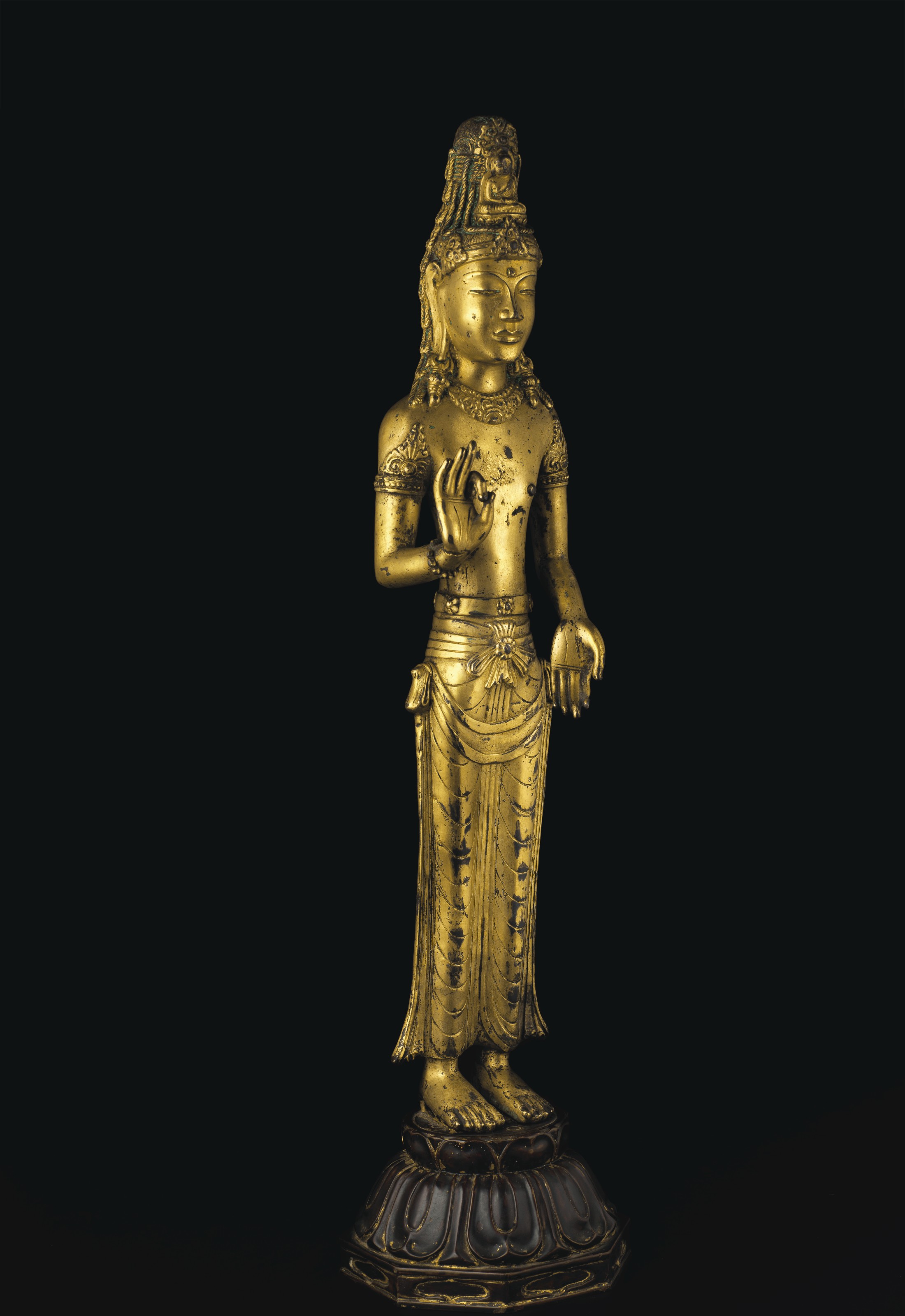
 A RARE GILT-BRONZE STANDING FIGURE OF AN ACUOYE GUANYIN
CHINA, YUNNAN, DALI KINGDOM, 12TH CENTURY
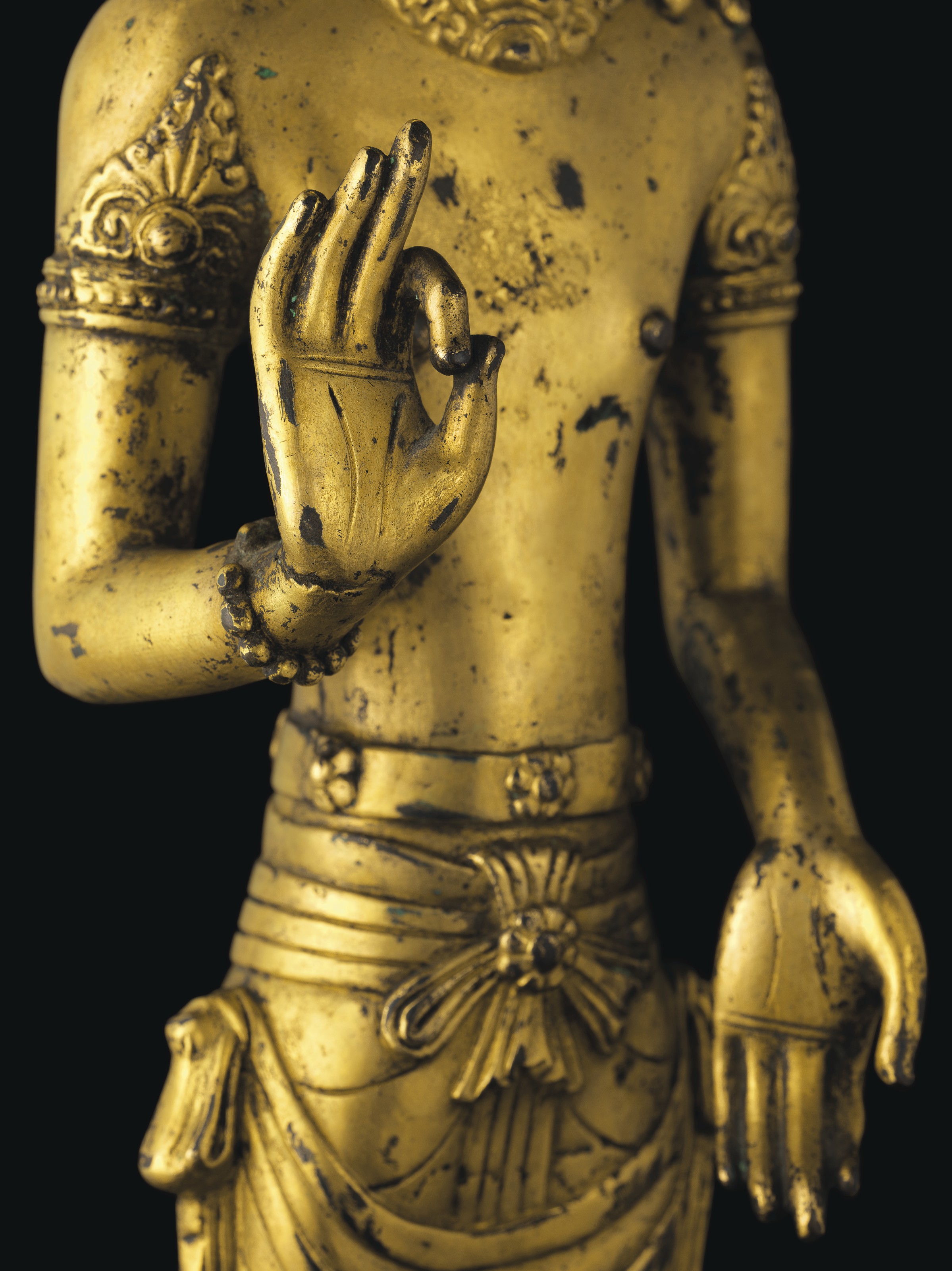
The tall, slender figure shown standing with right hand raised in vitarkamudra and left held in varadamudra, the long hair drawn up into a tall coiffure (jatamukuta) bound by a band and elaborately dressed in twisted cords falling in loops around and flanking a central seated image of Amitabha Buddha and falling to the shoulders behind the earring-hung ears, wearing a jeweled necklace and arm bands and a floret-decorated belt worn above the waist and the top of the dhoti secured by a knotted sash, the upper back with a rectangular opening and the back of the upper legs with a square casting patch
这尊高挑纤细的造像呈站立姿势,右手高举结说法印(vitarkamudra),左手垂下结施与印(varadamudra)。长发向上梳成高髻(jatamukuta),以发带束紧,并精心编结成缠绕的绳股状,在中央的阿弥陀佛坐像两侧盘成环结,垂落于佩戴耳珰的双耳后方肩头。造像佩戴宝珠项链、臂钏,腰间系有一条饰有小花图案的腰带,缠裤(dhoti)的裙腰部分以打结的帛带固定。背部上方有一处长方形开口,大腿后侧有一块方形铸造修补痕迹。
18 in. (45.7 cm.) high, lacquered softwood base
高 18 英寸(45.7 厘米),配漆面软木底座
来源:
Private Collection, United States, acquired in Tokyo in 1946.
The property of a gentleman; Christie’s New York, 6 November 1980, lot 209.
Robert H. Ellsworth, New York.
The Irving Collection, no. 1949.
著录:
Ann Ray Martin, “American Mandarin,” Connoisseur, November 1984, p. 101.
The “Luck of Yunnan”
Standing Bodhisattva Acuoye Avalokiteshvara
Termed the “Luck of Yunnan” by American scholar Helen Burwell Chapin (1892–1950), sculptures of this type represent the Bodhisattva Acuoye Guanyin and were produced in the twelfth century in the Dali Kingdom (AD 937–1253), an independent state in southwestern China that was coeval with China’s Song dynasty (AD 907–1279) and more or less congruent with present-day Yunnan province.
The comparatively large image of a seated Buddha Amitabha at the base of the figure’s high topknot of hair identifies this sculpture as the bodhisattva Avalokiteshvara, the bodhisattva of Infinite Compassion, known formally in Chinese as Guanshiyin Pusa and informally as Guanyin. Considered a spiritual emanation of Amitabha, Avalokiteshvara is the only bodhisattva in whose crown or headdress Amitabha appears, and thus Amitabha’s presence here definitively identifies this figure as Avalokiteshvara.
Standing upright with his weight evenly distributed on both legs, the bodhisattva holds his left hand in the varadamudra, or gift-giving gesture, in which the hand is lowered, palm outward. (A ritual hand gesture, a mudra symbolizes a particular action, power, or attitude of a deity.) He holds his right hand, raised to chest height, in the vitarka mudra, in which the tips of thumb and index finger touch to form a circle; this mudra emblemizes both intellectual discussion and the transmission of the Buddha’s teachings. Together, the combination of vitarka and varada mudras indicates that the bodhisattva is preaching.
The Chinese term for this type of Guanyin image, “Acuoye Guanyin”, first appeared in the Nanzhao tuzhuan, a long, illustrated handscroll depicting the history of the Nanzhao Kingdom now in the collection of the Fujii Yurinkan, Kyoto. The scroll, dated by inscription to AD 898, represents the prophecy made by an Indian monk, which predicted the rise to power of the Meng family and the casting of a bronze Acuoye Guanyin modeled on the monk’s mental vision. The Indian monk, who demonstrated various supernatural deeds, was actually a manifestation of Acuoye Guanyin. This leads to one theory that the name “Acuoye” is a transliteration of the Sanskrit term acharya, which means “preceptor”. (See Gong Jiwen, ‘A Fine Arts Anthropology Study on Avalokitesvara Iconography in Kingdom of Nanzhao-Dali’, Ph.D. diss., Yunnan University, 2017, pp. 1 and 156). Other scholars have suggested that the name “Acuoye” may be a transliteration of the Sanskrit term ajaya, which means “all victorious”. Invested with miraculous powers, the sculpture was adopted by the Meng family as its tutelary deity and witnessed the family’s rise to royal status and fostered the establishment of the Nanzhao Kingdom (738–937), which controlled Yunnan during the eighth and ninth centuries. From 937 onward, the same region, by then controlled by the Duan family, became known as the Dali Kingdom (AD 937–1253). While the Chinese emperor based his legitimacy on the Mandate of Heaven, the Yunnan monarchs grounded theirs on the will of Guanyin. The possession of a special image, a palladium in the form of the Acuoye Guanyin, thus conferred legitimacy on the ruler. In that context, a tutelary deity called ajaya, or “all victorious”, stood as an appropriate reference for an icon associated with members of a ruling family. (Adapted from Denise Patry Leidy, Donna Strahan, et al., Wisdom Embodied: Chinese Buddhist and Daoist Sculpture in the Metropolitan Museum of Art, New York: The Metropolitan Museum of Art, 2010, pp. 136-38, no. 32.)
Fashioned in gold and backed by an elaborate, openwork mandorla, the eighth- or ninth-century Acuoye Guanyin discovered in 1978 inside the Qianxun Pagoda at the Chongsheng Temple, Dali, Yunnan province, is both the earliest and the most prominent example of the tutelary deity of the Nanzhao and Dali kingdoms. (see: Leidy and Strahan, Wisdom Embodied, p. 136, fig. 99) This effigy of Guanyin, which was replicated through successive dynasties, is the model from which derive the several related twelfth-century sculptures including the present example. (See Angela F. Howard, “Buddhist Monuments of Yunnan: Eclectic Art of a Frontier Kingdom” in Maxwell Hearn and Judith G. Smith, eds., Arts of Song and Yuan: Papers Prepared for an International Symposium, New York: The Metropolitan Museum of Art, 1996, pp. 231-45)
This figure’s slender body, elongated proportions, and distinctive facial features are typical of Dali-Kingdom sculptures, as are the torque, the long earrings that rest on the shoulders, and the arrangement of the hair in an Indian-style jatamukuta. Those features not only distinguish such images from sculptures produced in Song-dynasty China but closely link them to sculptures created in India and Southeast Asia. In fact, the slender body, clinging drapery, and fashioning of the hair in a jatamukuta find parallels in such Buddhist and Hindu sculptures from Indonesia as three seventh-to-ninth-century bronzes in the collection of The Metropolitan Museum of Art, New York: 2004.556, 1987.142.160, and 1987.218.15. Apart from possible relationships with Indonesian sculptures, elements of the Acuoye Guanyin bear a striking resemblance to those of a ninth-century, sheet gold and electrum sculpture of an Avalokiteshvara from Champa now in the collection of the Asian Civilizations Museum, Singapore (See https://www.buddhistdoor.net/features/the-new-ancient-religions-gallery-at-the-asian-civilisations-museum-singapore). To wit, the matted hair piled high on the head and bound together with cords in a jatamukuta, the proportionally large image of the Buddha Amitabha set at the base of the jatamukuta, the slender body with a torque embellishing the neck, the scarf tied at either hip and looping below the waist, and the subtle drapery folds that delicately flow over the legs all suggest possible influence from Champa, in present-day central Vietnam, on the sculpture of the Dali Kingdom. (See Albert Lutz and Angela Falco Howard, Der Goldschatz der drei Pagoden: Buddhistische Kunst des Nanzhao- und Dali-Konigreichs in Yunnan, China, 1st ed., Zurich: Museum Rietberg, 1991, pp. 68-74)
Sculptures of the Acuoye Guanyin are dated to the second half of the twelfth century on the basis of their similarity to a sculpture in the collection of the San Diego Museum of Art (1941.83) that bears an inscription that dates it between 1147 and 1172. That date is further confirmed by the striking resemblance of such sculptures to a golden image depicted in the so-called Long Scroll of Buddhist Images (Fig. 1) painted between 1172 and 1190 by Zhang Shengwen (active 1163–1189) and now in the collection of the National Palace Museum, Taipei. (See Leidy and Strahan, Wisdom Embodied, p. 136, fig. 98)
Closely related sculptures of the Acuoye Guanyin appear in a number of collections in both Asia and the West, including the Yunnan Provincial Museum, Kunming; The Metropolitan Museum of Art, New York (42.25.28); Freer Gallery of Art, Washington, DC (F1946.10a-b); Asian Art Museum, San Francisco (B60S34); San Diego Museum of Art (1941.83); Brooklyn Museum; National Palace Museum, Taipei; Victoria and Albert Museum, London; Musée Guimet, Paris; and Sumitomo Collection in the Sen-oku Museum in Kyoto, Japan.
Robert D. Mowry
Alan J. Dworsky Curator of Chinese Art Emeritus,
Harvard Art Museums, and
Senior Consultant, Christie’s
“Luck of Yunnan”(云南之运)
阿嵯耶观音菩萨立像
此类造像被美国学者Helen Burwell Chapin(1892–1950)称为“Luck of Yunnan”,代表的是阿嵯耶观音(Acuoye Guanyin)菩萨像,制作于12世纪的大理国(公元937–1253年)。大理国是中国西南部的一个独立政权,与中国的宋朝(公元907–1279年)同时代,其疆域大致相当于今天的云南省。
造像高耸发髻基部有一尊相对较大的阿弥陀佛坐像,由此可确定此像为观音菩萨——即大悲观世音菩萨,正式名称为“观世音菩萨”,简称“观音”。作为阿弥陀佛的化现,观音是唯一在其宝冠或发饰中出现阿弥陀佛的菩萨,因此阿弥陀佛的出现明确证明了此像的身份即为观音。
菩萨双腿均匀承重,直立而立。左手结varadamudra(施与印),即手掌向外、手向下的手势(手印为仪式性手势,象征神灵的特定行为、力量或态度)。右手抬至胸前,结vitarka mudra(说法印),拇指与食指指尖相触成环;此手印象征智慧辩论与佛法传授。说法印与施与印的组合表明菩萨正在说法。
此类观音像的中文名称“阿嵯耶观音”最早出现于《南诏图传》。该图卷是一幅描绘南诏国历史的长卷手绘,现存于京都Fujii Yurinkan。此画卷根据铭文定为公元898年绘制,表现了一位印度僧人的预言,预言蒙氏家族将崛起掌权,并根据僧人的心中所见铸造一尊铜质阿嵯耶观音像。这位展示了各种神通事迹的印度僧人,实际上是阿嵯耶观音的化身。由此产生一种说法,认为“Acuoye”是梵文acharya的音译,意为“导师”(参见龚吉雯《南诏大理国观音造像的艺术人类学研究》,云南大学博士论文,2017年,第1、156页)。另有学者认为“Acuoye”可能是梵文ajaya的音译,意为“全胜”。这尊造像被认为具有神奇力量,被蒙氏家族奉为护法神,见证了蒙氏家族登上王位,并推动了南诏国(738–937年)的建立。南诏国在8至9世纪统治着云南地区。从937年起,同一地区改由段氏家族控制,被称为大理国(公元937–1253年)。中国皇帝以“天命”作为其统治的合法性基础,而云南的君主则以观音的意志为根基。拥有一尊特殊造像——一尊阿嵯耶观音形式的palladium(护国圣像)——便赋予了统治者合法性。在此背景下,被称为ajaya(“全胜”)的护法神,正适合作为与统治家族成员相关的圣像之称谓。(改编自Denise Patry Leidy, Donna Strahan, et al., <Wisdom Embodied: Chinese Buddhist and Daoist Sculpture in the Metropolitan Museum of Art>,纽约:大都会艺术博物馆,2010年,第136-138页,第32号)
1978年在云南省大理崇圣寺千寻塔内发现的阿嵯耶观音像,以黄金铸造,背衬精美的镂空背光,年代为8至9世纪,是南诏和大理国护法神像中最早、最著名的实例(参见Leidy与Strahan, <Wisdom Embodied>,第136页,图99)。这尊观音像在历代被反复复制,成为包括本件拍品在内的几尊相关12世纪造像的原型(参见Angela F. Howard, “Buddhist Monuments of Yunnan: Eclectic Art of a Frontier Kingdom”,载于Maxwell Hearn与Judith G. Smith编《Arts of Song and Yuan: Papers Prepared for an International Symposium》,纽约:大都会艺术博物馆,1996年,第231-245页)。
此像纤细的身形、拉长的比例以及独特的面部特征均为大理国雕塑的典型特征,其项圈、垂落于肩部的长耳珰以及印度式jatamukuta(发髻)亦是如此。这些特征不仅使此类造像区别于中国宋代的雕塑,更将其与印度和东南亚的造像紧密联系起来。事实上,纤细身姿、贴体衣纹以及jatamukuta(发髻)的塑造方式,在印度尼西亚的佛教和印度教雕塑中可找到对应,例如纽约大都会艺术博物馆藏的三件7至9世纪青铜像:2004.556, 1987.142.160, and 1987.218.15。除了与印度尼西亚雕塑的可能关联外,阿嵯耶观音的某些元素也与现存新加坡Asian Civilizations Museum的一件9世纪占婆(Champa)捶打金片和金银合金观音像具有惊人的相似性(参见https://www.buddhistdoor.net/features/the-new-ancient-religions-gallery-at-the-asian-civilisations-museum-singapore)。即:纠结长发高高盘起并以绳股束成jatamukuta(发髻);比例较大的阿弥陀佛像置于jatamukuta基部;纤细身躯配以颈部项圈;帛带系于两侧髋部并在腰下形成环结;以及轻覆双腿的微妙衣褶——所有这些都表明今越南中部的占婆可能对大理国的雕塑产生了影响(参见Albert Lutz与Angela Falco Howard合著<Der Goldschatz der drei Pagoden: Buddhistische Kunst des Nanzhao- und Dali-Konigreichs in Yunnan, China>第一版,苏黎世:Museum Rietberg,1991年,第68-74页)。
阿嵯耶观音像的年代被定为12世纪下半叶,依据是其与San Diego Museum of Art所藏一件带有铭文的造像(1941.83)相似,该铭文将年代定于1147年至1172年之间。这一年代又得到此类造像与张胜温(活跃于1163–1189年)于1172年至1190年间所绘<Long Scroll of Buddhist Images>(《梵像卷》,图1)中一尊金色造像惊人相似的进一步确认。该画卷现藏于台北National Palace Museum(参见Leidy与Strahan, <Wisdom Embodied>,第136页,图98)。
阿嵯耶观音的紧密相关造像见于亚洲和西方的多个收藏机构,包括:昆明Yunnan Provincial Museum;纽约The Metropolitan Museum of Art (42.25.28);华盛顿特区Freer Gallery of Art (F1946.10a-b);旧金山Asian Art Museum (B60S34);San Diego Museum of Art (1941.83);Brooklyn Museum;台北National Palace Museum;伦敦Victoria and Albert Museum;巴黎Musée Guimet;以及日本京都Sen-oku Museum的Sumitomo Collection。
Robert D. Mowry
哈佛艺术博物馆(Harvard Art Museums)Alan J. Dworsky中国艺术荣誉策展人
佳士得高级顾问

