
侧边栏

14世纪尼泊尔铜鎏金莲花手观音立像(纽约佳士得)
尺寸:H. 45.4 cm
年代:14世纪
质地:铜鎏金
风格:尼泊尔
来源:拍卖会
成交:2,490,500美元(2012.03)
参阅:外部链接
鉴赏:
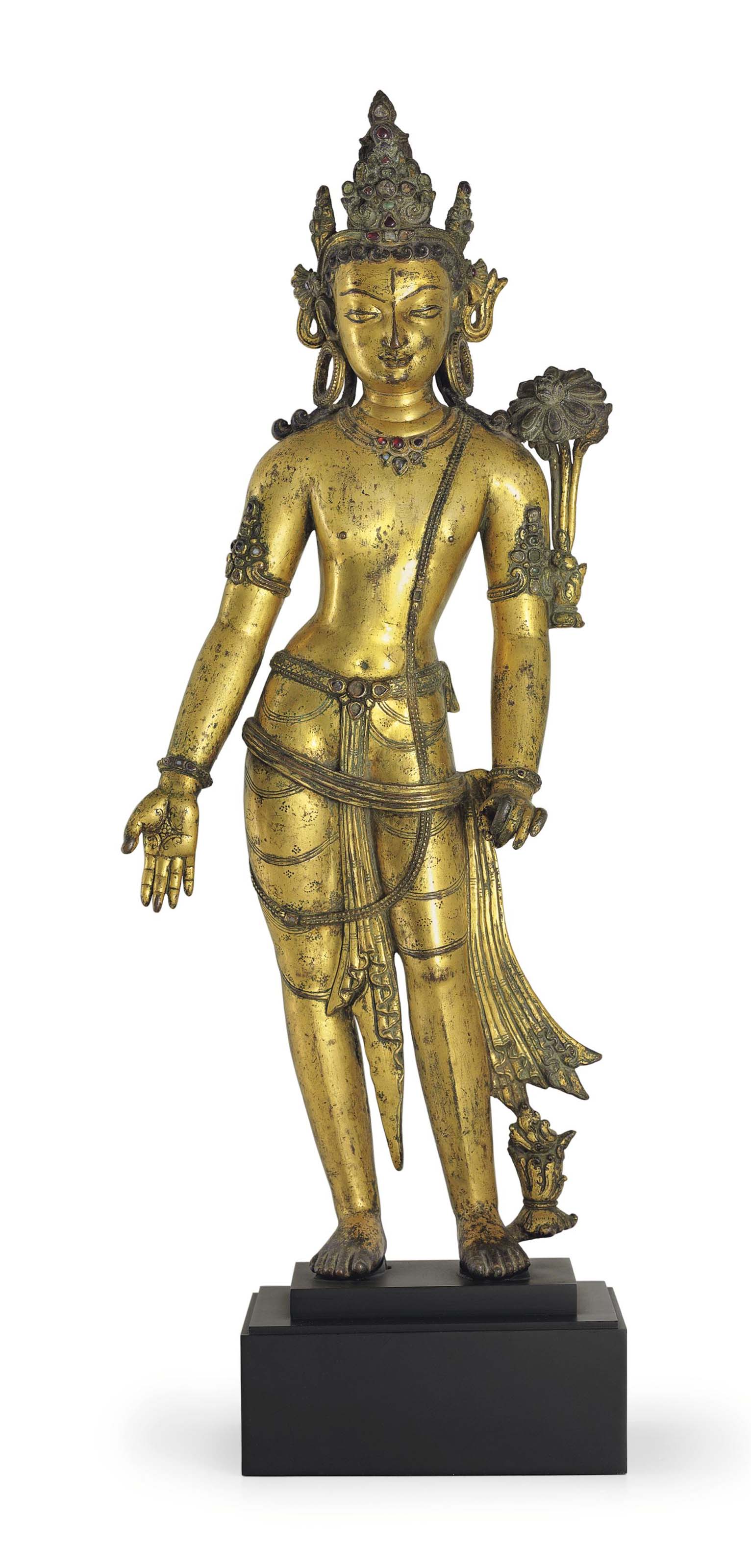 An important gilt bronze figure of Padmapani
Nepal, 13th century (应该为14世纪)
Standing with his right hand in varadamudra and a lotus blossoming at his left shoulder, dressed in a dhoti incised with a stippled pattern and secured with a beaded belt with pendant ribbon, adorned with the sacred thread and sash hanging across the hips, the face with downcast eyes and gently arching brows flanked by large hoop earrings, the hair piled into a high chignon and secured with a foliate tiara
此尊立姿,右手结施愿印(varadamudra),左肩侧绽放一朵莲花。下身着裙(dhoti),裙上刻有点状纹饰,腰间系珠串腰带,垂有飘带。圣带与帔帛横跨臀部两侧。面容低垂双目,双眉柔和弯弓,两侧饰大环耳珰。发髻高盘,以花叶状宝冠束之。
来源:
Doris Wiener Gallery, New York, 1967
展览:
Philadelphia Museum of Art, Pennsylvania, June-July 1978
Worshipped in Nepal from at least the mid-6th century, Avalokiteshvara was one of the most popular Buddhist deities in the Kathmandu Valley, his worship rivaling that of the Buddha himself. With time, the compassionate characteristics of Avalokiteshvara became intertwined with the attributes of the local Nepalese deities such as the rain god, Bunga-dyo, and even the Brahmanical Shiva, and the customs for worship of these different gods were integrated into one another. Demand for images of this auspicious bodhisattva was therefore staggering, and from an early period, craftsmen throughout the valley were executing works in wood, stone, paint, and bronze. A distinct Newari style of representation emerged from this locus of fervent worship, influenced initially by the Gupta dynasty and later, as seen in this work, the Pala dynasty of Northeastern India. The deity is almost always depicted standing, in contrast to the post-Guptan Indian tradition of showing him seated. The style is further characterized by the lithe form of the body and the gracefully swaying hips. The folds of the dhoti, simply patterned with stippling, hang between the legs and are secured diagonally across the hips with a sash, while the sacred thread extends almost to the knee.
Representations of Padmapani in Nepal remained consistent in style for several centuries. This work was dated to the 14th century through careful comparison with positively dated in situ bronzes, and is of extraordinary fine execution.
至少在公元六世纪中叶,尼泊尔便开始供奉观音菩萨,他是加德满都谷地最受欢迎的佛教神祇之一,其信仰之盛甚至可与佛陀本人并驾齐驱。随着时间的推移,观音的慈悲特质逐渐与尼泊尔本地神祇(如雨神Bunga-dyo,乃至婆罗门教的湿婆神)的功德相互交融,不同神祇的崇拜仪轨也彼此融合。因此,人们对这尊吉祥菩萨造像的需求极为惊人。早在早期,谷地的工匠们便以木、石、彩绘和青铜等材质创作其形象。在这种炽热的崇拜土壤中,形成了独特的尼瓦尔艺术风格,最初受到笈多王朝的影响,其后(如本件作品所示)又受到印度东北部波罗王朝风格的影响。与后笈多印度传统中本尊呈坐姿不同,此尊菩萨几乎总以立姿呈现。其风格特征还体现在身姿纤长、臀部优雅地摆动。裙衣(dhoti)衣褶简约,饰以点刻纹样,垂于双腿之间,腰间以帛带斜挎于臀部固定,而圣线几乎垂至膝部。
尼泊尔的莲花手菩萨造像风格在数百年间保持稳定。通过与具有确切纪年、保存于原地的铜像进行仔细比对,此件作品可断代为十四世纪,工艺极为精湛。

