
侧边栏

5世纪北魏皇兴四年(470年)铜鎏金王钟造持莲蕾观音立像(香港苏富比)
尺寸:高27.7cm
年代:北魏皇兴四年(470年)
质地:铜鎏金
风格:中原
来源:拍卖会
成交:11,480,000港元(2016.10)
参阅:外部链接
鉴赏:
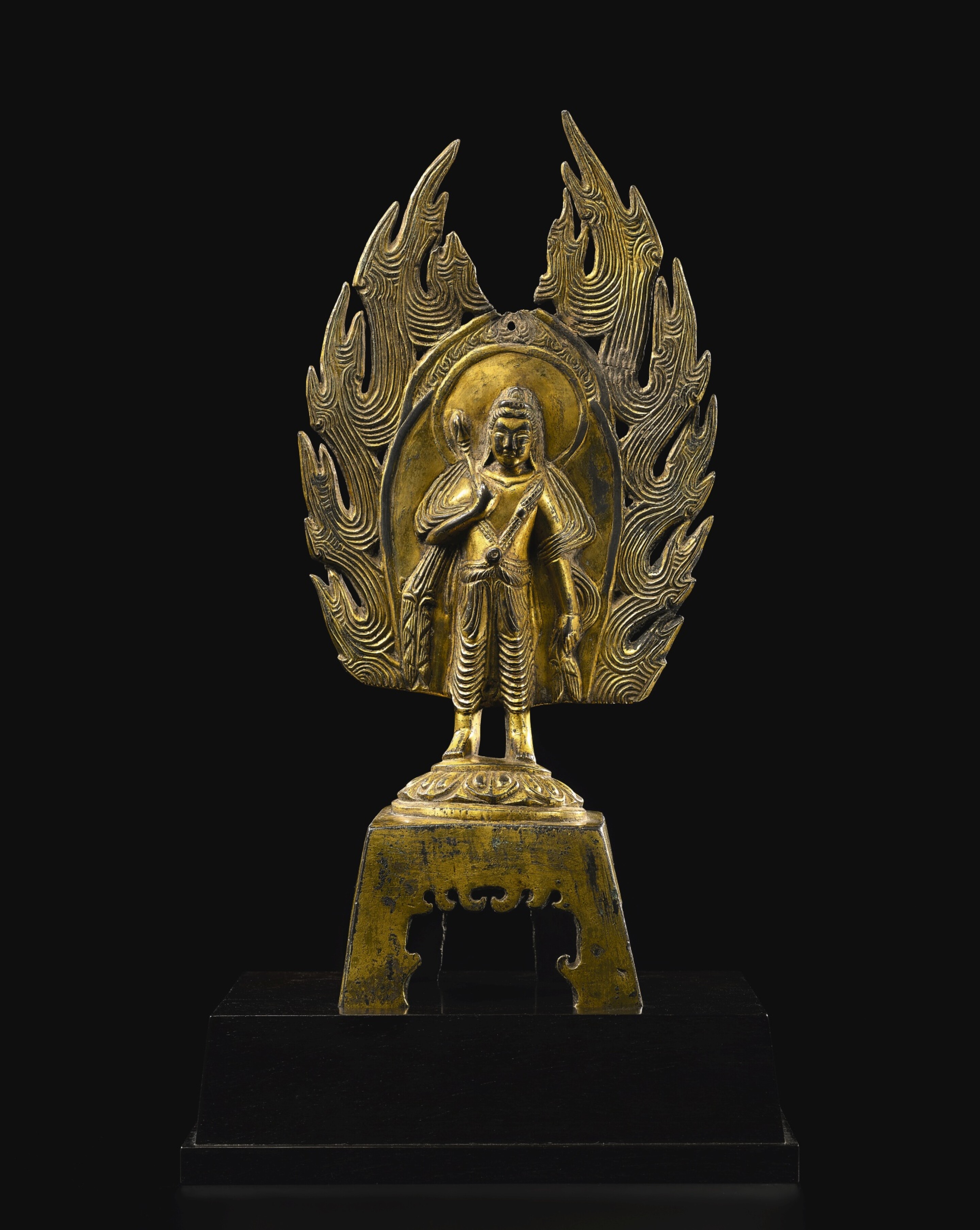
 坂本五郎珍藏早期佛教铜像
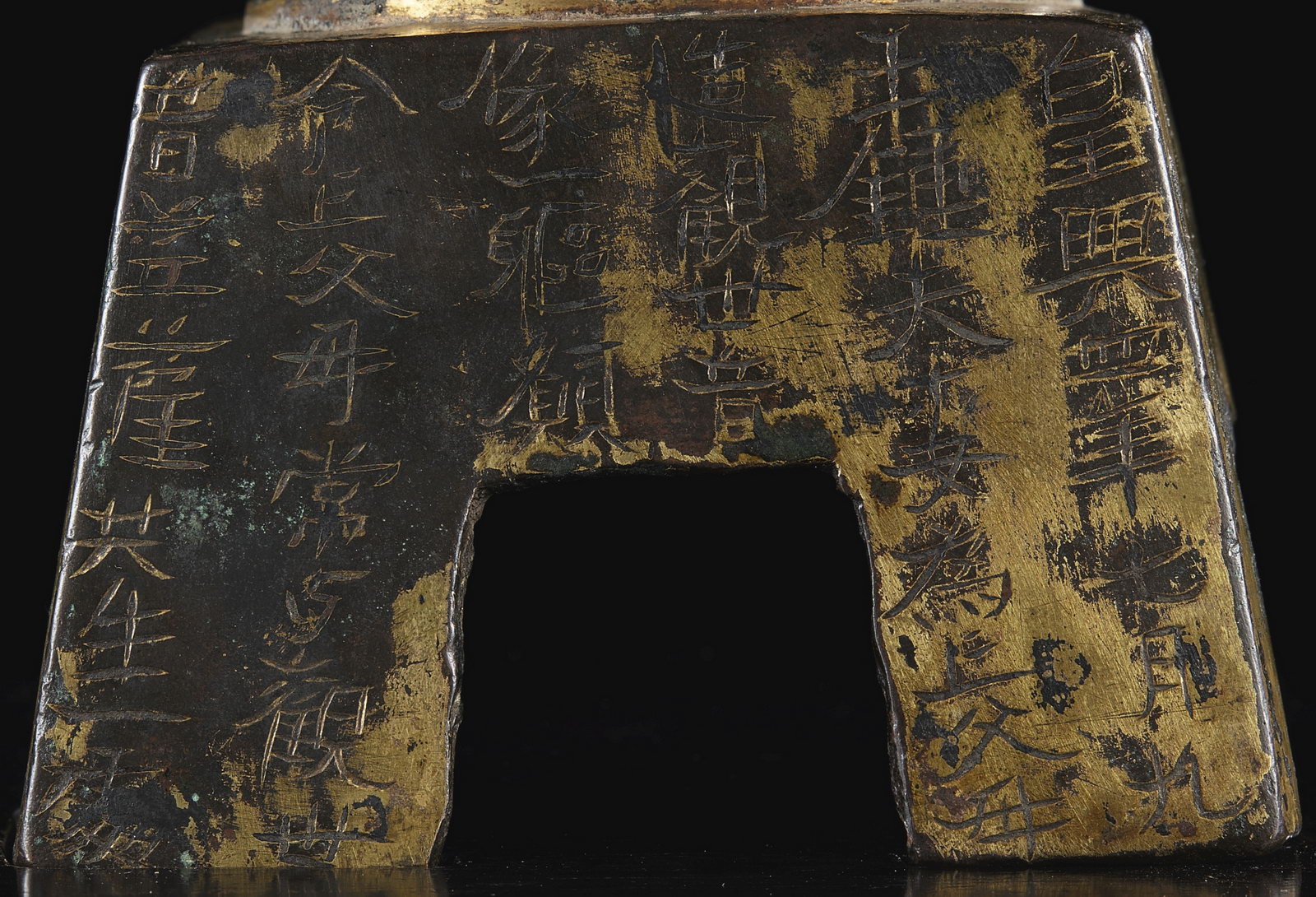
发愿文:皇兴四年七月九王钟夫妻为亡父母造观世音像一躯。愿令亡父母常与观世音萨共生一处。
十六国及北魏早期佛像多为一佛跌坐于方座,两旁有二狮子,题材和构图单调,至皇兴(467年)后,造像的题材趋多样化,站立之观音、弥勒亦多出现。
一尊宏伟且极为罕见的大型鎏金铜莲花手菩萨立像
北魏,皇兴四年(公元470年)
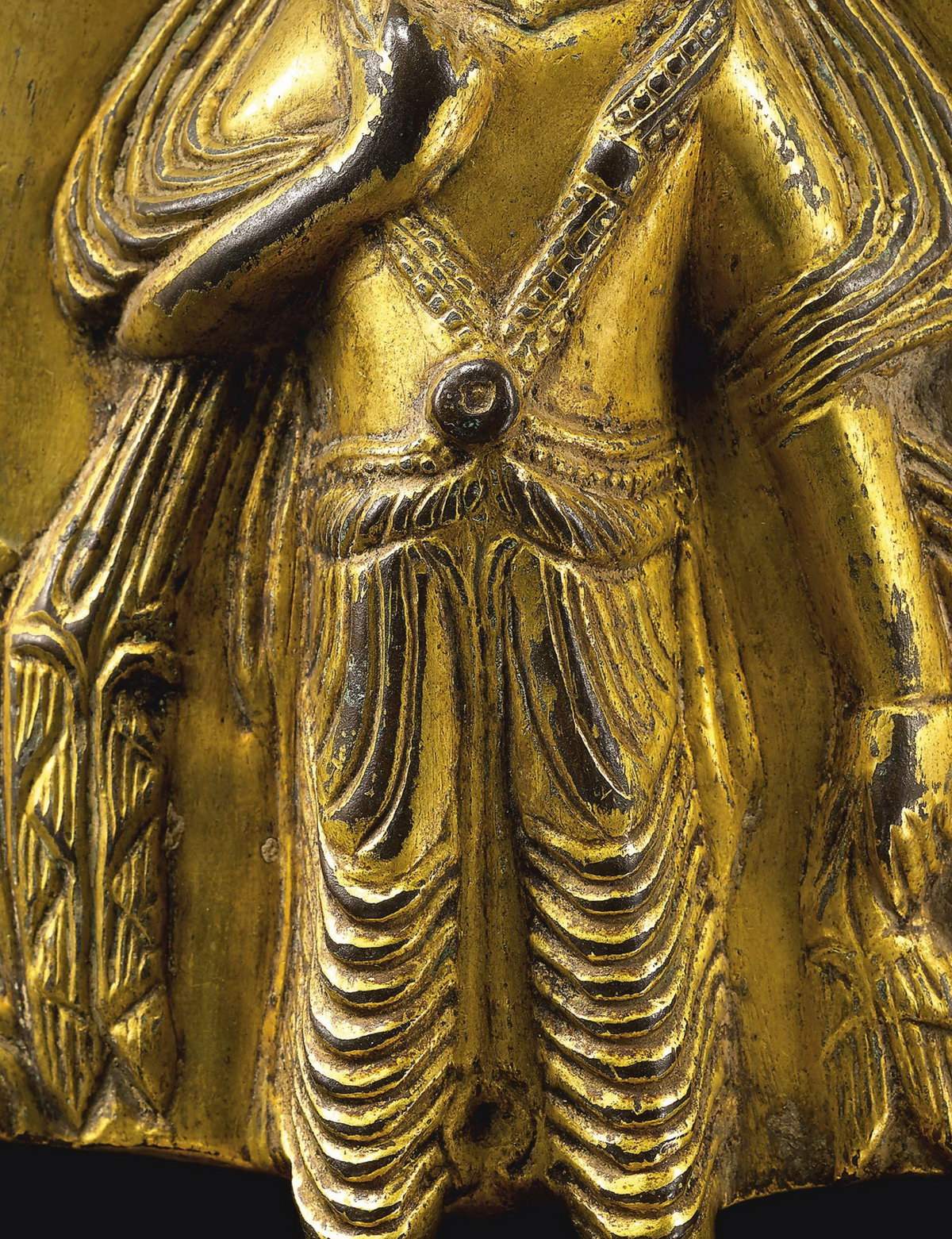
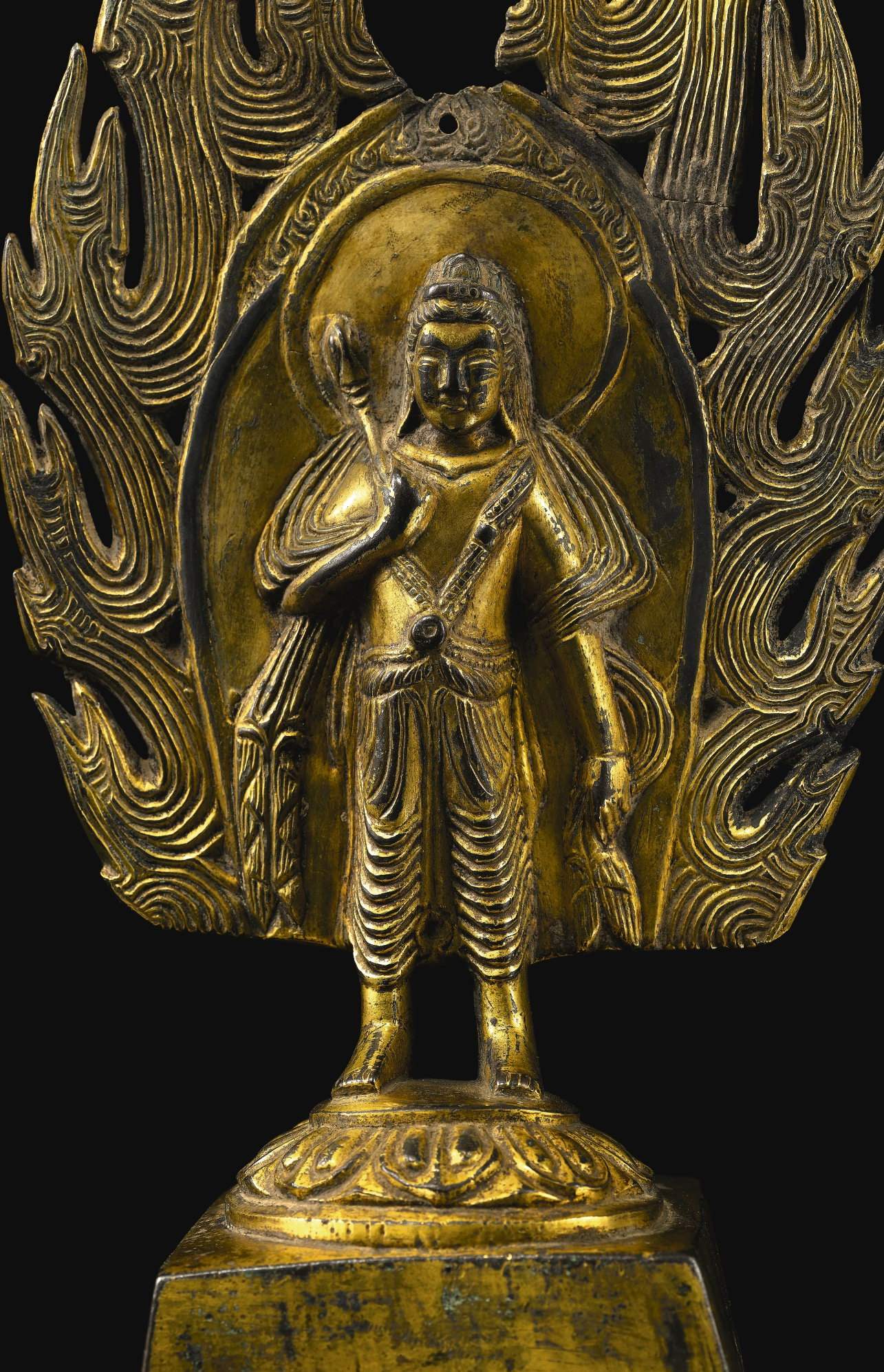
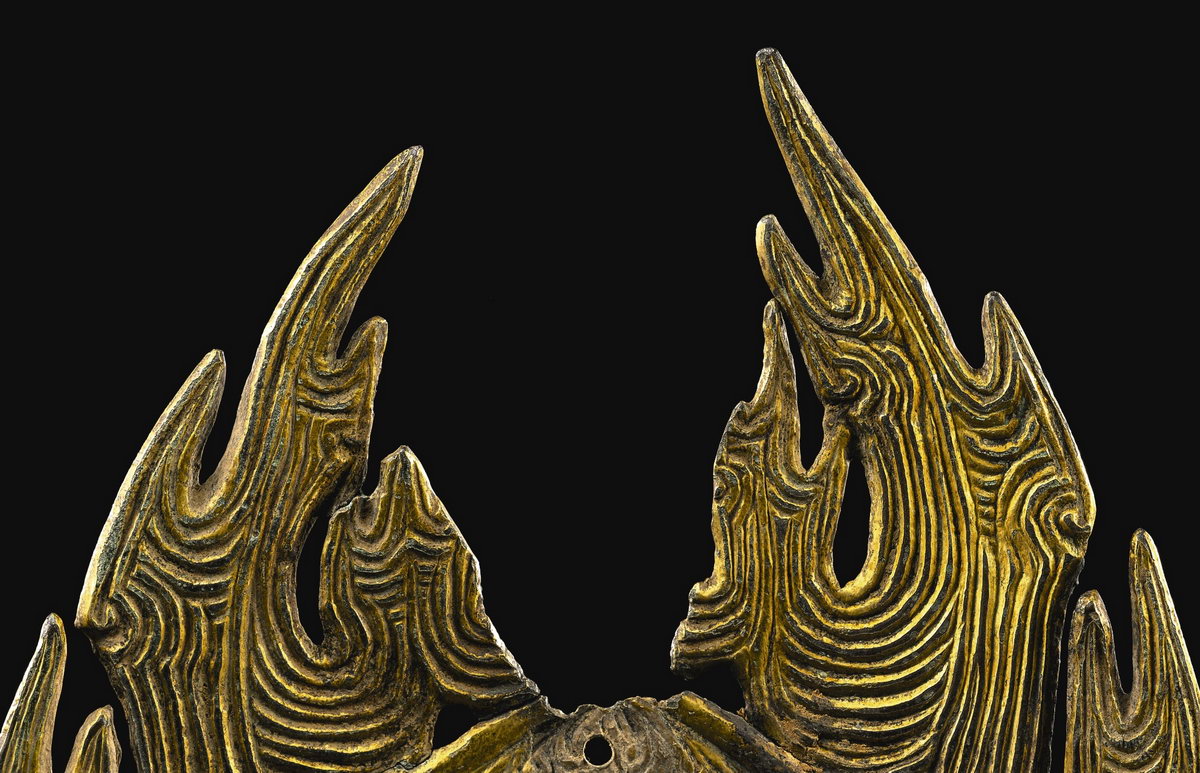
此像铸造极为精细,呈现观世音菩萨之化身——莲花手菩萨的站立姿态。菩萨结实挺拔地立于舟形背光前,背光边缘饰以凶猛翻腾的火焰纹。下方为束腰形莲花座,再下连于一座宽展的四足尖拱形基座。菩萨右手屈肘,持一莲茎,莲茎向上伸展,顶端生一莲花蓓蕾;左手握住从左肩飘下的帔帛一端。身着裙裳(dhoti),衣褶皱叠,垂于膝前。面容宁静,头戴宝冠,后有圆形头光。基座背面刻有发愿文,内容为皇兴四年(公元470年)所造,译文为:“王仲天为父母敬造莲花手菩萨一躯,愿父母得值莲花手。” 背光背面未加修饰。配木座。
展览:
《中国古代雕刻展》,日本桥高岛屋,东京,1959年,图版E
《东方艺术展——庆祝东方古美术馆开馆》,东京国立博物馆,东京,1968年,图录编号528
文献:
水野清一,《中国の雕刻:石仏・金銅仏》(Chinese Sculpture: Stone and Bronze Buddhist Sculptures from the Yin to the Tang Dynasty),东京,1960年,页96
松原三郎,《中国佛教雕刻史研究》(基于石窟以外金铜石佛的研究),东京,1961年,图版23a-b
松原三郎,《增订中国佛教雕刻史研究》,东京,1966年,图版23a-b
松原三郎,《中国佛教雕刻史论》,东京,1995年,卷I,图版35a
图录说明
这件坂本氏旧藏的莲花手菩萨像,凝聚了五世纪雕塑艺术的最高精髓——既有受犍陀罗艺术启发的细腻造型,又将菩萨的高贵特征以有力的站姿清晰呈现,堪称私人收藏中同类造像的巅峰之作。它在日本流传有绪,1960年代水野清一、松原三郎等著名学者便曾著录并讨论,对其铭文纪年的重要性已明确认知。此像尺寸硕大、铸造精细,配以火焰纹环绕的雄劲背光,生动展现了佛教在中国北方逐步本土化的历程,也揭示了北魏政权统治下莲花手菩萨信仰的盛行。
佛教在当时政治动荡、社会文化剧烈变迁的时代背景下得以昌盛,依靠的是来自中亚鲜卑族拓跋部统治者的护持。拓跋部在439年最终统一中国北方后,作为外来民族,为寻求统治合法性,对外来宗教自然尤为接纳。北魏时期铸造的供养像,其风格从4世纪至5世纪初以浓厚印度风为主导(如本场拍卖第3201及3202号),逐步演变至本尊这样的面貌——衣纹处理中仍可见犍陀罗影响,但整体风格已朝向更为汉化的表现方式发展。
本尊体现出与五世纪下半期紧密相关的特征,这些特征可追溯至犍陀罗范本,Hugo Munsterberg在《Artibus Asiae》1953年第XVI卷第3期第193页的文章〈A Group of Chinese Buddhist Bronzes From the D’Ajeta Collection〉中已有阐述。Munsterberg指出,北魏艺术家在风格和图像上均受到西方、印度及中亚原型的启发,尽管他们根据自身的艺术传统和宗教观念进行了调整。印度造像中的莲花手菩萨通常姿态柔美,腰肢微摆,头部略倾,整体呈优雅曲线之姿;而北魏工匠在此创造了一尊截然不同的崇拜像——以庄严肃穆的挺拔站姿呈现,气度非凡。
在已发表的同类大型造像中,最接近的一例是弗利尔美术馆藏(编号F1909.266)的一尊更早的鎏金铜莲花手菩萨像,其纪年为453年。此外,可比较1967年河北满城县孟村出土、现藏河北省博物馆的一尊纪年475年的立佛,著录于《中国文物精华大辞典·青铜卷》,台北,1993年,页347,图版1249,以及松原三郎《中国佛教雕刻史论》,东京,1995年,卷I,图版35b。
其它博物馆馆藏纪年造像例证:伦敦大英博物馆藏P.T. Brooke Sewell旧藏一尊,纪年471年,著录于W. Zwalf编《Buddhism – Art and Faith》,伦敦,1985年,页199,图版294;西雅图美术馆藏一尊,纪年485年,著录于《Mayuyama, Seventy Years》,东京,1976年,图版112;同书图版117为东京国立博物馆藏一件略晚的东魏543年例。
一件较小的莲花手菩萨像,干支纪年对应公元484年,曾先后为陈介祺及驻日意大利大使Blasco Lanza d’Ajeta侯爵(1813-1884年)旧藏,于2013年3月19日在纽约拍出,拍品编号12;出光美术馆旧藏一件纪年504年例,2001年10月29/30日售于香港佳士得,拍品编号503;斯托克莱特(Stoclet)旧藏一件纪年516/517年例,1965年5月11日售于伦敦苏富比,拍品编号121。
将此尊金铜菩萨置于北魏石雕脉络中,水野清一在其里程碑式著作《中国の雕刻:石仏・金銅仏》(东京,1960年,页15)中断言:此像“与云冈早期风格一致”。其所指风格包括同书中图55所示的菩萨像。
莲花手菩萨(意为“持莲花者”)是观世音菩萨(中国称观音)的一种化现,其信仰在北魏时期尤为盛行。这从现存金铜供养像中莲花手菩萨数量众多——尤其是如此超群品质的大型像——便可印证。作为大慈大悲的尊神,他是五方佛中最古老的阿弥陀佛的化现,被认为创造了万物生灵,并代表悲悯与创造力的人格化,其象征即为手中所持的莲花(padma)。如本尊所示,莲花手菩萨通常呈现庄严的站姿,右手持象征清净与超凡脱俗的莲花高举过肩。他身着如印度王子般的衣饰,裙裳优雅的衣褶皱叠垂于膝间。
A MAGNIFICENT AND EXTREMELY RARE LARGE GILT-BRONZE VOTIVE FIGURE OF PADMAPANI NORTHERN WEI DYNASTY, DATED 4TH YEAR OF THE HUANGXING PERIOD (IN ACCORDANCE WITH 470)
very finely cast as a standing manifestation of Avalokitesvara in the form of Padmapani, the lotus-bearing bodhisattva depicted standing sturdily against a mandorla bordered with ferocious flaming swirls on a lotus base supported on a splayed four-legged cusped plinth, rendered holding a lotus stem in his right hand with the right elbow bent, the stem extending upward and bearing a lotus bud, the left hand holding one end of the billowing scarf draped over the shoulders and arms, , adorned in a dhoti with voluminous folds cascading over his knees, the serene countenance framed by a headdress and circular halo, the splayed reverse of the plinth incised with a dedicatory inscription dated to the fourth year of the Huangxing period (in accordance with 470), which can be translated as 'Wang Zhongtian patronising a figure of Padmapani for his parents, with the hope that the parents can be in the presence of Padmapani', the reverse of the mandorla undecorated, wood stand
Exhibited
Chugoku Kodai Choukoku Ten [Chinese Ancient Sculptures], Nihonbashi Takashimaya, Tokyo, 1959, pl. E.
Exhibition of Eastern Art celebrating the opening of the Gallery of Eastern Antiques, Tokyo National Museum, Tokyo, 1968, cat. no. 528.
Literature
Mizuno Seiichi, Chūgoku no chōkoku: Sekibutsu. Kondōbutsu/Bronze and Stone Sculpture of China: from the Yin to the T'ang Dynasty, Tokyo, 1960, p. 96.
Saburo Matsubara, Chugoku Bukkyo Choukoku Shi Kenkyu [Chinese Buddhist Sculpture - A study based on bronze and stone statues other than works from cave temples], Tokyo, 1961, pls. 23a-b.
Saburo Matsubara, Zoutei Chugoku Bukkyo Choukoku Shi Kenkyu [Chinese Buddhist Sculpture - A study based on bronze and stone statues other than works from cave temples], Tokyo, 1966, pls. 23a-b.
Saburo Matsubara, Chugoku Bukkyo Choukuku Shi Ron/History of Chinese Buddhist Sculpture, Tokyo, 1995, vol. I, pl. 35a.
Catalogue Note
Encapsulating the finest qualities of fifth century sculpture, with its sensitive modelling inspired by the art of Gandhara, and crisp articulation of the aristocratic features of the bodhisattva in a powerful standing posture, the Sakamoto Padmapani is arguably the greatest example of its type remaining in private hands. It has a longstanding history in Japan, where it was discussed and illustrated by the eminent scholars Mizuno Seiichi and Saburo Matsubara in the 1960s, who recognised the importance of its dated inscription. Large in size, intricately cast and framed by the powerful flaming mandorla, it reveals the gradual evolution of an indigenous style of Buddhism in northern China and draws light on the popularity of the cult of Padmapani under the rule of the Northern Wei dynasty (386-534).
Buddhism flourished in an era of political turbulence and intense social and cultural change, under the patronage of the founders, the Tuoba clan of the Xianbei people from Central Asia. Having finally unified northern China in 439, their quest for legitimacy as outsiders made them particularly well disposed to a foreign religion. The sculptural style of votive images produced in the dynasty gradually evolved from showing strong Indian influences in the 4th and early 5th century, as seen on lots 3201 and 3202 in this collection, to the current figure, where Gandharan influences are still present in the treatment of the drapery, but the style has evolved to a slightly more sinicised mode of expression.
The figure displays characteristics closely associated with the second half of the fifth century, that may be traced back to Gandharan models, as explained by Hugo Munsterberg in 'A Group of Chinese Buddhist Bronzes From the D’Ajeta Collection’, Artibus Asiae, vol. XVI, no. 3, 1953, p. 193. Munsterberg notes that the Northern Wei artists were inspired by Western, Indian and Central Asian prototypes, all as regards style and iconography, even though they modified these to suit their own artistic traditions and religious conceptions. While the Indian Padmapani is nearly always depicted with a lithe body, swaying hips and the head gently tilted to the side, the overall style resulting in a graceful curvilinear form, the Northern Wei artist has here created an object of worship that is quite different, with its majestic stern standing posture.
The closest published example of this unusually large size, cast with similar powerful flaming mandorla, is an earlier gilt-bronze figure of Padmapani, dated to 453, in the Freer Gallery of Art, accession number F1909.266. Compare also a figure of standing Sakyamuni, dated to 475, unearthed in Mengcun, Mancheng county, Hebei in 1967, and now preserved in Hebei Provincial Museum, illustrated in Zhongguo wenwu jinghua daquan. Qingtong Juan, Taipei, 1993, p. 347, pl. 1249 and in Saburo Matsubara, Chugoku Bukkyo Choukuku Shi Ron/The Path of Chinese Buddhist Sculpture, Tokyo, 1995, vol. I., pl. 35b.
For other dated examples in museum collections, see one from the collection of P.T. Brooke Sewell, now in the British Museum, London, dated to 471, published in W. Zwalf (ed.), Buddhism – Art and Faith, London, 1985, p. 199, pl. 294; and one dated to 485 in the Seattle Art Museum, Seattle, illustrated in Mayuyama, Seventy Years, Tokyo, 1976, pl. 112, together with a slightly later example, dated to 543 of the Eastern Wei dynasty, in the Tokyo National Museum, Tokyo, pl. 117.
A smaller figure of Padmapani, with a cyclical date corresponding to 484, formerly in the collections of Chen Jieqi and Marquis Blasco Lanza d’Ajeta, Italian Ambassador to Japan (1813-84), was sold in our New York rooms, 19th March 2013, lot 12; another, dated to 504, from the Idemitsu Museum, was sold at Christie’s Hong Kong, 29th/30th October 2001, lot 503; and a third, dated to 516/517, from the Stoclet collection, was sold in our London rooms, 11th May 1965, lot 121.
Placing the current bronze in the context of Northern Wei stone sculpture, Mizuno Seiichi in his landmark work Chugoku No Choukoku: Sekibutsu. Kondobutsu/Bronze and Stone Sculpture of China: from the Yin to the T'ang Dynasty, Tokyo, 1960, p. 15, asserts that it is “identical with the early Yün-kang style”, of sculptures including the bodhisattva illustrated as fig. 55.
The cult of the bodhisattva Padmapani, known as the “lotus bearer” – a manifestation of Avalokitesvara, or Guanshiyin in Chinese, was especially popular in the Northern Wei period, as demonstrated by the preponderance of Padmapani figures in the surviving number of bronze votive figures, especially large-scale figures of this superlative quality. This much revered deity of compassion and mercy was an emanation of the oldest of the five cosmic Buddhas, Amitabha, and was believed to have created all things animate as well as being the personification of the all-pitying one and the power of creation, represented by the padma or lotus flower held in his hand. As seen here, Padmapani is generally portrayed in a majestic standing posture, holding his symbol, the lotus flower, in his right hand over his shoulder, signifying purity and spiritual elevation. He is dressed like an Indian prince, with the elegant folds of his dhoti hanging down over his knees.

