
侧边栏

15世纪西藏铜鎏金药师佛(香港邦瀚斯)
尺寸:高27cm
年代:15世纪
质地:铜鎏金
风格:西藏
来源:拍卖会
成交:2,502,500港元(2021.04)
参阅:香港邦瀚斯
鉴赏:
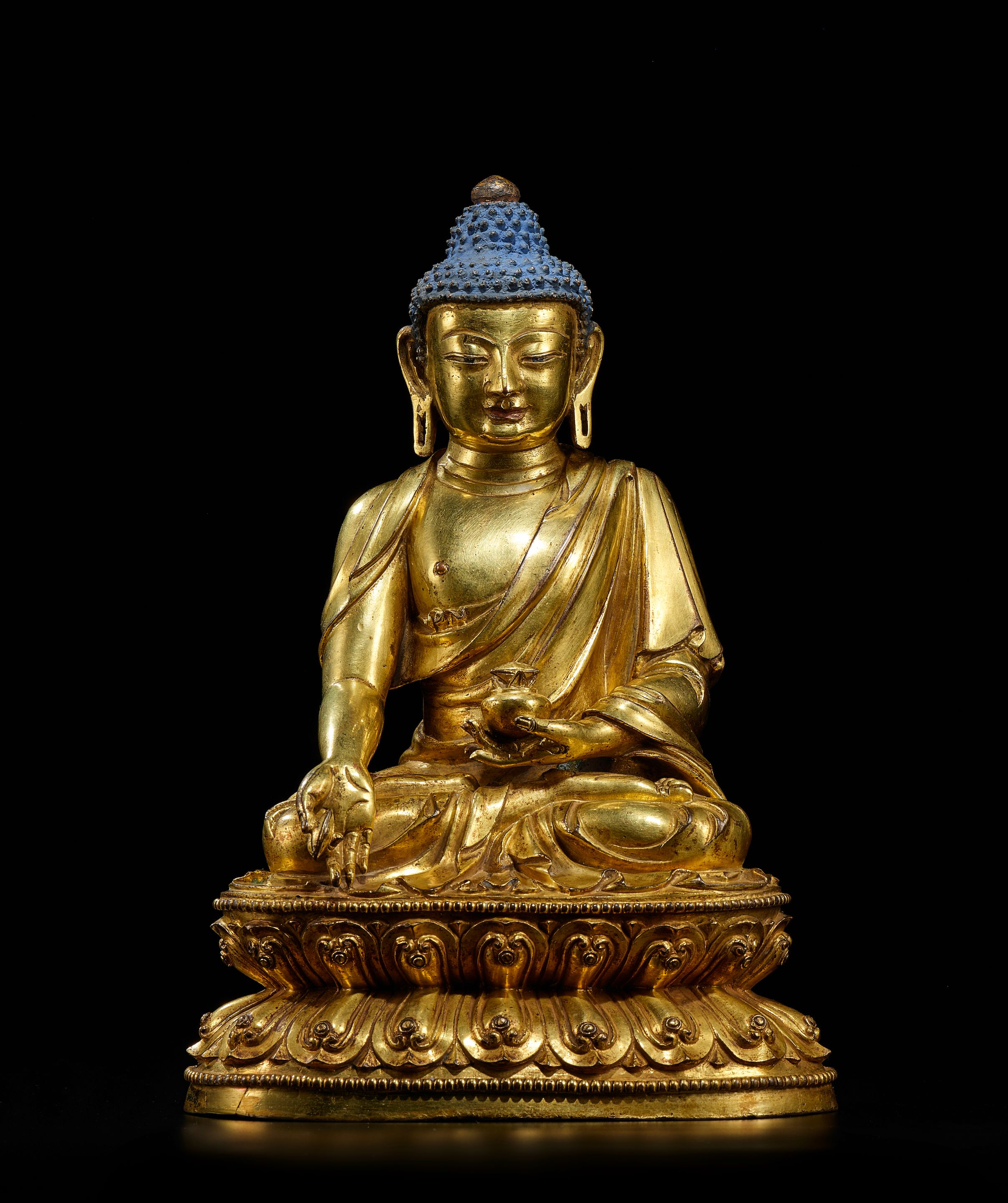
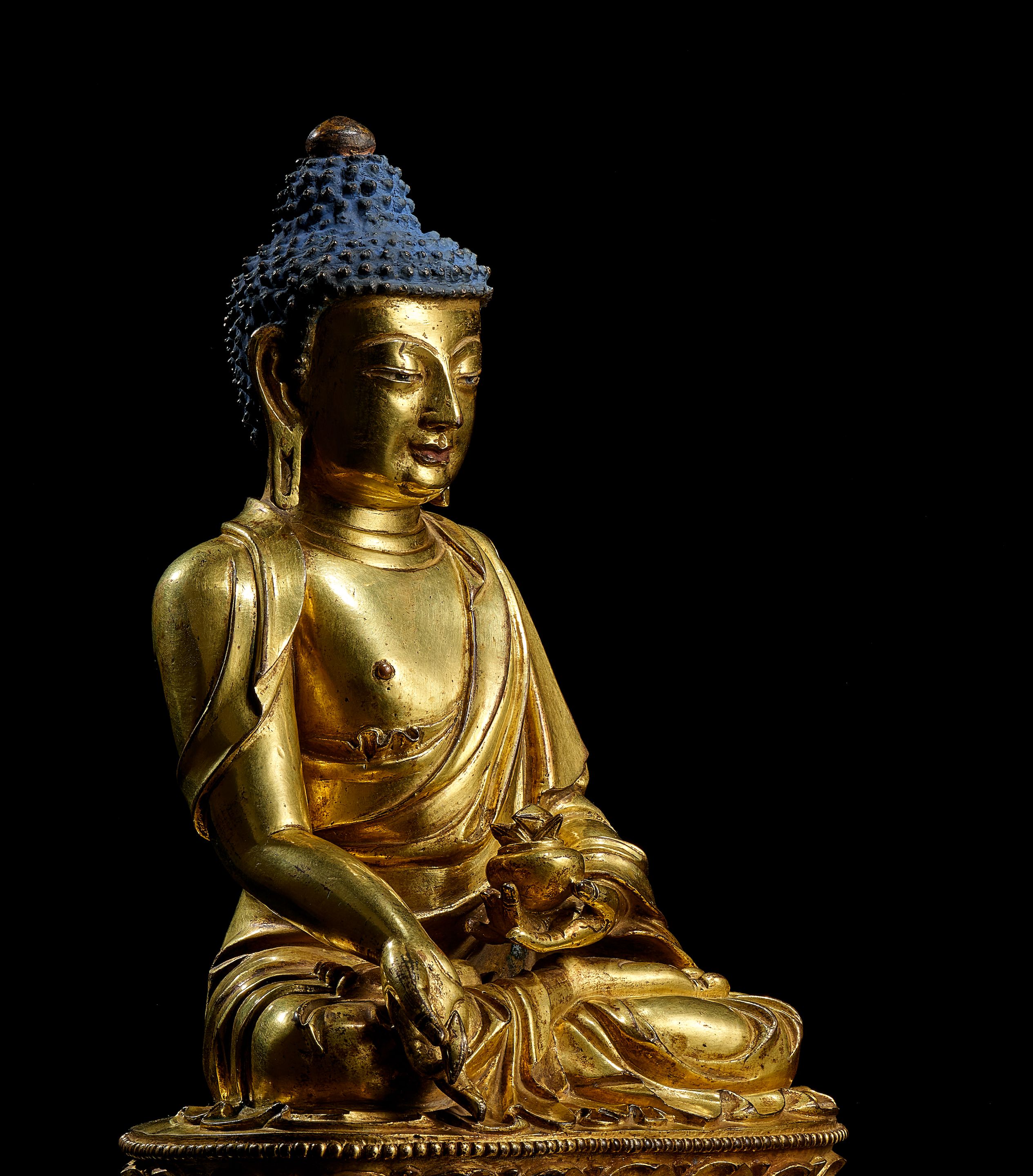
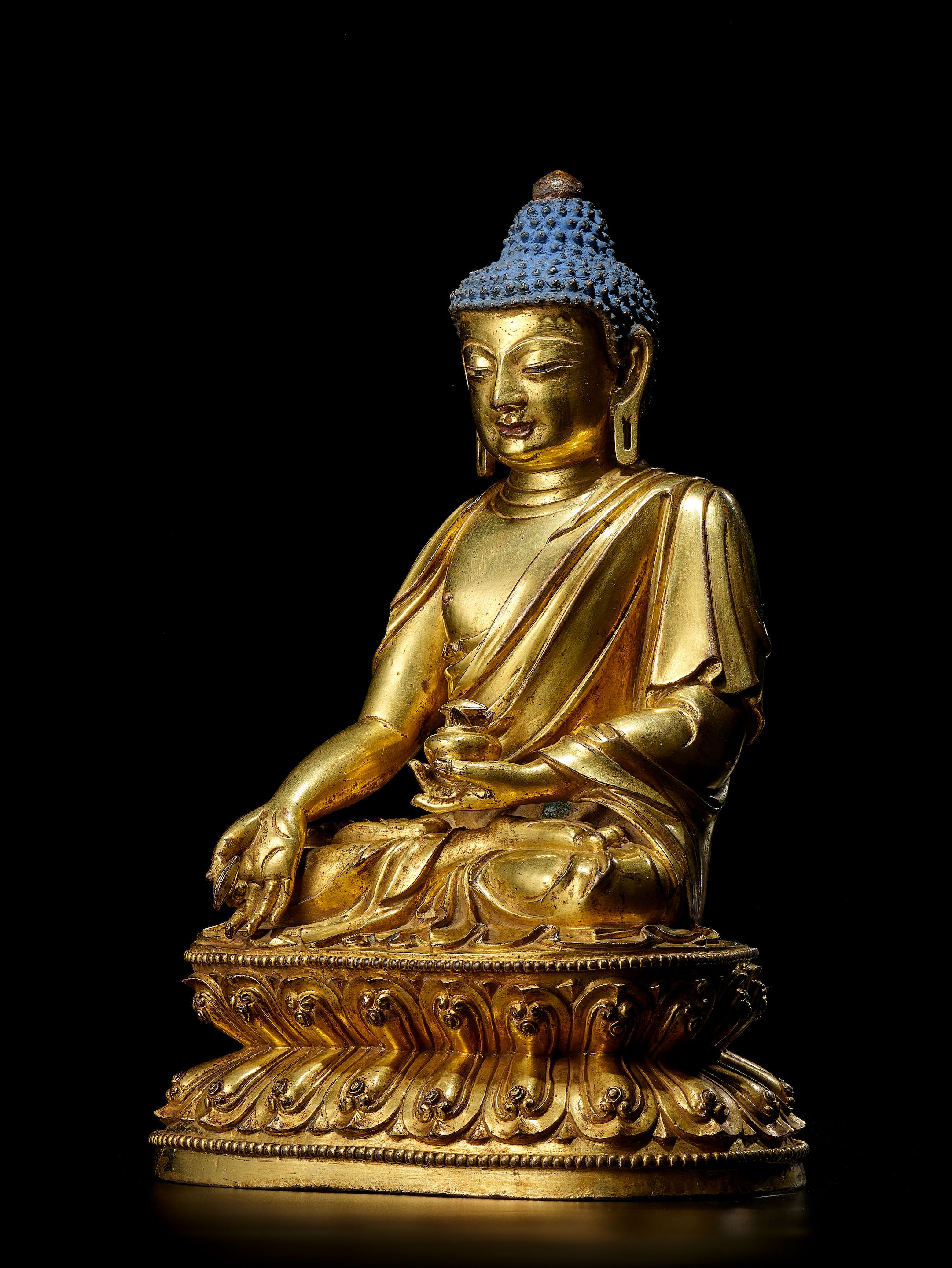 A GILT COPPER ALLOY FIGURE OF BHAISHAJYAGURU
TIBET, 15TH CENTURY
Himalayan Art Resources item no.16980
27 cm (10 5/8 in.) high
Footnotes
西藏 十五世紀 銅鎏金藥師佛像
Skillfully modelled and thickly gilded, this impressive bronze depicts Bhaishajyaguru, the Medicine Buddha, who is worshipped in Mahayana and Vajrayana Buddhism to overcome physical, mental, and spiritual sickness, and to purify karmic debt. In line with classic iconographical prescriptions, his left hand holds a medicine jar containing nectar from the myrobalan plum, and his right hand extends in the wish-granting gesture (varada mudra) while holding a single fruit between the thumb and index finger.
During the Yongle (r.1402-24) and Xuande (r.1425-35) reigns, Chinese imperial workshops produced refined gilt bronze sculptures in a distinct style, exemplified by the widely published Shakyamuni in the British Museum (1908,0420.4), and another Yongle-marked Bhaishajyaguru sold at Christie's, New York, 19 March 2014, lot 1624. To strengthen secular and religious alliances with Tibet, some of these bronzes were gifted to Tibetan hierarchs and monasteries, where they subsequently influenced Buddhist images produced locally. The current lot is a superior example of bronze images created in Tibet in close emulation of the imperial style.
Stylistic parallels can be drawn between the present work and the two aforementioned Yongle bronzes. The classic Yongle style is evident across all three bronzes in the treatment of the robes, namely in the dramatic pleats falling from the left shoulder, tight ruffles around the waist, and rounded folds across the legs. Similarities extend to the plump cheeks and square jaw, as well as the elongated lotus petals evenly spaced around the base between two rows of rounded pearls.
Although following much the same style, subtle stylistic details set this Tibetan Bhaishajyaguru apart from imperial models. For instance, each lotus petal encircling the base culminates in a two-point tip cradling a round jewel, whereas those in the Yongle examples end in a three-point curl. The robes of the Tibetan figure are also afforded slightly thicker folds with harder edges, as if made of a heavier, warmer, less silky material. Additionally, his right shoulder is covered by the robe, a detail absent from the Yongle or Xuande bronzes, but more commonly seen in Ming pieces produced later in the 15th century (see Buddhist Statues of Tibet, Hong Kong, 2003, p.235, no.224; and Sotheby's, Paris, 15 December 2016, lot 129).
Also see another Yongle-inspired Tibetan bronze, ungilded and not as faithful to the imperial style, sold at Bonhams, Hong Kong, 29 November 2016, lot 124.
这尊令人印象深刻的铜像铸造技艺精湛、鎏金丰厚,表现的是药师佛(Bhaishajyaguru,即Medicine Buddha)。在大乘(Mahayana)与金刚乘(Vajrayana)佛教中,信众尊崇药师佛以消除身、心、灵的病患,并净化业债。依照经典的图像学规范,其左手持药钵,内盛诃子(myrobalan plum) 所酿之甘露;右手结施愿印(varada mudra),拇指与食指间捻有一枚果实。
在永乐(Yongle,1402-1424年在位) 与宣德(Xuande,1425-1435年在位) 两朝,中国宫廷作坊生产了一批风格鲜明的精致鎏金铜像,其典范之作包括广为刊载的大英博物馆(British Museum)藏释迦牟尼佛(馆藏号1908,0420.4),以及另一尊带有永乐年款的药师佛像,售出于佳士得纽约,2014年3月19日,拍品1624号。为加强与西藏的世俗与宗教联盟,部分此类铜像被赠予西藏的教派领袖和寺院,进而影响了当地所造的佛教造像。本件拍品正是西藏地区高度模仿宫廷风格而铸造的铜像中的上乘之作。
本件作品与前述两尊永乐铜像之间存在风格上的平行对应关系。经典之永乐风格在三尊造像的袈裟处理上均清晰可辨,即从左肩垂落的戏剧性衣褶、腰际紧束的密褶以及双腿上圆润的衣纹。相似之处还包括丰腴的双颊与方颚,以及莲座上均匀环绕、位于两圈圆珠之间的细长莲瓣。
尽管大体上遵循了相同的风格,但细微的风格特征使这尊西藏药师佛像与宫廷范本有所区别。例如,环绕莲座的每片莲瓣顶端为双叉式(two-point tip),内含一颗圆珠;而永乐例中的莲瓣顶端则为三曲式(three-point curl)。西藏造像的袈裟衣褶亦略显厚重,边缘更硬朗,仿佛采用了更厚实、更温暖、丝质感较弱的材料。此外,其右肩被袈裟覆盖——这一细节不见于永乐或宣德铜像,但更常见于15世纪后期明代造像(参见《佛韵——西藏佛教雕塑》,香港,2003年,第235页,编号224;以及苏富比巴黎,2016年12月15日,拍品129号)。
另见一尊受永乐风格启发的西藏铜像,未鎏金且对宫廷风格的遵循不甚严格,售出于邦瀚斯香港,2016年11月29日,拍品124号。

