
侧边栏

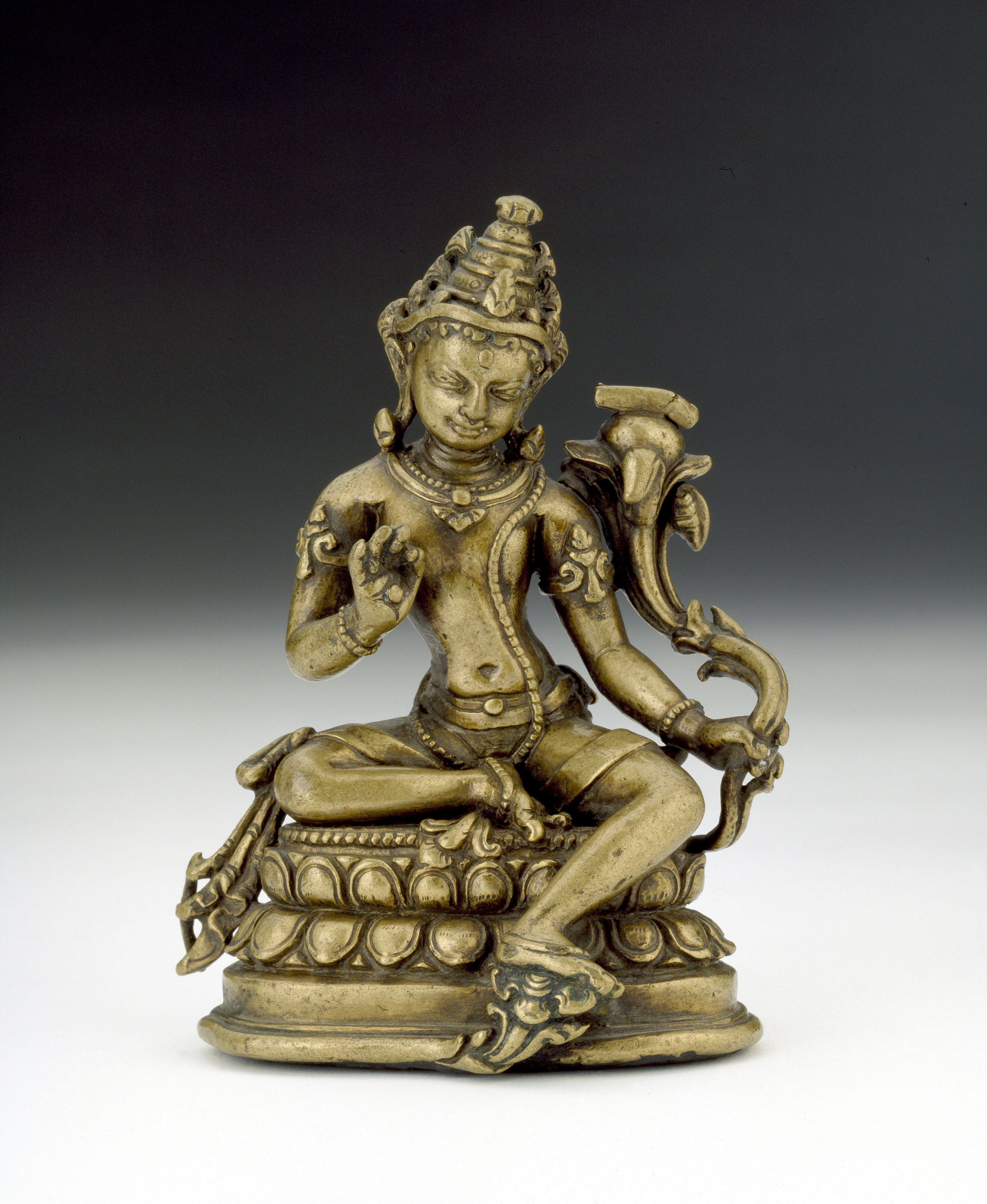
11-12世纪印度帕拉青铜文殊菩萨半跏趺说法坐像(牛津大学阿什莫林博物馆)
尺寸:9.5 x 7 x 4.4 cm
年代:11-12世纪
质地:青铜(bronze)
风格:东北印度 帕拉
来源:牛津大学阿什莫林博物馆
参阅:外部链接
鉴赏:
 佛像网, 编号: 11157
牛津大学阿什莫林博物馆对此造像的注解:
Manjusri is represented here as Manjughosha, the young prince, his body of saffron hue rendered by the yellowish brass alloy. The ritual treatise for this aspect of Manjusri stipulates his position as vamardhaparyanka asana, the left leg pendant on a small lotus, as he clasps a lotus stem with his left hand and presents his right hand in a 'gracious attitude' [1]. Here Manjusri holds the thick lotus stem, to which the sculptor has chosen to add a book above the blossom, as a reminder of his role as the Bodhisattva of wisdom, and his right hand is raised in abhaya mudra, the gesture of protection. This aspect of Manjusri was described in Indian treatises, though without the book. When the Great Pandit of Kashmir travelled in Tibet during the early thirteenth century, he taught this liturgy and so modified the iconography [2]. Subsequent Tibetan treatises stipulate his body colour as white rather than golden, and his position as vajrasana, rather than vamardhaparyanka asana [3].
This small sculpture of Manjusri is masterfully modelled and cast in the mode of Pala India. The posture of his body is both graceful and subtle; no exertion of muscles is apparent. The body is perfectly aligned: the head tilted slightly downwards and to the right, the chin jutting over the right hip, the angle of the head echoed by that of the pendant left leg. A virtually identical treatment of the body and pose is seen in a circa twelfth-century Padmapani in the Nyingjei Lam collection, which also has the fleshy feet with splayed toes, and wears the beaded sacred thread clinging to the chest and following the bend of Manjusri's slender body [4]. This Padmapani is rendered in a dark copper alloy with an elaborate piled coiffure, yet both have the slightly plump face with broad forehead and square jaw, the mouth closed, the full lips forming a very gentle smile, and the hairline with curled twists of hair under the edge of the crown. Although it was characteristic of Pala sculpture to emphasize copper or silver inlay, here it is only the pupils of the eyes which have pitch. The eyes have a pure almond shape with thick upper and lower eyelids. The urna is high in the forehead. The naturalistic ears are extended by the weight of the floret earrings. A single triangle is used as decorative motif in the diadem in front of the tiered crown, the largest triangle is at the centre with two smaller lateral staves at the temples and as finial for each tier [5].
Manjusri's relatively slender body proportions are also similar to sculptures attributed by von Schroeder to Indian artists working in Tibet during the eleventh to twelfth century. Although his body is less elongated and less languorous than earlier Pala models, this sculpture retains specific Pala stylistic elements, such as the short fabric ties at the belt, folded just at the hip [6]. The massive legs have no calf muscle, and the feet are rather small with a pronounced splay of the toes and plump pads of feet, again characteristics often seen in Pala images [7].
The lotus pedestal also follows the style of Pala India, with two tiers of nonaligned petals and beading. Although Manjusri himself is fully modelled in the round, with the distinctive cross band behind the head to retain the two lateral fans of the crown [8], here the pedestal does not have petals all across the back of the sculpture although the tiers are differentiated. Lacking any inscriptional evidence, the provenance of this sculpture cannot be determined precisely, but it was clearly produced within the Buddhist milieu of the late Pala dynasty in Eastern India. Its small size, light weight, and pristine condition suggest that it was long ago imported to Tibet, where it was preserved until the mid-twentieth century.
[Footnotes:]
1 de Mallmann, Introduction a l'iconographie du tantrisme bouddhique, p. 252, cites the Sadhanamala, 50, 69, and 70, for a description of this aspect of Manjusri and the name Manjughosha; also p.10, with explanation of this asana as pertinent to forms of Manjusri.
2 Shakya Shri Bhadra, the Great Pandit of Kashmir, taught in Tibet from 1204 to 1213, according to The Blue Annals, tr. Roerich, pp. 82, 103, et passim.
3 See this iconographic example in Willson and Brauen, Deities of Tibetan Buddhism, no. 185: White Manjughosha in the tradition of the Great Pandita of Kashmir. See Huntington and Huntington, Leaves of the Bodhi Tree, pls. 146-7, for two 13th-14th-century Tibetan sculptures of Manjusri in this iconography, both strongly influenced by Pala aesthetic models.
4 Weldon and Casey Singer, The Sculptural Heritage of Tibet, pl. 6: Padmapani, h. 10.8 cm, rendered in a copper alloy with gold, copper, silver, and semi-precious gems, attributed to Eastern India, c. twelfth century. I thank David Weldon and Ulrich von Schroeder for discussion of the differentiation between Pala images made in India and those made in Tibet following the Pala aesthetic.
5 This model of tiered crown inspired by Pala India is frequently found in Tibetan paintings attributed to the late eleventh to thirteenth century, see Kossak and Casey Singer, Sacred Visions, plates 4, 5, 8, etc.
6 See the stone sculpture of Manjusri in von Schroeder, Buddhist Sculptures in Tibet, vol. 1, pl. 120B-C, attributed to an Indian artist working in Tibet.
7 This proportion of legs and feet is also seen in the Padmapani of the Nyingjei Lam collection cited earlier; compare also von Schroeder, op. cit., vol. 1, pl. 110C, for a brass Tara described as Indian work in Tibet in the late Pala style, c. twelfth century. For very similar legs and feet in twelfth century Pala stone sculptures see Huntington, The 'Pala-Sena' Schools of Sculpture, pls. 80, 84.
8 According to von Schroeder, this band is characteristic of late Pala sculpture (personal communication); see e.g von Schroeder, op. cit., vol. 1, pl. 97 B-C, for a late Pala Manjusri whose crown is retained precisely in this manner.
In: Heller, Amy, Early Himalayan Art (Oxford: Ashmolean Museum, 2008)
此尊文殊菩萨表现为少年王子形象的曼殊瞿沙(Manjughosha),其赭黄色身色由淡黄色黄铜合金呈现。关于此化现文殊的仪轨规定其姿态为左腿半垂莲上(vamardhaparyanka asana),左手握莲茎,右手施“慈悲印”(gracious attitude)[1]。此像中,文殊握持粗壮莲茎,匠人特意在莲华上方增刻经箧,以彰显其智慧菩萨的本誓;右手扬起施无畏印。此种文殊化现虽载于印度仪轨,然彼时并无经箧之制。及至十三世纪初,迦湿弥罗大班智达入藏传此教法,始增经箧而改图像[2]。后世藏文仪轨则规定其身色为白而非金黄,坐姿为金刚座(vajrasana),而非半垂腿坐(vamardhaparyanka asana)[3]。
此尊小型文殊造像以帕拉风格精工铸作,造型圆融微妙,全无筋肉凸显之态。身姿匀称:头微右下倾,下颌与右胯相应,垂落左腿与之呼应。Nyingjei Lam收藏一尊约12世纪莲花手观音,其身形姿态与此像几乎全同,足部同样丰腴、趾间舒展,圣线缀珠贴胸,随文殊纤细身姿婉转而下[4]。彼像以深色铜合金铸就,发髻繁复;然二像皆面庞微丰、广额方颐,双唇闭合、饱满含笑,发际线于宝冠下缘呈卷曲状。帕拉造像虽以铜银镶嵌为特征,此像仅瞳孔处施黑漆。双目纯杏形,上下眼睑丰厚。白毫位于额际高处。耳垂因花形耳饰而自然拉长。层叠宝冠正面以三角形为装饰母题——中央最大,两侧各一小三角形延伸至鬓角,每层冠饰亦以三角收顶[5]。
文殊身形相对纤细,亦与von Schroeder归为11至12世纪入藏印度匠人所作造像相似。虽较早期帕拉范式略显收敛,此像仍保留帕拉风格元素,如腰带处短襻恰悬于胯际[6]。腿部粗壮而无腓肌,双足偏小、趾间舒展、足掌丰腴,此亦帕拉造像常见特征[7]。
莲座亦循帕拉风格,双层莲瓣错落,缀连珠纹。文殊虽作全方位圆雕,脑后设横带以固定宝冠双侧垂饰[8],然莲座背部未通雕莲瓣,仅以双层区分。虽无铭文可确证 provenance,此像显属东印度帕拉晚期佛教语境之作。其体量小巧、质地轻盈、品相如新,暗示其早年入藏,供奉至二十世纪中叶。
注释:
[1] de Mallmann《密宗佛教图像学导论》页252引《成就法鬘》第50、69、70种,述此文殊化现及“曼殊瞿沙”之名;同书页10释此坐姿与文殊诸化现之关联。
[2] 据《青史》(Roerich译本页82、103等),迦湿弥罗大班智达释迦室利跋陀罗于1204至1213年间在藏传法。
[3] 参见Willson与Brauen《藏传佛教尊神》第185号:迦湿弥罗大班智达所传白曼殊瞿沙。Huntington《菩提树叶》图版146-7为两尊13至14世纪藏传此文殊像,皆深受帕拉美学影响。
[4] Weldon与Casey Singer《西藏雕塑遗产》图版6:莲花手观音,高10.8厘米,铜合金嵌金、铜、银及半宝石,东印度,约12世纪。承David Weldon与Ulrich von Schroeder指教,辨析印度本土帕拉造像与西藏仿帕拉风格造像之差异。
[5] 此种源自帕拉的层叠冠式,常见于11至13世纪藏传唐卡,参见Kossak与Casey Singer《神圣视野》图版4、5、8等。
[6] 参见von Schroeder《西藏佛教雕塑》卷1图版120B-C石雕文殊,归为入藏印度匠人作品。
[7] 此种腿足比例亦见于前引Nyingjei Lam收藏莲花手观音;又见von Schroeder前揭卷1图版110C黄铜度母,称其为约12世纪西藏所作帕拉晚期风格印度作品。12世纪帕拉石雕中相似的腿足,参见Huntington《帕拉-塞那雕塑流派》图版80、84。
[8] 据von Schroeder私信,此横带为帕拉晚期造像特征;参见von Schroeder前揭卷1图版97 B-C帕拉晚期文殊,其宝冠正以此法固定。

