
侧边栏

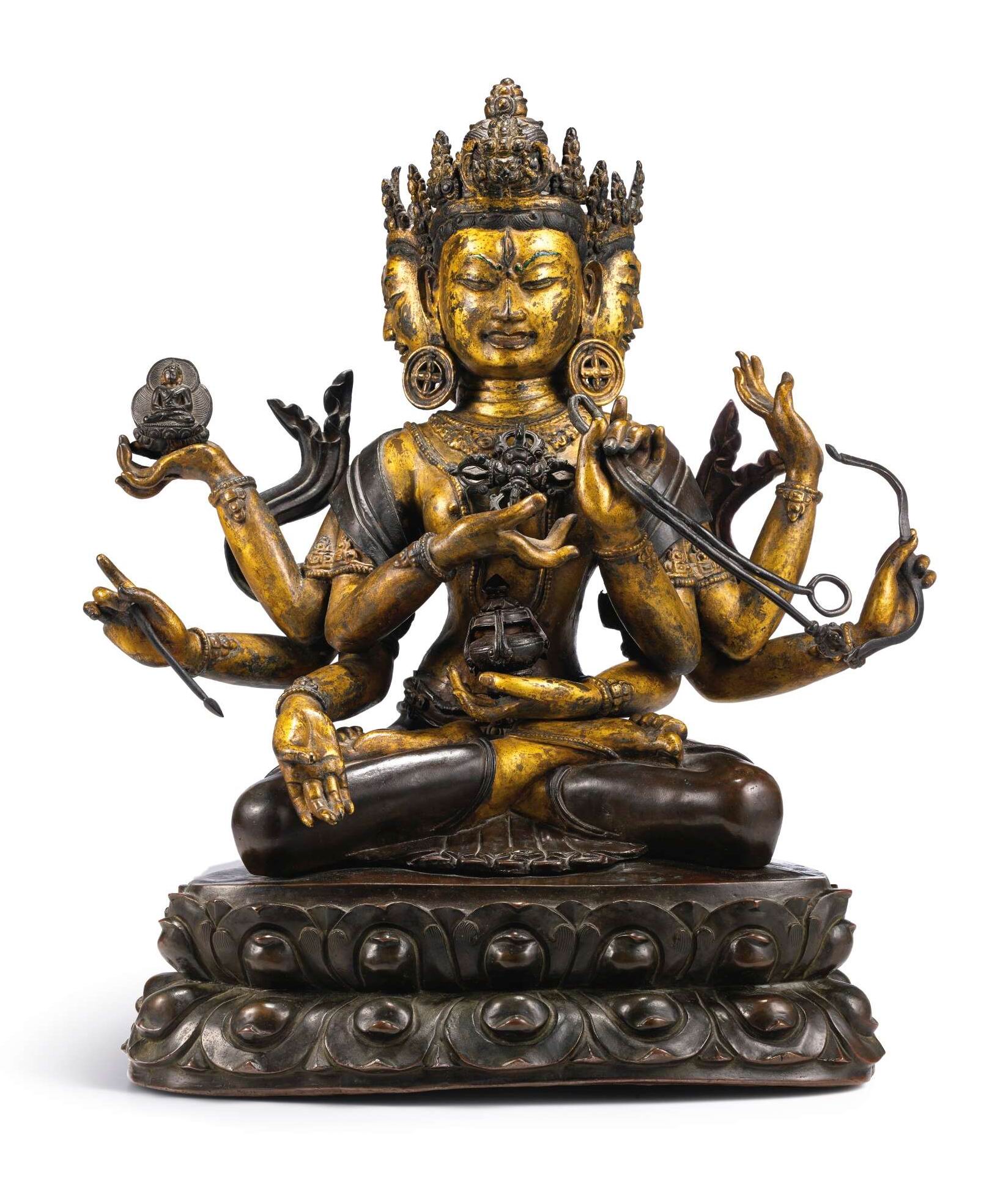
清代乾隆铜鎏金尊胜佛母(香港苏富比)
尺寸:高38.5cm
年代:清代
质地:铜鎏金
风格:乾隆
来源:拍卖会
成交:1,250,000港元(2016.04)
参阅:香港苏富比
鉴赏:
 佛像网, 编号: 33035
N IMPERIAL GILT-BRONZE FIGURE OF USHNISHAVIJAYA
QING DYNASTY, QIANLONG PERIOD
the three-headed, eight-armed goddess superbly cast seated on a double lotus pedestal in vajraparyankasana, carrying in the right hands a vishvavajra raised to the chest, Amitabha Buddha seated on a lotus, an arrow and the varada mudra, the left hands holding a noose with the tarjani mudra, the abhaya mudra, a bow and the nidana-kumbha vase of life, her three faces in meditative expression with eyes cast down, framed by large wheel-shaped earrings and wearing a diadem centred with a kirtimurka and seated Vairocana, the hair arranged in an elaborate high chignon, adorned in layered chains of jewellery and wearing a celestial scarf draped across the shoulders with billowing ends, the exposed skin of the goddess gilt, the base unsealed
Provenance
A private French collection, assembled in the 1970s, by repute.
法国私人收藏,收藏搜集于1970年代
Catalogue Note
Large powerfully cast bronze images of Tibetan deities were commissioned at the Qianlong court for furnishing Imperial palaces, especially those temples of the Mountain Resort, the Summer Palace at Rehol. Examples still preserved at Chengde include a bronze figure of Amitayus seated on a lotus throne, similarly constructed as the current figure, with cold-gilded face, dated 1785, illustrated by Wang Jiapeng, Buddhist Art from Rehol. Tibetan Buddhist Images and Ritual Objects from the Qing Dynasty Summer Palace at Chengde, Taipei, 1999, pp.52-3, pl. 6.
See also a Central Tibetan prototype, a bronze figure of Ushnishavijaya from the late 17th/early 18th century, illustrated ibid., p.92, pl. 26. The current figure closely adheres to the earlier Central Tibetan example. It is similarly constructed with near-identical positioning of the iconography, crisply cast lotus base left ungilded, and sensitively rendered cold-gilded three heads, with the eight hands arranged in the same manner with their respective implements. For gilt-bronze figures of Ushnishavijaya in Western collections, see an 18th century Tibetan figure in the Royal Ontario Museum, Toronto, illustrated www.himalayanart.org/items/77551, and a Chinese figure from the J.P.H.Y. collection, Belgium, illustrated by Ulrich von Schroeder, Indo-Tibetan Bronzes, Hong Kong, 1981, pl. 157C.
Ushnishavijaya, 'Victorious Crown Ornament, the goddess of long-life, is one of three special long-life deities along with the Buddha Amitayus and White Tara. Together they are known as the Three Long-life Deities of Tantric Buddhism.. In the words of Jamyang Kyentse Wangpo (1820-1892), Ushnishavijaya is “the colour of an autumn moon; with three faces, white, yellow and blue and eight hands. Each face has three very large eyes. The first right hand holds a visvavajra, second a white lotus with Amitabha residing, third an arrow and the fourth in supreme generosity. The first left holds a vajra lasso, second a bow, third bestowing protection and fourth in meditative equipoise holding an auspicious nectar vase; complete with silks and jewel ornaments, seated in [vajra] posture. Within the outer circle of the stupa, on the right [side of the chaitya], above a moon is Avalokiteshvara with a body white in colour; the left hand holds a lotus. On the left [of the chaitya], above a sun is Vajrapani, blue; the left hand holds an utpala with vajra; standing in a peaceful manner and adorned with silks and jewels.”
An Imperial thangka of Ushnishavijaya, commissioned as part of a set for the Xumifushou Temple, a replica of the Tashilhunpo of Tibet, the monastery of the Panchen Lama, built by the Qianlong Emperor to celebrate his seventieth birthday in 1780, was sold in these rooms, 7th April 2015, lot 3653. See also a thangka of Ushnishavijaya in the Palace Museum, Beijing, illustrated in Cultural Relics of Tibetan Buddhism Collected in the Qing Palace, The Forbidden City Press, Hong Kong, 1992, pl. 19-1; and another thangka of Ushnishavijaya, illustrated in Asian Art Gallery, Chinese Imperial Patronage: Treasures from Temples and Palaces, Vol. II, London, 2005, pp. 106-7, pl. 40, where the authors point out that Rolpal Dorje, the National Preceptor under the Qianlong Emperor and supreme religious authority, dedicated the second floor of the temple to the cult of Ushnishavijaya, and that the largest and most frequent rituals were performed there by a contingent of fifty lamas.
大型有力铸就的西藏神祇青铜像,是由乾隆宫廷委托制作,用于陈设于皇家宫殿,尤其是避暑山庄(热河行宫)中的那些寺庙。仍保存在承德的例子包括一尊坐于莲花宝座上的无量寿佛铜像,其结构与本尊造像相似,面部饰有鎏金,年代为1785年,见于王家鹏所著《热河佛教艺术:清代承德避暑山庄的藏传佛教造像与法器》,台北,1999年,第52-3页,图版6。
另见一尊西藏中部的原型,为17世纪末/18世纪初的佛顶尊胜佛母铜像,同上书,第92页,图版26所示。本尊造像严格遵循了较早的西藏中部范例。其结构相似,图像元素的定位几乎完全相同,清晰铸造的莲花底座未施鎏金,三个头像施以冷金且刻画细腻,八臂以相同方式排列并持有各自法器。关于西方收藏中的尊胜佛母鎏金铜像,见多伦多皇家安大略博物馆藏一尊18世纪西藏造像,载于www.himalayanart.org/items/77551;以及比利时J.P.H.Y.收藏中的一件中国造像,载于乌尔里希·冯·施罗德著《印度与西藏的铜像》,香港,1981年,图版157C。
尊胜佛母(Ushnishavijaya),意为“胜利的冠冕”,是长寿女神,与无量寿佛和白度母同为三位特殊的长寿本尊。三者合称为密宗佛教的“长寿三尊”。用蒋扬钦哲旺波(1820-1892)的话来说,尊胜佛母“身如秋月;具三面,白、黄、蓝色,八臂。每面各具三眼。右第一手持十字金刚杵,第二手持白色莲花,上有阿弥陀佛住留,第三手持箭,第四手结施胜印。左第一手持金刚索,第二手持弓,第三手结施无畏印,第四手结禅定印,托举吉祥宝瓶;身着天衣及珠宝严饰,结跏趺坐(金刚坐)。于佛塔外圈之内,在(佛塔)右侧,月轮之上,是观音菩萨,身白色;左手持莲花。在(佛塔)左侧,日轮之上,是金刚手菩萨,身蓝色;左手持带金刚杵的邬波罗花;寂静而住,以天衣及珠宝为饰。”
一幅御制尊胜佛母唐卡,作为须弥福寿寺(为庆祝乾隆皇帝1780年七十寿辰而建,是班禅喇嘛驻锡地扎什伦布寺的复制品)的一套陈设的一部分而委托制作,曾售于本拍卖行,2015年4月7日,拍品3653号。另见北京故宫博物院藏一幅尊胜佛母唐卡,载于《清宫藏传佛教文物》,紫禁城出版社,香港,1992年,图版19-1;以及另一幅尊胜佛母唐卡,载于《亚洲艺术画廊:中国皇家供养:寺庙与宫殿珍宝》第二卷,伦敦,2005年,第106-7页,图版40,书中作者指出,乾隆皇帝的国师、藏传佛教最高宗教权威章嘉·若必多吉(Rolpal Dorje)将寺庙二层专门用于尊胜佛母的供奉,并由五十名喇嘛组成的僧团在那里举行规模最大、最频繁的仪式。

