
侧边栏

元代石雕观音菩萨头像(巴黎佳士得)
尺寸:高57cm
年代:元代
质地:石雕
风格:中原
来源:拍卖会
成交:349,500欧元(2014.10)
参阅:巴黎佳士得
鉴赏:
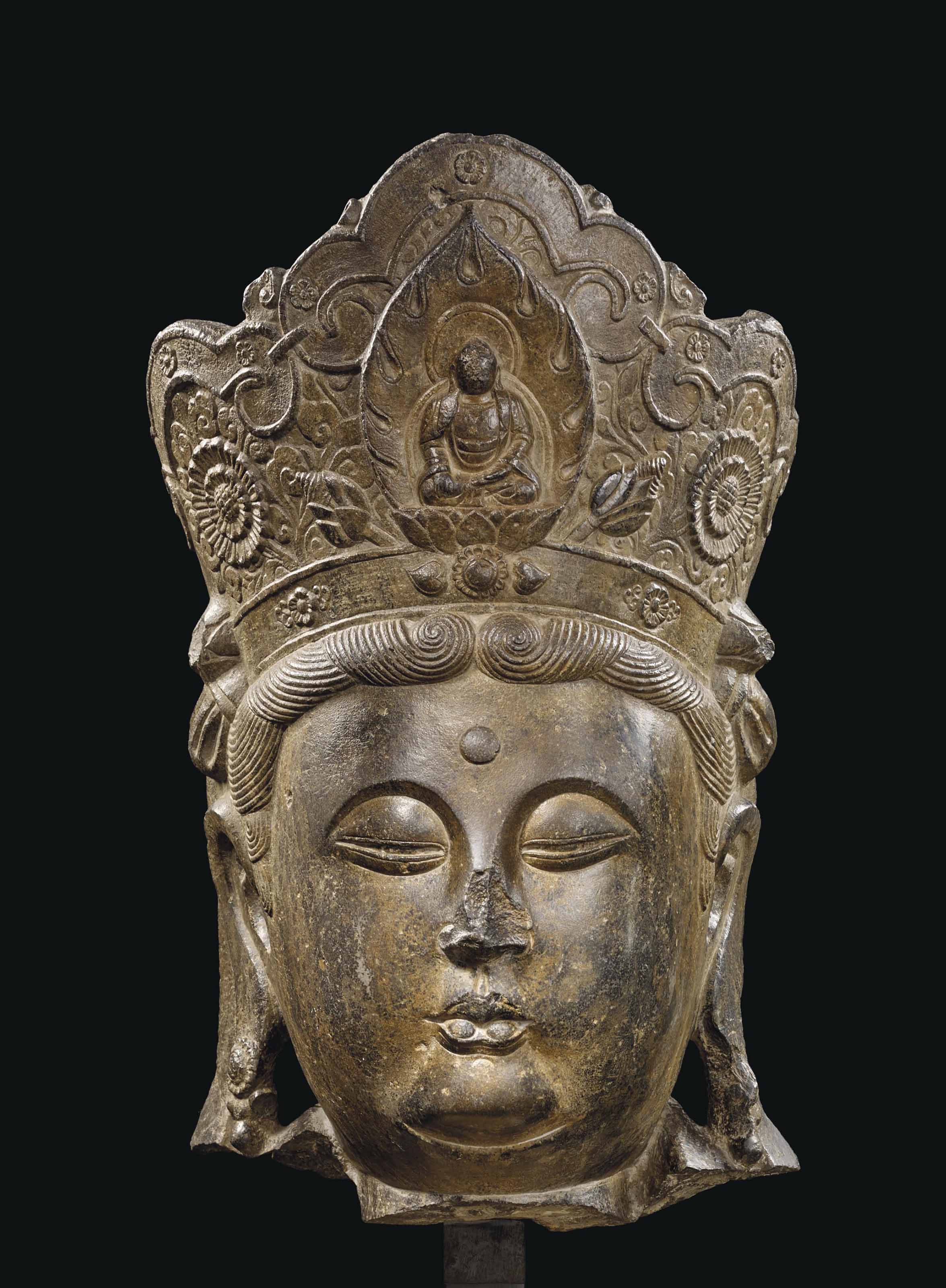 RARE ET IMPORTANTE TETE DE GUANYIN EN CALCAIRE
CHINE, DYNASTIE YUAN (1271-1368)
The oval face is sculpted with a serene and meditative expression. It displays strongly arched eyebrows, over almost closed eyes, connected to the nose by a narrow bridge. His forehead is adorned with the urna. The sunken, almost almond-shaped eyes are have heavy eyelids, which reinforces the linear effect produced by the eyebrows. The meticulously carved heart-shaped lips suggest a faint smile, and the chin is accentuated by an incision. Both ears are executed with elongated earlobes decorated with small rosettes. Various curling locks frame the face while the rest is combed backwards in a chignon on top of his head, and is kept together by a high, scalloped-shaped crown, which is carved in shallow relief with three arches above a lotus flower flanking a minute figure of Buddha Shakyamuni. The latter is seated on a lotus base in front of a flaming mandorla. A pair of knotted ribbons is attached to both sides of the crown with some small streamers falling down behind the ears.
鹅蛋形脸庞上刻画出宁静沉思的表情。双眉高挑,覆于几乎闭合的双目之上,眉心以窄桥与鼻梁相连。额头饰有白毫(urna)。内陷的杏仁形双眸眼睑厚重,进一步强化了眉毛所营造的线条感。精心雕琢的心形嘴唇微带笑意,下颌以阴刻线条突出。双耳耳垂修长,饰有小花形耳饰。数缕卷曲的发丝环绕脸庞,其余头发向后梳理,在头顶结成发髻,由一顶高耸的扇形宝冠束拢。宝冠以浅浮雕手法刻出三座拱门,下方饰以莲花,拱门两侧供奉一尊微小的释迦牟尼佛坐像。释迦佛坐于莲花座上,身后饰有火焰形背光。宝冠两侧各系一组结带,数条小飘带垂落耳后。
来源:
Acquired at auction at Drouot (sale curated by Michel Beurdeley), Paris, in the 1970s.
著录:
John Walker,Experts Choice 1000 Years of the Art Trade, Seventh
International Exhibition Presented by C. I. N. O. A. Virginia
Museum of Fine Arts, Richmond, Virginia, Stewart, Tabori &
Chang Publishers, New York, 1983, page 21.
展览:
La Biennale des Antiquaires, September-October 1980.
Virginia Museum of Fine Art, 1983.
This magnificent and large head presents the bodhisattva of Compassion and Mercy. The iconography of the god was originally created on Indian soil and brought to China by monks at the beginning of the Christian era. In the early phase of Chinese Buddhism stone and bronze examples of the god of Compassion were following these Indian iconographic treatises by depicting him as a male god. By the end of the Tang period (618-907) the depiction of Avalokiteshvara or in Chinese Guanyin had gradually become feminized to reach a climax during the Song dynasty (960-1279), when the majority had acquired a definite female appearance. During this period of transition the mercy aspect of the god was emphasized resulting in these stronger female features. The presented superb sculpted head shows the result of this development, which had become the hallmark for all Guanyin representations from now onwards.
This head surpasses in quality known examples in public institutes like the Rietberg Museum, Zurich (O. Siren, Chinese Sculptures in the von der Heydt Collection, Museum Rietberg, Zurich 1959, plate 57), Metropolitan Museum (O. Siren, Chinese Sculpture: From the Fifth to the Fourteenth Century, vol. II, SDI Publications, Bangkok 1998, plate 563 C), Wereldmuseum Rotterdam (De Schatten van het Wereldmuseum Rotterdam, Wereldmuseum Rotterdam 2000, p.39) and Musée Guimet.
这尊宏伟的大型首像呈现的是大慈大悲的菩萨。这一神祇的图像学范式最初诞生于印度本土,并在公元纪元之初由僧人传入中国。在中国佛教的早期阶段,慈悲之神的石质与铜质造像遵循这些印度图像学论典,将其表现为男性神祇。至唐代(618-907)晚期,观音菩萨(梵文 Avalokiteshvara,中文称 Guanyin)的形象已逐渐女性化,并在宋代(960-1279)达到顶峰,此时多数造像已呈现出明确女性面容。在这一过渡时期,神祇的慈悲面相被强调,因而出现了这些更为强烈的女性特征。这尊精美的雕刻首像正是这一发展的结果,自此成为所有观音造像的标志。
就品质而言,此首像超越了诸多公立机构中的已知名品,如苏黎世里特贝格博物馆(Rietberg Museum, Zurich)(见 O. Siren 著《Chinese Sculptures in the von der Heydt Collection》,里特贝格博物馆,苏黎世,1959年,图版57)、大都会艺术博物馆(Metropolitan Museum)(见 O. Siren 著《Chinese Sculpture: From the Fifth to the Fourteenth Century》第二卷,SDI Publications,曼谷,1998年,图版563 C)、鹿特丹世界博物馆(Wereldmuseum Rotterdam)(见《De Schatten van het Wereldmuseum Rotterdam》,鹿特丹世界博物馆,2000年,第39页)以及吉美博物馆(Musée Guimet)所藏之例。

