14世纪(1365年)尼泊尔唐卡六臂财续佛母(伦敦苏富比)
尺寸:104cm by 86.4cm
年代:14世纪, DATED 1365
质地:唐卡
风格:尼泊尔
来源:拍卖会
成交:825,250英镑(2011.05)
参阅:伦敦苏富比
鉴赏:
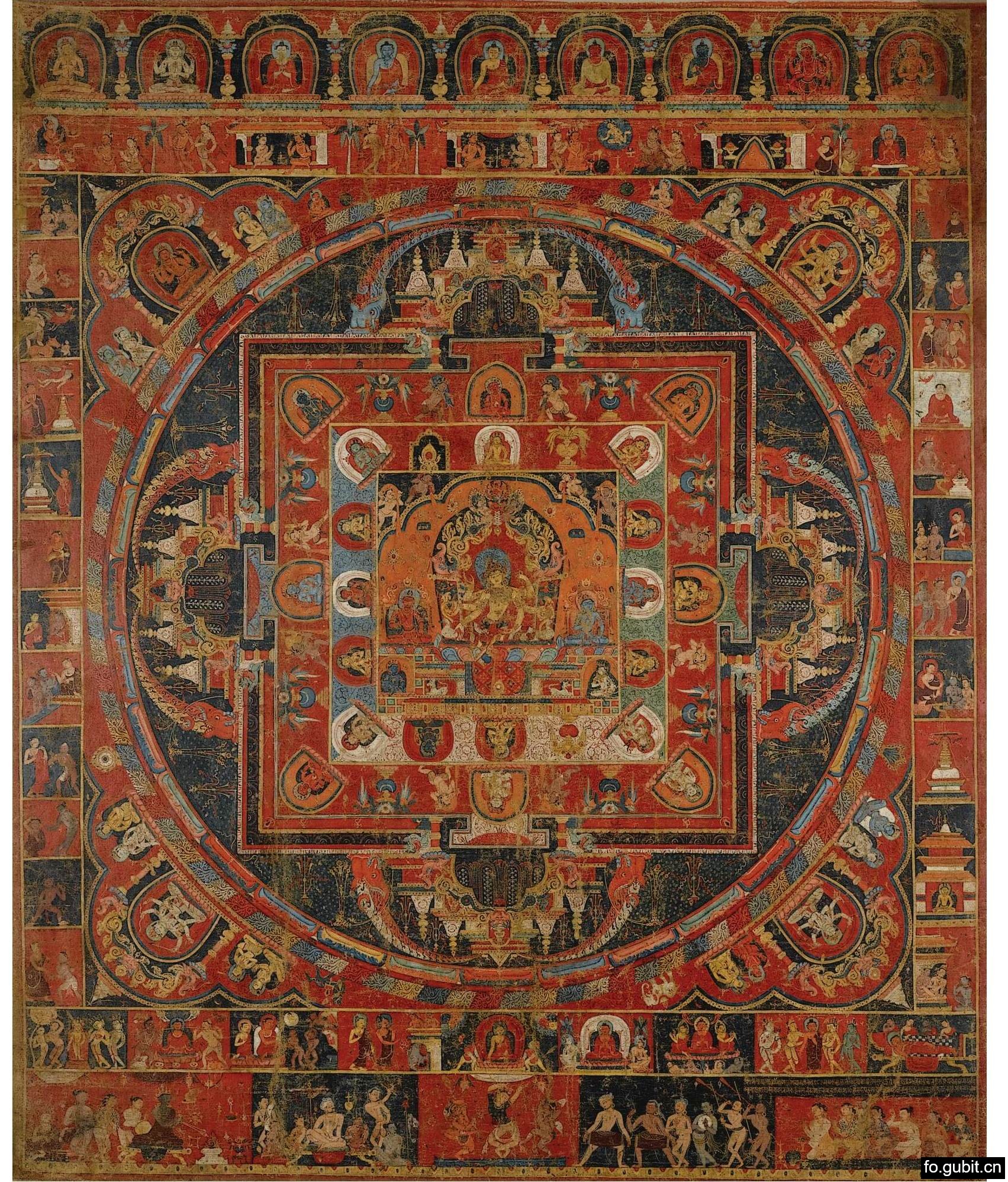 VASUDHARA MANDALA, BY JASARAJA JIRILA, NEPAL, DATED 1365
Distemper on cloth; with the six-armed goddess seated in lalitasana on a lotus at the centre of the mandala palace, holding a bound volume of the prajnaparamitasutra, a sheaf of grain and a kalasha in her left hands, her right with bountiful gestures and one supporting a triratna emblem, a tall torana arch rising behind with vyala at either side supported by hamsa, two makara above emerging from swirling waters with the snake-tails of naga appearing from the mouth of the kirtimukha mask at the apex, all supported by a lion throne within a cusped niche strewn with gold, gems, caskets and jewelled emblems poured from sacks held by corpulent attendants above, with seated bodhisattvas to either side of Vasudhara, Avalokiteshvara to her right and Vajrapani to her left, the central shrine bordered on four sides by registers of deities together with vases of abundance and gems on red, green, blue and white scrollwork grounds, with an outer concentric register of deities and kalasha vases and attendants bearing sacks of gems, all on a red scrollwork ground leading to the four elaborate palace gates beneath vajra-form arches, the palace set in midnight blue space contained within a circular multicoloured lotus and flame border, with cusped arches surmounted by stupas at the outer corners housing shrines to the four-armed Prajnaparamita upper left and multi-armed Pancha Raksha goddesses with kneeling adorants and auspicious emblems, and with a final concentric register depicting scenes from the Suchandra avadana on three sides, and episodes from the life of the Buddha below including the miraculous birth, the disturbance of the Buddha's meditation by cowherds, the worship of the Buddha by monkeys, the subjugation of the rogue elephant Nalagiri, the assault of Mara, the first teaching, the miracle of multiplication at Srivasti, the audience with the Hindu gods Indra, Shiva, Brahma and Vishnu, and the Parinirvana, the uppermost register with Maitreya at the left, Shadakshari, Vairochana, Akshobya, Ratnasambhava, Amitabha, Amoghasiddhi, Avalokiteshvara, and Manjushri to the right, and the lower register depicting scenes of ritual and dance to music, with the donor family depicted to the right beneath a two-line Newari inscription.
Provenance
Doris Wiener, New York, circa 1970
Exhibited
Nepal: Where the Gods are Young, The Asia Society, New York, 1975
Himalayas: An Aesthetic Adventure, The Art Institute of Chicago, 2003
Literature
Thanka Art, pl.T.; Art News, vol.73, March 1974, no.3, p.97
Pal 1975, no.43
Pal 1978b, pl.72
Pal 2003, no.32, p.60
Catalogue Note
Inscription:
om sristanyayaksi,srimani sreyostu samvat 485 magha krsna titithau yokoche khila xx paksa khadvasurisa datara krta iya vasudhara pata
acaju srijulo vahara raju jusana vamtasohasake dajaka guthisamuhaske dunta juro xxx ju jasaraja jirilasyam liksita jasapta subhamastu
“The great milk Yakshi, the great Jewel. May it be auspicious. In the Year 485 [C.E. 1365] on the Third day or tithi of the dark half of The month of Magha [January-February] the inhabitants of Yokoche … Paksa, and Khadvasuri, The donors, commissioned this painting of Vasudhara. The priest teacher (acaju, in Sanskrit, acarya) sri Julo, Vahara, and Raju are … responsible for establishing the Guthi. Jasaraja Jirila painted (liksita) this painting (jasapta)”
This sumptuous Vasudhara mandala is the earliest recorded Nepalese paubha that contains a date within its dedicatory inscription, and was painted in 1365 by Jasaraja Jirila. It may be assumed that Jasaraja Jirila was a Newar from the Kathmandu valley. Although nothing is known of the artist mentioned in the inscription his work remains one of the finest and most important of the relatively small corpus of early Buddhist and Hindu paintings from the Kathmandu Valley. Details are drawn with consummate finesse, charm and sensitivity, no more so than in the animated scenes of worship, music and dance below. Choice pigments are used throughout creating a vibrant palette, with subtle shades complimenting the predominant vermillion and midnight blue that define the early painting of Nepal. The ordered geometric schema belies the dynamism in the structure of the painting, with a sense of radiating expansion from the calm sanctuary at its centre. The distinctive shrines with cusped arches at the ordinal points are a common feature of Vasudhara mandalas from this early period, cf. a mandala of circa 1400 in a private collection, see Pal 2003, cat. no.33. And the overall format is typical for Newar painting with the inclusion of ritual scenes and portraits of the painting's donors below; and with each framed episode from the Suchandra avadana and the Great Miracles depicted with alternating and acutely contrasting backgrounds, deep red to dark blue or white, a conventional Nepalese device used already in 12th century manuscript cover illustration, see Zwalf 1985, pls.169, 172. A consecratory practise peculiar to Nepalese painting, of placing a tablet of gold beneath the painted surface at the heart of the principal deity, may explain the darkened square seen on the upper body of Vasudhara, see Bruce-Gardner 1975, pp.378-81.
The Buddhist goddess Vasudhara is worshipped in Nepal as bestower of prosperity, and is depicted at the centre of the painting holding emblems of wealth and abundance and symbols of the Buddhist faith. The scenes in the side registers and the lower of the two upper registers refer to episodes from the legend of Suchandra whose son stole bricks from a stupa: the sacrilegious act resulted in the breakdown of the family and the loss of their wealth. Suchandra supplicated the Buddha with meagre offerings, all that he could muster in his straightened circumstances. The Buddha advised that he worshipped Vasudhara, and his wealth was restored. The story promotes the devotional worship of the goddess and is often included in Nepalese Vasudhara mandalas, see Pal 1975, p.82. Indeed Vasudhara is one of the most popular goddesses in Nepal. According to mythology she is the consort of the king of the nature spirits who are invoked for bountiful harvests: Vasudhara is traditionally depicted holding a sheaf of grain in one of her left hands. Furthermore the inscription pays homage to Vasudhara as sristanyayakshi, srimani, the great milk yakshi, the great jewel, equating wealth and prosperity with the ownership of cattle and the bountiful production of milk, see Pal 2003, p.280 for the translation and interpretation of the inscription by Gautama V. Vajracharya. This exquisite Vasudhara mandala was painted during the reign of the Nepalese Malla king Jayarjunadeva (r.1361-1382), a period of relative calm in Nepal following recent punishing Muslim raids, and remains a document to the artistic genius that made Newar artists famed and sought-after throughout the Himalayan region, and as far afield as the Chinese imperial courts of the Yuan, Ming and Qing dynasties.
《财续佛母(Vasudhara)坛城(Mandala)》,由贾萨拉贾·吉里拉(Jasaraja Jirila)绘制,尼泊尔(Nepal),纪年1365年
布面胶彩;六臂女神以自在坐姿(lalitasana)居于坛城宫殿中央莲台之上,左手持般若波罗蜜多经函(prajnaparamitasutra)、谷穗与宝瓶(kalasha),右手结施愿印,另一右手托举三宝标(triratna);身后高耸的托拉纳拱门(torana)两侧立有由哈姆萨(hamsa,即圣鹅)支撑的威亚拉(vyala)瑞兽,拱顶两条摩羯鱼(makara)自翻涌浪涛中腾跃而出,顶端饕餮面饰(kirtimukha)口中探出那伽(naga)蛇尾;整体坐于莲瓣佛龛内的狮子宝座之上,佛龛散落金、宝石、宝匣与珍宝徽记,上方由丰腴侍从倾倒袋中宝物;财续佛母两侧为菩萨眷属:右为观音(Avalokiteshvara),左为金刚手(Vajrapani);中央坛城四面环绕诸尊序列,红、绿、蓝、白卷草纹地上饰有丰盈宝瓶与珍宝;外圈同心环饰诸尊、宝瓶与持宝袋侍从,红卷草纹地通向四座精美的金刚拱顶宫门;坛城置于午夜蓝虚空之中,外围环绕彩色莲花与火焰圆环;外隅佛龛顶部饰有尖拱与佛塔,左上角佛龛供奉四臂般若佛母(Prajnaparamita),另有数臂五护佛母(Pancha Raksha)、跪拜供养人与吉祥徽记;最外圈三面绘《苏禅陀罗譬喻》(Suchandra avadana)故事,下方绘佛陀生平事迹:降诞、牧羊人扰禅定、群猴拜佛、降伏狂象那拉吉里(Nalagiri)、魔罗(Mara)的袭击、初转法轮、舍卫城(Srivasti)神变、与印度教诸神因陀罗(Indra)、湿婆(Shiva)、梵天(Brahma)及毗湿奴(Vishnu)相会,以及涅槃(Parinirvana);最上方一排左侧为弥勒(Maitreya),其后为六字大明王(Shadakshari)、毗卢遮那(Vairochana)、阿閦佛(Akshobya)、宝生佛(Ratnasambhava)、阿弥陀佛(Amitabha)、不空成就佛(Amoghasiddhi)、观音(Avalokiteshvara)以及右侧的文殊师利(Manjushri);下方一排绘有仪式、乐舞场景,最右侧两行尼瓦尔语(Newari)题记下方绘有施主家族。
来源
多丽丝·维纳(Doris Wiener),纽约,约1970年
展览
《尼泊尔:诸神年少时》(Nepal: Where the Gods are Young),亚洲协会(The Asia Society),纽约,1975年
《喜马拉雅:一场审美之旅》(Himalayas: An Aesthetic Adventure),芝加哥艺术学院(The Art Institute of Chicago),2003年
文献
Thanka Art,图版T.;Art News,第73卷,1974年3月,第3期,第97页
Pal 1975,第43号
Pal 1978b,图版72
Pal 2003,第32号,第60页
图录说明
题记:
*om sristanyayaksi,srimani sreyostu samvat 485 magha krsna titithau yokoche khila xx paksa khadvasurisa datara krta iya vasudhara pata acaju srijulo vahara raju jusana vamtasohasake dajaka guthisamuhaske dunta juro xxx ju jasaraja jirilasyam liksita jasapta subhamastu *
“伟大的乳汁药叉女(milk yakshi),伟大的珍宝(great jewel)。愿吉祥。在485年(公元1365年),星宿月(Magha,即1-2月)黑月第三日(tithi),来自Yokoche … Paksa 和 Khadvasuri 的居民,施主们,委托绘制此财续佛母(Vasudhara)画像。祭司导师(acaju,梵文acarya)斯里·朱罗(sri Julo)、瓦哈拉(Vahara)和拉朱(Raju)负责建立供奉行会(Guthi)。贾萨拉贾·吉里拉(Jasaraja Jirila)绘制(liksita)此画(jasapta)。”
这幅华丽的财续佛母坛城是现存最早带有题记纪年的尼泊尔帛画(paubha),由贾萨拉贾·吉里拉于1365年绘制。据推测,贾萨拉贾·吉里拉是加德满都谷地(Kathmandu valley)的尼瓦尔人(Newar)。尽管关于题记中提到的这位画师一无所知,但他的作品在相对稀少的加德满都谷地早期佛教与印度教绘画中,依然是最精美、最重要的遗存之一。细部描绘精妙绝伦,充满魅力与细腻情感,尤其是下方生动的供养、乐舞场景。全画使用上乘颜料,色调明快,微妙的层次衬托出主导尼泊尔早期绘画的朱砂红与午夜蓝。规整的几何图式之下暗含着画面的动感结构,从中央宁静的坛城向外辐射出扩张的气势。四正方位带尖拱的独特佛龛是这一早期财续佛母坛城的常见特征(参见约1400年的一件私人收藏坛城,见Pal 2003,第33号)。整体格局为典型的尼瓦尔绘画,下方包含仪式场景和施主肖像;每一帧苏禅陀罗譬喻(Suchandra avadana)和大神变(Great Miracles)的故事交替使用强烈的对比背景——深红、深蓝或白色,这是早在12世纪经板插图中即已使用的尼泊尔传统手法(参见Zwalf 1985,图版169、172)。尼泊尔绘画有一种独特的开光仪式:在主尊心口位置的颜料下方放置金箔,这可能解释了财续佛母上身所见的那块深色方块(参见Bruce-Gardner 1975,第378-81页)。
佛教女神财续佛母(Vasudhara)在尼泊尔被奉为赐予繁荣之本尊,画面中央的她手持财富丰饶与佛教信仰的象征物。两侧边框以及上方第二排的场景描绘了苏禅陀罗(Suchandra)的故事:其子从佛塔盗砖,此亵渎之举导致家道中落、财富尽失。苏禅陀罗在困顿中以仅有的微薄供品向佛陀祈请。佛陀建议他供奉财续佛母,于是他的财富得以恢复。这个故事弘扬了对女神的虔诚供养,常被绘入尼泊尔的财续佛母坛城中(参见Pal 1975,第82页)。在尼泊尔,财续佛母确实是最受欢迎的女神之一。据神话记载,她是精怪之王(护佑丰收之神)的配偶:传统上,财续佛母的左手之一持谷穗。此外,题记中以“伟大的乳汁药叉女,伟大的珍宝”礼赞财续佛母,将财富与繁荣等同于拥有牛群和丰饶的乳汁生产(题记的翻译与阐释参见Pal 2003,第280页,Gautama V. Vajracharya撰)。这幅精美的财续佛母坛城绘制于尼泊尔马拉王朝(Malla)国王贾亚鲁纳·德瓦(Jayarjunadeva,在位1361-1382年)统治时期,此时尼泊尔刚刚经历破坏性的穆斯林入侵,进入相对平静的阶段。此画见证了尼瓦尔画师的艺术天才——正是这种天才使他们在整个喜马拉雅地区乃至远至中国元、明、清宫廷中闻名并被争相延请。