9世纪印度帕拉那烂陀寺合金铜空行观音(纽约佳士得)
尺寸:高11.7 cm
年代:9世纪
质地:合金铜
风格:印度 帕拉 那烂陀寺
来源:拍卖会
成交:56,250美元(2016.03)
参阅:外部链接
鉴赏:
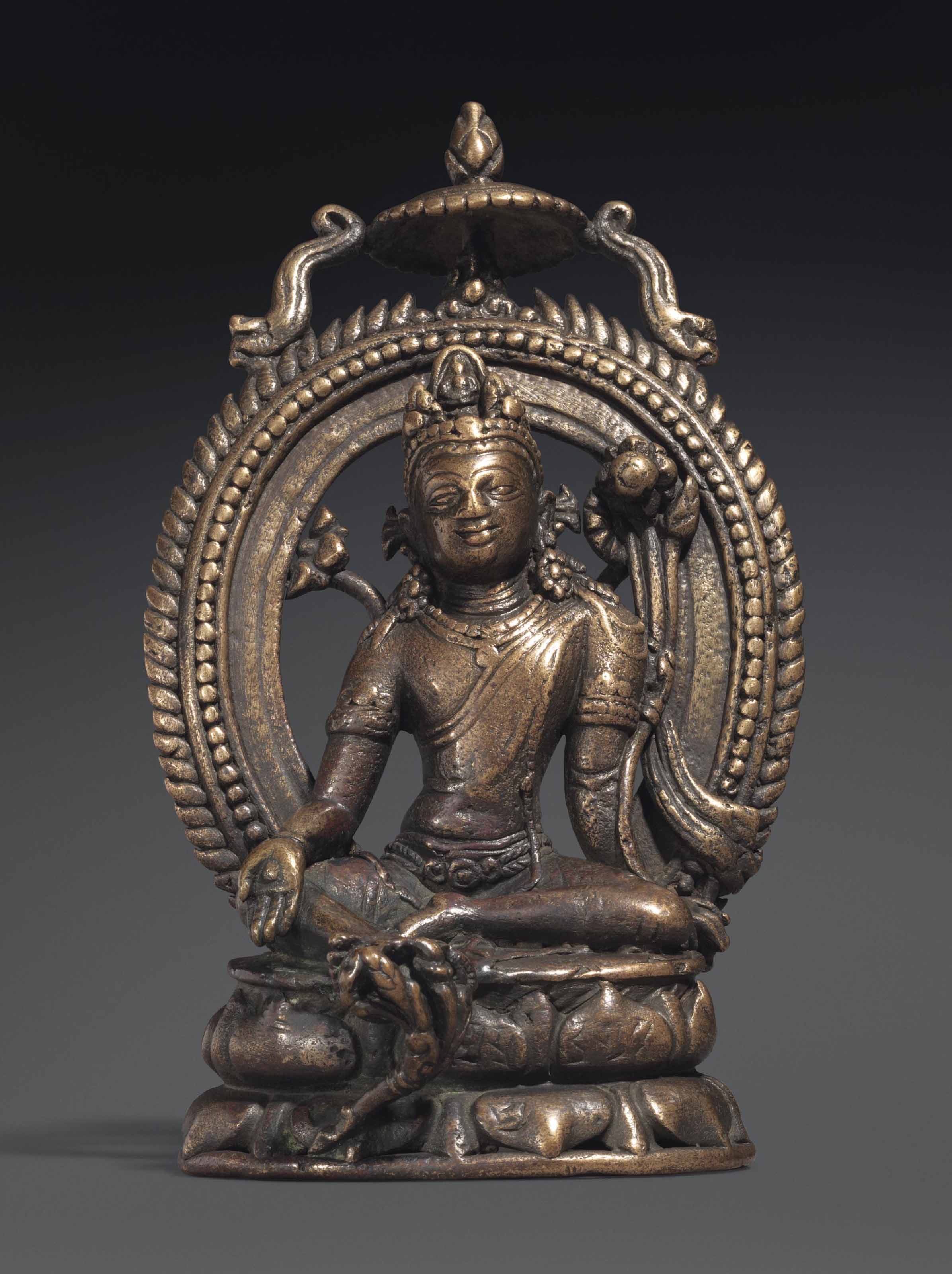 A BRONZE FIGURE OF PADMAPANI
NORTHEAST INDIA, PALA PERIOD, 9TH CENTURY
Seated in lalitasana on a lotus base with his right hand lowered in varadamudra, his left resting on the base and holding the stem of a lotus flowering along his upper arm, clad in a dhoti, upavita, and a scarf draped across his chest, bejewelled, his face displaying a serene expression with almond-shaped eyes below incised arched eyebrows, faint smiling lips, his hair piled into a jatamakuta centered by a minute figure of Buddha Amitabha and secured with a tiara, backed by a flaming halo engraved on the reverse with the Buddhist credo “ye dharma hetu”
呈游戏坐(lalitasana)于莲座之上,右手低垂结施与印(varadamudra),左手置于莲座,持一莲花茎,莲花绽放于上臂处。身着裙袍(dhoti)、圣线(upavita),胸间斜披一条帛带,周身佩戴珍宝。面容神情宁静,杏仁状双眸位于阴刻的弯眉之下,双唇微启含笑。头发高盘为发髻冠(jatamakuta),髻中央安奉一尊微小的阿弥陀佛像,并以宝冠(tiara)束固。身后为火焰边饰的头光,背面阴刻佛教缘起偈(ye dharma hetu)。
来源:
London market, by the early 1990's
Acquired by 2000
Nalanda flourished as a principal Buddhist center and university during the Pala period and was a primary site for the production of bronzes reaching a high point during the 9th century. The relative scarcity of remaining examples can be explained by the intrinsic value of the material itself, which may have resulted in the melting down of old sculptures for the production of new ones. By the 9th century, a mature and highly refined style was achieved that served as a defining prototype for later developments in the Himalayas and Southeast Asia.
The present work displays the essential features of this ninth century maturation, particularly with regard to the elegantly modeled, slightly bent posture of the figure. While earlier examples, such as an eighth century Bodhisattva in the Patna museum, exhibit a similar style and composition, a century later the sculptors had honed their craft allowing for greater corporal expressiveness and movement of form (U. von Schroeder, Indo-Tibetan Bronzes, 1981, p. 230-231, fig. 52F).
那烂陀(Nalanda)在波罗时期作为主要的佛教中心与大学而蓬勃发展,并且是铜像制作的首要之地,其制作水平在9世纪达到了顶峰。现存实例相对稀少的原因在于材料本身的内在价值——旧有雕塑常被熔毁以铸造新像。至9世纪,一种成熟且高度精炼的风格已然形成,成为喜马拉雅地区及东南亚后世发展的典范性原型。
本件作品展现了9世纪这一成熟时期的基本特征,尤其是在优雅塑造、微带曲度的姿态方面。尽管更早的实例——例如巴特纳博物馆(Patna museum)藏的一尊8世纪菩萨像——呈现出相似的风格与构图,但一个世纪之后,工匠们的技艺已臻纯熟,使得身体的表现力与形体的动感得以进一步增强(参见U. von Schroeder,《Indo-Tibetan Bronzes》,1981年,第230-231页,图52F)。