12世纪印度帕拉黑石雕空行观音(纽约佳士得)
尺寸:高147.4 cm
年代:12世纪
质地:黑石雕
风格:印度 帕拉
来源:拍卖会
成交:24,663,500美元(2017.03)
参阅:外部链接
鉴赏:
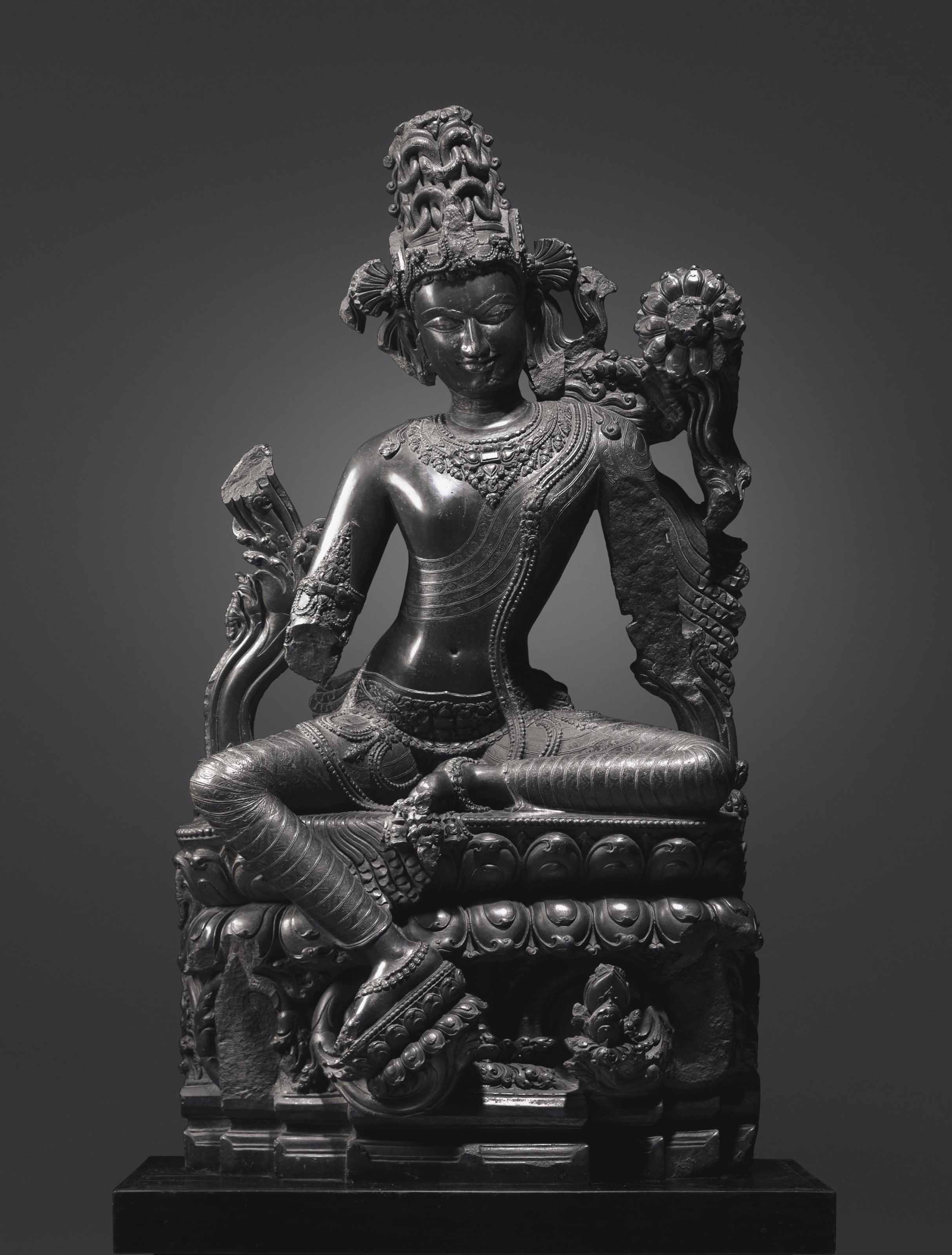 A Large and Important Black Stone Figure of Lokanatha Avalokiteshvara
Northeastern India, Pala Period, 12th century
传承:
F.W. Bickel, Zurich, by 1922.
Museum of Fine Arts, Boston (acc.no. 22.381), 1922 – 1935.
H. Kevorkian, acquired from the above in 1935.
Art of the Near East and the Orient: Classical Antiquities: Property of the Kevorkian Foundation, Parke-Bernet Galleries Inc, New York, 4-5 November 1966.
Important Asian and Japanese Works of Art, Sotheby Parke Bernet Inc, New York, 19 November 1975.
with Galleria Galatea, Turin, Italy.
Acquired by the present owner from the above in 1976.
著录:
A.K. Coormarswamy, “Buddhist Sculpture: Recent Acquisitions,” Museum of Fine Arts Bulletin, vol. 20, no. 120 (August 1922), p. 49, fig. 8
A.K. Coomaraswamy, Catalogue of the Indian Collections in the Museum of Fine Arts, Boston, Part II: Sculpture, Museum of Fine Arts, Boston, 1923, p. 78 and plate XXXVI
Lokanatha and Coomaraswamy:
A Tale of a Divine World Savior and a Mortal Curator
By: Pratapaditya Pal
All conquering is the Savior of the World.
His lotus hand, stretched down in charity,
is ripping streams of nectar to assuage
the thirsty spirits of the dead.
His glorious face is bright with gathered moonlight
and his glance is soft
with that pity that he bears within. [1]
So exalts the poet Ratnakirti of unknown date in a panegyric of the Bodhisattva known variously as Lokanatha (Savior of the World), Lokeshvara (Lord of the World) or the overarching Avalokiteshvara (The Allseeing Lord). The most popular of the class of Mahayana Buddhist savior divinities, generically referred to as bodhisattva (literally wisdom being), they are considered as persons who have arrived at the threshold of enlightenment or nirvana but have held back out of compassion to help those less fortunate in reaching the goal. As another poet (also of unknown date) Buddhakara prays “May that great saint, his body formed by moonlight…/dispel your grief and grant you/the streaming nectar of his peaceful happiness.”
Thus a bodhisattva could be divine or mortal person and of either gender. The Dalai Lama of Tibet is considered an earthly emanation of the Bodhisattva Avalokiteshvara.
This preeminent bodhisattva of Mahayana (the Great Vehicle) Buddhism, which developed in India during the early centuries of the Common Era, the Lotus-bearer (Padmapani) has remained an inspiration among the followers of this particular form of the religion. As a result, he has a wide variety of iconographic forms in both India and all other countries of Asia where his cult spread, as is clear from the surviving archaeological and literary evidence. He was especially venerated in the region of present day Bihar, West Bengal and Bangladesh in the Indian subcontinent between the 8th and 12th centuries from where numerous images of the deity have survived but few as monumental as the one that is the principal subject of this essay. Although created nine centuries ago, the afterlife of the object in the west in the 20th century brings us to the second component of our title: the “mortal curator.”
Apart from the art historical and aesthetic significance of the sculpture, to be discussed presently, it has an unusual importance for today’s museums and private collectors for its recent history. As it has now become obligatory for an object to have a pucca, unassailable provenance that was not a desideratum when I first came to work at the Museum of Fine Arts, Boston (MFA) in 1967, it would be difficult to find an antiquity with a better pedigree than this sculpture. Besides having been sold at two public auctions in New York in the mid-20th century, its arrival and earlier history in America can be traced back to 1922, which makes its American existence almost a century old [2].
It was first acquired in the year 1922 for the Boston Museum by none other than Dr. Ananda Kentish Coomaraswamy (1877-1947) (fig. A). In 1917, when the museum was already world famous for its rich collection of Chinese and Japanese art, it obtained a substantial assemblage of Indian art from Coomaraswamy who had begun amassing the material mostly in India under the British Raj around 1910. At the time there was no restriction in the movement of art among the various nations or from continent to continent. One of the greatest patrons and benefactors of the museum Dr. Denman Ross (1853-1935), a wealthy Bostonian and a professor of art and design at Harvard University (as well as a MFA trustee) had been steadily forming a vast private collection of art of global diversity, including India since the late 19th century [3]. Ross and Coomaraswamy had met in London in the first decade of the 20th century and it was largely due to their cooperation that the museum had secured the famous Goloubew Collection of Indian and Persian paintings in 1914 which Coomaraswamy would publish a few years after joining the museum in 1917 [3].
It should be noted that the current year represents the centennial of Coomaraswamy’s joining the staff of the MFA. 1917 also marks the beginning of the history of collecting Indian art by American museums. Hence, this publication also serves as a tribute to the man who not only ”introduced” Indian art to America but who toiled indefatigably for the next three decades until his death to become the most celebrated curator of Indian art this country has ever known. One of the outstanding polymathic scholars in humanities, in the first half of the 20th century, Coomaraswamy strode the world of Indian art in America like a colossus.
As Walter Muir Whitehill in his centennial history of the MFA wrote, “Few scholars in any field have thought more profoundly or written more prolifically than Ananda K. Coomaraswamy. He was physically and intellectually a unique ornament to the Museum of Fine Arts for three decades…” [4]. The Coomaraswamy Collection was purchased by the museum with funds provided by Dr. Denman Ross and hence the credit-line for the objects reads, “Ross-Coomaraswamy Collection.”
The Ross-Coomaraswamy Collection the museum acquired consisted largely of Indian paintings and a group of small bronzes. Therefore, he began earnestly to add sculptures with gusto for the next decade which can be gauged easily from the numerous articles that he wrote with ferocious frequency in the museum’s bulletin (which were indispensable sources for my own education in the fifties) and from the catalogues and books he published by the end of the third decade of the century. One of his major acquisitions in 1922 was the colossal figure of the World Savior that is the subject of this publication.
There is no doubt that the sculpture was acquired by the museum in 1922 as indicated by the accession number in museum records. Moreover, in an article in the museum bulletin of August 1922, it is mentioned in a note that it was one of several objects that AKC had recently bought in India for the collection [5]. There was no restriction then in taking art into or out of the country. The piece was published again in 1923 in the catalogue of the sculpture collection also by Coomaraswamy [6]. What is clear from the photographs he published is that originally the figure was missing his nose which seems to have been restored subsequently, perhaps by one of the subsequent owners, but with sensitivity [7].
In the catalogue entry Coomarawamy simply gave a brief physical description of the sculpture, characteristic of all the catalogue entries. In fact, his discussion of the piece in the Bulletin article is not much more fulsome except that he calls the figure Padmapani and characterizes it as the “most important” and “monumental” of the museum’s “medieval” Buddhist sculptures. Otherwise the brief description in the bulletin is repeated verbatim in the catalogue entry. It is interesting that when it came to writing catalogue entries of objects Coomaraswamy was clinical and almost a minimalist even if the representation was luxuriantly carved as is our figure. Even in the bulletin article he did not dilate upon the iconographic concept or the symbology of the figure.
The sculpture is carved from the familiar black stone that occurs in the region of both Bihar and old Bengal: now West Bengal in India and Bangladesh. The material is identified in literature generically as schist but is also known as phylite. The hardness of the stone allows it to be carved confidently into rich surfaces with both exuberant, modish designs and details of extraordinary finesse, as is evident in this impressive work. The back of the sculpture is left largely unfinished thereby revealing that the bodhisattva was meant to be viewed only from the front and sides. In fact, the image could have been the principal focus of worship, as is indicated by its size, or it served as an acolyte flanking a Buddha figure with the Bodhisattva Maitreya on the other side. The three together constitute the holy triad of Pala period Mahayana Buddhism where the Buddha represents the past, Lokanatha/Lokeshvara the present (busy helping other strivers) and Maitreya, the friendly one, symbolizing the Buddha of the future.
There were independent temples dedicated to Lokanatha in both Bihar and Bengal during the Pala period, as is evident from the large number of his forms described in the compendium of the 12th century text called Sadhanamala or the “Garland of Evocations.” The illustrations in the 1043 C.E. Prajnaparamita manuscript now preserved in the University library at Cambridge, U.K. also provide evidence of major temples in Bihar and Bengal dedicated to Lokanatha [8]. While most temples in the region have not survived we illustrate here two sculptures from the Metropolitan Museum of Art that provide clear ideas of the forms and designs of shrines in the region during the rule of the Pala dynasty (ca. 750-1150 C.E.) (figs. B & C).
Although one of the two reliefs represents the Hindu deity Vishnu and the other an esoteric mandala of the Bodhisattva Manjushri, stylistically the works are roughly contemporaneous and reveals two different architectural forms. Likely the temple in which our bodhisattva would have been installed, if the principal image, would have looked closer to the Buddhist stele. A noteworthy difference between the two Metropolitan sculptures and the ex-Boston figure is that while those two are clearly solid steles or reliefs, albeit deeply carved, the Lokanatha, viewed from the front, creates a strong illusion of a three dimensional composition. This kind of liberating the volume of the figure from the background to convey three dimensionality, greater linearity, as well as motion, is often encountered in Pala period steles and is visually more compelling than the typical densely carved and crowded reliefs.
Detached from a back support, the figure of the bodhisattva seated elegantly on the “lotus-boat” seems to float in the air. The unencumbered sinuous outline contains an animated body that seems to echo the undulant rhythm of associated vegetation. His seat is a fully open lotus that rises from the waters below represented by swags of thick curling vines around his extended right foot resting on a smaller bloom. The leg stretches forcefully at an angle enhancing the illusion of an active figure. The left leg rests horizontally on the seat (paryanka) which is why the posture is described generally as ardhaparyanka, the prefix ardha meaning half. As a further variation, ardhaparyanka with one leg dangling or extended is known as lalitasana, or the graceful posture, and if the right leg had been raised on the seat with the knee thrust upward, the posture would be called maharajalila (royal pleasure or ease), as we see in the eleventh century example from Bihar acquired in 1963 from Nasli Heeramaneck by the Boston Museum (fig. D) [9]. Stylistically this sculpture is probably earlier than its more monumental counterpart. Noteworthy is that Coomaraswamy had suggested a 11th–12th century date for it in 1922-23 and I would on comparison with dated examples give a date around 1100 for this figure [10].
Together with the profuse and diverse body ornaments our figure wears, clearly the bodhisattva’s conceptual model is that of an ideal, youthful handsome prince. He wears a dhoti whose volume is indicated with bold horizontal lines while the torso is diagonally draped with a very fine transparent cotton scarf. The region, especially Bengal, was famous from ancient times for the production of the finest gossamer muslin since Roman times, if not earlier, as much for its Royal Bengal tiger. Noteworthy also is the sacred cord (upavita) that descends in two strands of pearls from his left shoulder; rather an anomaly for a Buddhist deity to vaunt his upper caste. In addition to his princely persona, an ascetic touch is provided by the vertical arrangement of the braids of long hair in a complex and exquisitely carved formation, as if of writhing intertwined snakes. This embellishment is of course called a jatamukuta or crown of matted hair, which makes him a rajarshi or a regal ascetic combing the personas of the regal Vishnu and the ascetic Shiva, both of whom are regarded as a savior deity by their respective followers. “Lokanatha,” the savior of the world, is as well an appropriate epithet for Vishnu, as “Lokeshvara” is for Shiva.
Unfortunately, the two arms of the bodhisattva are damaged but the left hand would have grasped the long stem of the lotus flower prominently carved above the shoulder. The right hand would have exhibited the gesture of blessing or bestowing boon (varahasta). As the poet Ratnakirti in the epigraph states with rhetorical flourish “his lotus hand stretched down in charity/is dripping the streams of nectar to assuage/the thirsty spirits of the dead.” I would say all sentient beings seeking nirvana rather than only the ghosts.
A few words about the importance of the lotus flower will not be out of place here. We encounter this Indian flower par excellence signifying both beauty and grace generally. In particular it serves as a metaphor for the hand, as stated by the poet, and for the foot as well as a footstool. The flower is also his principal attribute in his left hand. It further serves as his seat where, of course, it is a metaphor of the human heart where the deity must be invoked in all three major religions: Buddhism, Hinduism and Jainism.
Normally in this period a Buddhist deity is distinguished from his/her Hindu or Jain counterpart by the presence of a tiny image of a Buddha in the hairdo or crown as is clear from the two examples in the MFA (figs. 4 & 5). However, in this case, the Buddha is placed behind the damaged central conical crest of the tiara as if secreted in a crevice like a hidden treasure. This reticent display of the Buddha is most unusual. The Buddha of course is Amitabha (Eternal Light) whose spiritual son Avalokiteshvara is. Generally, therefore the latter also has the red complexion of the former. However, the Sadhanamala describes the complexion of both Lokanatha and Khasarpana-Lokeshvara as white, which is corroborated by the two poets quoted above, who consistently compare his luster with the moon [11]. Of course, in most of the Pala sculptures surviving today, there is no longer any evidence of coloring. Likely, the stone would have originally been painted the prescribed color, as, indeed, clay images for seasonal worship are polychromed today.
Thus, with insufficient iconographic indicators, Coomaraswamy may have felt that the prominent lotus attribute justified the appellation Padmapani, rather than the alternatives Khasarpana Lokeshvara or Lokanatha. Neither Amitabha, the parental Buddha if the former, nor Vajradharma, if the latter, is present, nor is there a Suchimukha (Needle mouthed) ghost drinking up the nectar that is obligatory for Khasarpana. Moreover, in the Cambridge manuscript labels of the famous shrines of the bodhisattva in eastern India he is consistently addressed as Lokanatha [12].
The question arises inevitably, as it did to me, when I first heard that the sculpture had been consigned to Christie’s for sale by the current owner, why would Coomaraswamy want to dispose it in 1935 unless he was acquiring something that was even better. The answer was discovered quickly when I realized he acquired another Pala representation of the same bodhisattva (fig. 5). I must admit that I was surprised by the decision and must state firmly that, as a curator myself I find it difficult to justify the substitution. While it is an attractive figure, neither for the obvious contrast in their sizes nor the aesthetic impact, I fail to see why it is a more desirable replacement, especially as the face is damaged. Unfortunately, in his absence, Coomaraswamy cannot be cross-examined. I would consider it as a complementary object as an example of a standing figure but not a substitute.
This should be a cautionary tale for all museum curators who rush to sell objects from the collection thinking their new acquisitions would be an improvement. It should further be pointed out that at the time the price of either object could not have been that different from one another and it should not have been difficult for Coomaraswamy to raise the funds to purchase the standing figure, (which incidentally is without forearms and feet). Even with a restored nose, the face of the seated bodhisattva is not only better preserved but better reflects Ratnakirti’s rhetorical excess when he wrote, “His glorious face bright with gathered moonlight/and his glance is soft/ with that pity that he bears within,” as quoted in the epigraph.
Moreover, because of their sheer difference in size – the standing figure being 35 inches whereas the seated at 58, Lokanatha is life size – the latter is one of the most imposing Pala period sculptures to appear in the market in this century – it would have been prudent to keep both examples in the collection. When complete with its surround and aureole the seated image may have been as much as 70 inches high. In fact, other comparable Pala period sculpture of such monumental proportions outside the subcontinent is the over life-size image of Vishnu now in the National Gallery in Canberra, Australia [13]. I am sure in 1935 the towering personality of Ananda Coomaraswamy would have commanded such respect at the board meeting of the Boston Museum that everyone present would have agreed to the deaccession of the object without a murmur [14]. When Coomaraswamy talks everyone listens. But, as we know, from our recent political experience in this country, even the loudest voice is not always right. When it comes to deaccessioning a work of art from a museum collection discretion is often the better part of valor.
We may live today in a world vitiated by nationalist jingoism, extreme self-righteousness as well as warped vision when it comes to politics, but when it comes to our appreciation of art in any form we should believe in what Disney optimistically characterized as “One World” in the New York World Fair when I first stepped down on American soil in the summer of 1964. On my initial visit to the Boston Museum I was proud to view the Indian collection handsomely re-installed in attractive galleries by my esteemed colleague Dr. Milo Beach who was then simultaneously working on his PhD at Harvard University and as a part time curator in the “Asiatic Art” department as it was then known. Among the sculptures displayed were some lively narrative reliefs from the site of Amaravati acquired by Dr. Coomaraswamy as gifts – yes as gifts – from the Government Museum, Madras and about which he wrote in the museum Bulletin in 1922 [15]. I have no doubt that the gift was largely due to the great esteem in which Coomaraswamy was held by his fellow Tamils.
How different the times are now when we are constrained by the currently prevalent attitude among some overzealous “preservers” of heritage in both India and the United States. For centuries Indian art objects traveled without passports or permits from the subcontinent as far as China and beyond in Asia and Scandinavia in Europe. Now, regrettably it is a different story: The only type of art that is discriminated against is the visual form.
Thanks to Coomaraswamy, this svelte, languorously graceful, richly embellished, and meticulously detailed and yet monumental Savior of the World set out from his destroyed and desecrated home on the subcontinent on its afterlife journey in 1922 and found its new temporary home in the prestigious Boston Museum. That shelter, however, also proved to be temporary and, after some brief appearances in New York, he disappeared into obscurity for almost eight decades. Now, perhaps, it will find a worthy and permanent home, somewhere in the new or the old world and will be at last accessible to us all to lend a helping hand as we falter on the path to enlightenment.
This also reminds me of a comment by Jacques de Marquette in a posthumous appreciation he wrote about Coomaraswamy which I think is appropriate to close this essay: “While completely aware of the illusory character of the world of objectivity, his [Coomaraswamy’s] was the attitude of the Buddha of compassion who refuses to enter Nirvana before the last blade of grass has been redeemed…” [italics mine], which, apparently “was one of his favorite references to the teachings” of the Buddha [16].
Endnotes
©Pratapaditya Pal – English version, 2017.
1. Ingalls 1965: 64 and 65 for the following quote.
2. Bibliographical references in the catalogue entry.
3. Coomaraswamy 1929.
4. See Weatherhill 1970 for an account of Dr. Ross’s largesse to the museum and for the quote below. My own account of the Ross-Coomaraswamy bond awaits publication sometime this year in the Ratan Parimoo Felicitation Volume.
5. Coomaraswamy 1922: 45. However, the records indicate that it was bought from the Swiss dealer F.W. Bickel of Zurich. No information about the dealer is now available.
6. Coomaraswamy 1923: 78 & Pl. XXXVI.
7. Curiously the MFA sold the sculpture directly to a private collector rather than at an auction. It was then sold twice at public auctions in New York. As of writing this essay I have not seen a technical report on the object nor have I had the opportunity to personally examine it.
8. For detailed identifications see Foucher 1900. More accessible may be two illustrations in Pal and Meech-Pekarik 1988: 87, fig. 32; 103, figs. 20-21.
9. This object was brought in 1963 under the curatorship of Robert Treat Paine Jr. when the deal to buy the Heeramaneck Collection by MFA was sealed (but abandoned in 1969). The mate to this sculpture is now in the Heeramaneck Collection in Los Angeles (see Pal 1988: 178-179).
10. For a close stylistic mate, compare the complete image of Simhanada Lokeshvara in the Museum for Indische Kunst in Berlin. It was recovered from Lakhisarai in eastern Bihar before 1905 and is part of the Waddell Collection. Bautze–Picron (1998: 41-42; 173, cat. #72) dates the piece to 11th-12th century, which seems accurate both on stylistic and epigraphical evidence of the dedication inscription on the pedestal.
11. See Bhattacharya 1958: 128-132. Khasarpana is a curious name, which according to Monier Monier Williams, A Sanskrit English Dictionary [Oxford at Clarendon Press, 1979 reprint; p. 334, column 3] is the name of a Buddha. The original meaning of kha in the Rigveda is a cave but in later Brahmananical literature it also came to denote space, air, or heaven. Since neither the Buddha nor the Suchinukha is present here, I have avoided a precise identification as did Coomaraswamy. Lokanatha is a generic moniker like Lokeshvara or Avalokiteshvara.
12. The preferred name in the Cambridge manuscript labels seem to be Lokanatha such as “Haladi Lokanatha of Varendra” (in Bengal), or “Lokanatha of Potalaka” or again “Lokanatha of Radha” (also in Bengal), etc. See Foucher 1900: 203-204.
13. It is the image from Shialdi in Bangladesh. Unfortunately this cannot be viewed on the National Gallery’s website, which is strange since it is the Gallery’s most important work from the subcontinent.
14. Coomaraswamy’s inability to find the modest funds in early 1935 seems curious as Denman Ross was still alive. He died of a stroke later that year on September 12 in London in search of more art to collect. Coomaraswamy would die on September 9, 1947.
15. Coomaraswamy 1922 and 1923.
16. Singam 1974: 14.
Lokanatha 与 Coomaraswamy:
一位神圣的世界救主与一位凡尘的策展人之故事
作者:Pratapaditya Pal
  征服一切的是世间救主。\\
  他那施予慈悲而垂下的莲花手,\\
  正倾泻出甘露的溪流,以抚慰\\
  死者干渴的灵魂。\\
  他荣耀的面容因凝聚的月光而明亮,\\
  他的目光柔和,\\
  带着内心所怀的悲悯。[1]
1
诗人 Ratnakirti(年代不详)在一首赞歌中如此赞颂这位菩萨,他被称为 Lokanatha(世间救主)、Lokeshvara(世间自在)或统称 Avalokiteshvara(观自在)。作为大乘佛教救度尊神中最受欢迎的一类(通称为菩萨,字面意为“觉有情”),他们被视为已抵达觉悟或涅槃门槛之人,但出于悲悯,选择暂缓进入,以帮助那些福缘较浅者达到目标。正如另一位诗人(亦年代不详)Buddhakara 所祈祷的那样:“愿那位大圣者,其身由月光所成……驱散您的忧伤,并赐予您/他那宁静法喜的流溢甘露。”
因此,菩萨可以是神圣的,也可以是凡俗之人,且可为男女两性。西藏的达赖喇嘛被视为观音菩萨在世间的一个化现。
这位大乘佛教(约公元初几个世纪在印度发展而来)中卓越的菩萨——莲华手(Padmapani),一直是这一特定佛教形态追随者们的灵感源泉。因此,在印度以及他的信仰所传播到的所有其他亚洲国家,他拥有极其丰富的造像形式,这一点从现存的考古与文献证据中清晰可见。在公元8至12世纪之间,他在今日印度次大陆的比哈尔邦、西孟加拉邦和孟加拉国地区尤其受到尊崇,该地区留存了大量此尊神的造像,但很少有像本文主要讨论的这尊那样具有纪念碑式的体量。尽管创作于九个世纪之前,这件物品在20世纪西方世界的“后世生涯”将我们引向了本文标题的第二部分:“凡尘的策展人”。
除了本件雕塑的艺术史与美学意义(将在后文讨论)之外,其近代历史对于今天的博物馆和私人收藏家也具有不同寻常的重要性。由于如今一件物品必须拥有可靠、无可挑剔的来源记录——这在我1967年开始在波士顿美术博物馆工作时并非必要——很难找到比这尊雕塑更具传承记录的古代文物了。除了在20世纪中期于纽约两次公开拍卖售出之外,它到达美国及更早的历史可以追溯到1922年,这意味着它在美洲的存在已近一个世纪[2]。
2
这尊雕塑于1922年由 Ananda Kentish Coomaraswamy 博士(1877-1947,图A)亲自为波士顿博物馆购得。1917年,当该博物馆已以其丰富的中国和日本艺术收藏而闻名世界时,它从 Coomaraswamy 处获得了一大批印度艺术藏品。Coomaraswamy 大约在1910年左右在英属印度时期开始收集这些材料,当时各国之间或各大陆之间的艺术品流通没有任何限制。博物馆最伟大的赞助人和捐助者之一 Denman Ross 博士(1853-1935),一位富有的波士顿人、哈佛大学艺术与设计教授(亦是波士顿美术馆理事),自19世纪末起便一直在稳步形成其涵盖全球多样性的庞大私人艺术收藏,其中包括印度艺术[3]。Ross 与 Coomaraswamy 在20世纪第一个十年相识于伦敦,很大程度上由于他们的合作,博物馆于1914年成功购得了著名的 Goloubew 印度及波斯绘画收藏,Coomaraswamy 在1917年入职博物馆几年后出版了这批藏品[3]。
值得注意的是,今年恰逢 Coomaraswamy 加入波士顿美术馆工作的一百周年。1917年也标志着美国博物馆开始系统收藏印度艺术的历史开端。因此,本文也是对这位伟人的致敬:他不仅将印度艺术“介绍”给了美国,而且在接下来的三十年里孜孜不倦地工作,直至去世,成为美国有史以来最负盛名的印度艺术策展人。作为20世纪上半叶人文学科领域杰出的博学者之一,Coomaraswamy 在美国的印度艺术领域如巨人般行走。
正如 Walter Muir Whitehill 在波士顿美术馆百年史中所写:“在任何领域,很少有学者比 Ananda K. Coomaraswamy 思考得更深刻或写作得更丰富。在三十年间,他无论在身体上还是才智上,都是波士顿美术馆独一无二的瑰宝……”[4]。Coomaraswamy 收藏由博物馆以 Denman Ross 博士提供的资金购得,因此这些物品的收藏来源标注为“Ross-Coomaraswamy 收藏”。
博物馆购得的 Ross-Coomaraswamy 收藏主要包括印度绘画和一组小型铜像。因此,在接下来的十年里,他开始热切地增添雕塑作品,这可以从他极为频繁地在博物馆馆刊上发表的众多文章(这些文章是我在五十年代求学时不可或缺的资料来源)以及他在该十年末出版的图录和书籍中轻松看出。他在1922年的重要购藏之一便是本刊主题——这尊巨型的世间救主像。
毫无疑问,这尊雕塑是博物馆于1922年购得的,博物馆记录中的入藏编号即为明证。此外,在1922年8月的博物馆馆刊的一篇文章中,一条注释提到,这是 AKC(Coomaraswamy)最近在印度为收藏购得的数件物品之一[5]。当时将艺术品带入或带出该国没有任何限制。这件作品于1923年再次出版于同样由 Coomaraswamy 编写的雕塑收藏图录中[6]。从他发表的照片中可以清楚看到,原本这尊雕像缺少鼻子,后来似乎由某位后续藏家进行了修复,但修复得颇为细致[7]。
在图录条目中,Coomaraswamy 仅对雕塑进行了简要的物理描述——这是他所有图录条目的特点。事实上,他在馆刊文章中对这件作品的讨论也并不更加详尽,只是称这尊像为 Padmapani,并将其描述为博物馆“中世纪”佛教雕塑中“最重要”和“具有纪念碑式”的作品。除此之外,馆刊中的简短描述在图录条目中被逐字重复。有趣的是,在撰写物品图录条目时,Coomaraswamy 是冷静且近乎极简主义的,即使造像本身雕刻得极为繁复精美,正如我们的这尊。即使在馆刊文章中,他也没有详细阐述该像的图像学概念或象征意义。
这尊雕塑采用比哈尔邦和旧孟加拉地区(即今印度的西孟加拉邦和孟加拉国)常见的黑色石材雕刻而成。这种材料在文献中通常被认定为片岩,但也被称为千枚岩。石材的硬度使其可以被自信地雕刻出丰富而华丽的表面,既呈现出繁复的时尚纹样,又展现出非凡精细的细节,这在这件令人印象深刻的作品中显而易见。这尊雕塑的背面大部分未作精细加工,表明这尊菩萨像原本只设计为从正面和侧面观看。事实上,这尊像可能是主要的礼拜焦点,其体量也表明了这一点;或者它可能是作为胁侍,与另一侧的弥勒菩萨一同侍立于一尊佛陀像的两侧。这三者共同构成了波罗时期大乘佛教的圣三尊:佛陀代表过去,Lokanatha/Lokeshvara 代表现在(忙于帮助其他精进者),而弥勒(慈氏)则象征着未来佛。
在波罗时期,比哈尔邦和孟加拉地区存在供奉 Lokanatha 的独立寺庙,这一点从12世纪文本《成就法鬘》(Sadhanamala)中描述的大量其化相中可以得知。现藏于英国剑桥大学图书馆的公元1043年《般若波罗蜜多》写本的插图也提供了证据,表明比哈尔邦和孟加拉地区有供奉 Lokanatha 的主要寺庙[8]。虽然该地区的大多数寺庙已不复存在,但我们在本文中展示了大都会艺术博物馆的两尊雕塑,它们清晰地展示了波罗王朝(约公元750–1150年)统治时期该地区寺庙的形式与设计(图 B 和 C)。
尽管这两件浮雕中的一件表现的是印度教神祇毗湿奴,另一件是菩萨文殊师利的秘密曼荼罗,但从风格上看,它们大致是同时期的作品,并展示了两种不同的建筑形式。如果我们的菩萨像曾是主尊,那么安放它的寺庙很可能更接近那件佛教石碑的风格。大都会博物馆的两件雕塑与前波士顿美术馆的这件作品之间一个值得注意的区别是:前两者显然是坚实的石碑或浮雕(尽管雕刻很深),而这尊 Lokanatha 像从正面观看时,营造出强烈的三维立体感。这种将造像的体量从背景中解放出来以传达三维立体感、更强的线条感以及动感的手法,在波罗时期的石碑中经常出现,在视觉上比典型的密集雕刻、拥挤的浮雕更具感染力。
3
脱离了背屏的支持,这尊优雅地坐于“莲舟”之上的菩萨像仿佛悬浮于空中。不受拘束的蜿蜒轮廓包含着富有生机的身体,似乎呼应着周围植物那起伏的韵律。他的座位是一朵盛开的莲花,从下方由厚重卷曲的藤蔓所代表的水面中升起。他伸出的右脚搁在一朵较小的莲花上,那腿以一定角度有力伸展,增强了造像动态的错觉。左腿水平放置在座位上,因此这种姿态通常被描述为半跏坐,前缀 ardha 意为“半”。作为另一种变体,一条腿悬垂或伸展的半跏坐被称为游戏坐,即优雅姿态;如果右腿抬起放在座位上,膝盖向上顶起,则称为国王游戏坐,正如我们在波士顿博物馆1963年从 Nasli Heeramaneck 购得的一件11世纪比哈尔邦实例中所见(图 D)[9]。从风格上看,这件雕塑可能比其更为巨型的对应作品年代更早。值得指出的是,Coomaraswamy 在1922-23年已将其年代定为11至12世纪,而我根据有纪年的实例进行比较,会将这尊像的年代定在1100年左右[10]。
与我们这尊菩萨像所佩戴的丰富多样的身体饰品相结合,其构想中的范本显然是一位理想化的、英俊的年轻王子。他穿着一条围裙式腰布,其体量以大胆的水平线条表现,而躯干则对角披覆着一条非常精细的透明棉质披巾。该地区,尤其是孟加拉,自古时代(至少自罗马时期甚至更早)以来,就以其生产最精致的薄纱而闻名,正如其以孟加拉虎闻名一样。同样值得注意的是从他的左肩垂下的两股珍珠组成的圣线——这对于一位佛教神祇而言颇为异常,仿佛在炫耀其高种姓身份。除了王子般的身份,一个禁欲主义的细节体现在他将长发编成发辫,以复杂而精美雕刻的形式垂直高盘(仿佛扭动缠绕的蛇),这种装饰当然被称为发髻冠,使他成为一位王者圣人,融合了王者风范的毗湿奴和苦行僧般的湿婆——这两位分别被各自的信众视为救度之神。Lokanatha(世间救主)同样也是毗湿奴的合适称号,正如 Lokeshvara 适用于湿婆一样。
遗憾的是,菩萨的双臂已损坏,但左手原本应握着那朵在肩部上方显著雕刻的莲花的长茎。右手则本应施予愿印(祝福或赐予恩惠的手印)。正如碑文所引诗人 Ratnakirti 以华丽的修辞写道:“他那施予慈悲而垂下的莲花手/正倾泻出甘露的溪流,以抚慰/死者干渴的灵魂。”我认为,是所有寻求涅槃的有情众生,而不仅仅是饿鬼。
关于莲花重要性的几句话在此不会显得多余。我们遇到的这种卓越的印度花卉,通常象征着美与优雅。它特别被用作手的隐喻(如诗人所述),也用作足和脚垫的隐喻。这朵花也是他左手中的主要持物。它同时也是他的座位——当然,在此处它是人类心灵的隐喻,在佛教、印度教和耆那教这三大宗教中,都必须从心灵中祈请神祇。
通常在这一时期,佛教神祇区别于其印度教或耆那教对应者的标志,是在发式或宝冠中出现一尊小型佛像,从波士顿美术馆的两件实例中可以清楚看出(图4和5)。然而,在此例中,佛陀被放置在被损坏的宝冠中央锥形顶饰的后方,仿佛隐藏在一个裂隙中,如同隐藏的珍宝。这种含蓄地展示佛陀的方式极为不寻常。这尊佛当然是阿弥陀佛(无量光),观音菩萨是他的法王子。因此,后者通常也具有前者的红色肤色。然而,《成就法鬘》中描述 Lokanatha 和 Khasarpana-Lokeshvara 的肤色均为白色,这得到了上文引用的两位诗人的印证,他们始终将他的光辉比作月亮[11]。当然,在大多数保存至今的波罗雕塑中,已没有任何着色的痕迹。很可能这些石像原本涂有规定的颜色,正如当今季节性礼拜所用的泥像(泥像)是彩色的。
因此,由于缺乏足够的图像学标志,Coomaraswamy 可能觉得显著的莲花持物正印证了 Padmapani(莲华手)这一称谓,而不是 Khasarpana Lokeshvara 或 Lokanatha。无论是前者所对应的本尊佛阿弥陀佛,还是后者所对应的 Vajradharma,都未出现;也没有 Khasarpana 所必需的吸饮甘露的针口饿鬼。此外,在剑桥写本中关于东印度著名菩萨寺庙的标注中,他一直被称为 Lokanatha[12]。
4
当我第一次听说这尊雕塑被现任藏家委托给佳士得拍卖时,一个问题不可避免地浮现在我的脑海中——正如它曾出现在我面前一样:为什么 Coomaraswamy 会在1935年想要处理掉它,除非他正在收购一件更优秀的作品?当我意识到他购入了同一菩萨的另一件波罗时期造像时(图5),答案很快就被发现了。我必须承认,我对这一决定感到惊讶,并且必须坚定地说,作为一名策展人,我觉得很难为这次替换辩解。虽然那是一尊吸引人的造像,但无论是从两者体量的明显对比,还是从审美冲击力来看,我都看不出为什么它是一件更理想的替换品,尤其是其面部还有损伤。不幸的是,由于他已然离世,我们无法盘问 Coomaraswamy 本人。我会将它视作一件补充性的物品——作为一尊立像的例子,但绝不是替代品。
这对于所有急于出售馆藏物品、认为新购藏品会有所改进的博物馆策展人来说,应是一个警示故事。还应该指出的是,当时这两件物品的价格不可能相差太大,Coomaraswamy 筹集资金购买那尊立像(顺便提一下,那尊立像缺少前臂和双足)本不应困难。即使鼻子经过修复,这尊坐姿菩萨的面部不仅保存得更好,而且更好地反映了 Ratnakirti 在引文中所写的那句富有修辞夸张的诗句:“他荣耀的面容因凝聚的月光而明亮,/他的目光柔和,/带着内心所怀的悲悯。”
此外,由于两者体量的巨大差异——立像高35英寸,而坐像高58英寸,Lokanatha 像几乎是真人大小——后者是本世纪出现在市场上最令人印象深刻的波罗时期雕塑之一。将两件藏品都保留在馆藏中本应更为明智。如果算上原有的背光和头光,这尊坐像完整时可能高达70英寸。事实上,在印度次大陆以外,另一件可与之媲美的如此纪念碑式体量的波罗时期雕塑,是现藏于澳大利亚堪培拉国家美术馆的那尊超真人尺寸的毗湿奴像[13]。我相信,在1935年,Ananda Coomaraswamy 那卓越的人格定会在波士顿美术馆的董事会上赢得如此的尊重,以至于在场的每个人都会毫无异议地同意该物品的退出馆藏[14]。当 Coomaraswamy 发言时,所有人都在倾听。但是,正如我们从近期这个国家的政治经验中所知道的,即使是最响亮的声音也并不总是正确的。当涉及到将一件艺术品从博物馆收藏中退出时,谨慎往往是勇气更好的部分。
我们今天可能生活在一个被民族主义的沙文主义、极端的自以为是以及扭曲的视野所败坏的世界——在政治方面尤其如此。但当我们欣赏任何形式的艺术时,我们应该相信迪士尼在纽约世界博览会上乐观地提出的“一个世界”的理念——那是我于1964年夏天首次踏上美国土地时的情景。在我第一次参观波士顿博物馆时,我自豪地看到印度艺术收藏被我所尊敬的同事 Milo Beach 博士重新布置在迷人的展厅中,他当时同时在哈佛大学攻读博士学位,并在当时被称为“亚洲艺术”的部门担任兼职策展人。展出的雕塑中包括一些来自阿玛拉瓦蒂遗址的生动叙事性浮雕,这些浮雕是由 Coomaraswamy 博士作为礼物——是的,作为礼物——从马德拉斯政府博物馆获得的,他曾在1922年的博物馆馆刊中撰文介绍过它们[15]。我毫不怀疑,这份礼物主要是由于 Coomaraswamy 受到他的泰米尔同胞们的极大尊敬。
如今的时代是多么不同,我们受到目前在印度和美国的一些过度热心的遗产“保护者”中盛行的态度的约束。几个世纪以来,印度艺术品无需护照或许可便可从次大陆旅行至中国及亚洲其他地方,远至斯堪的纳维亚和欧洲。可悲的是,现在情况不同了:唯一受到歧视的艺术类型是视觉形式。
感谢 Coomaraswamy,这尊苗条、慵懒而优雅、装饰华丽、细节一丝不苟地精致且具有纪念碑体量的世间救主,于1922年从他位于次大陆上被摧毁和亵渎的家园开始了其身后的旅程,并在著名的波士顿博物馆找到了新的临时居所。然而,那个庇护所也被证明是暂时的,在纽约短暂亮相后,他消失了近八十年,默默无闻。现在,也许他会在新世界或旧世界的某个地方找到一个值得的且永久的家,并最终为我们所有人所见,在我们于觉悟之路蹒跚前行时伸出援助之手。
这也让我想起了 Jacques de Marquette 在他死后写的一篇关于 Coomaraswamy 的纪念文章中的评论,我认为以此结束本文是合适的:“尽管完全意识到客观世界虚幻的本质,他[Coomaraswamy 的]态度是慈悲佛陀的态度——在最后一根草得到救赎之前拒绝进入涅槃……”[斜体为本人所加],这显然“是他最常引用的佛陀教义之一”[16]。