13世纪尼泊尔马拉早期铜鎏金莲花手观音立像(纽约佳士得)
尺寸:高63.4 cm
年代:13世纪
质地:铜鎏金
风格:尼泊尔 马拉早期
来源:拍卖会
成交:8,229,000美元(2015.05)
参阅:外部链接
鉴赏:
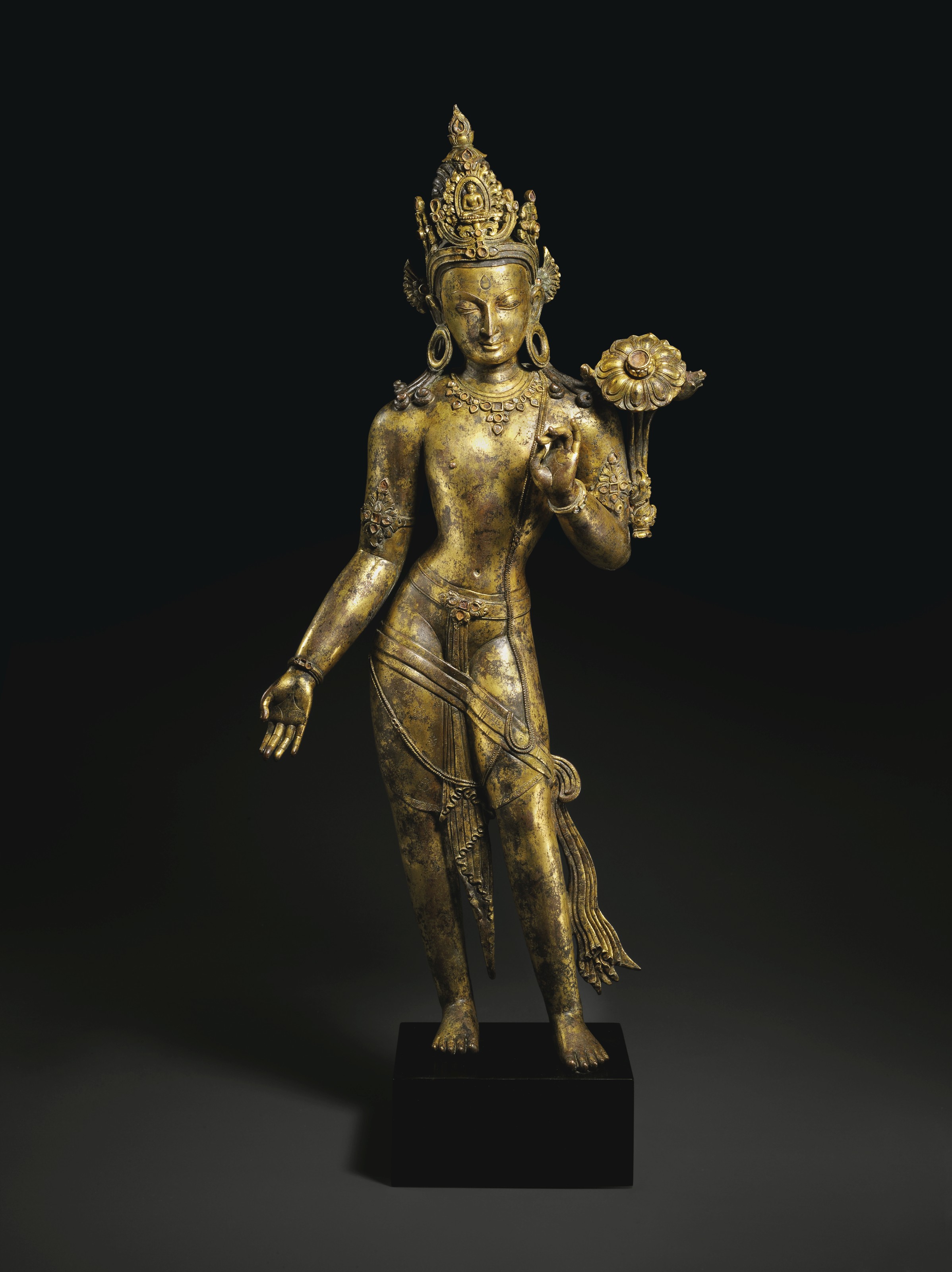
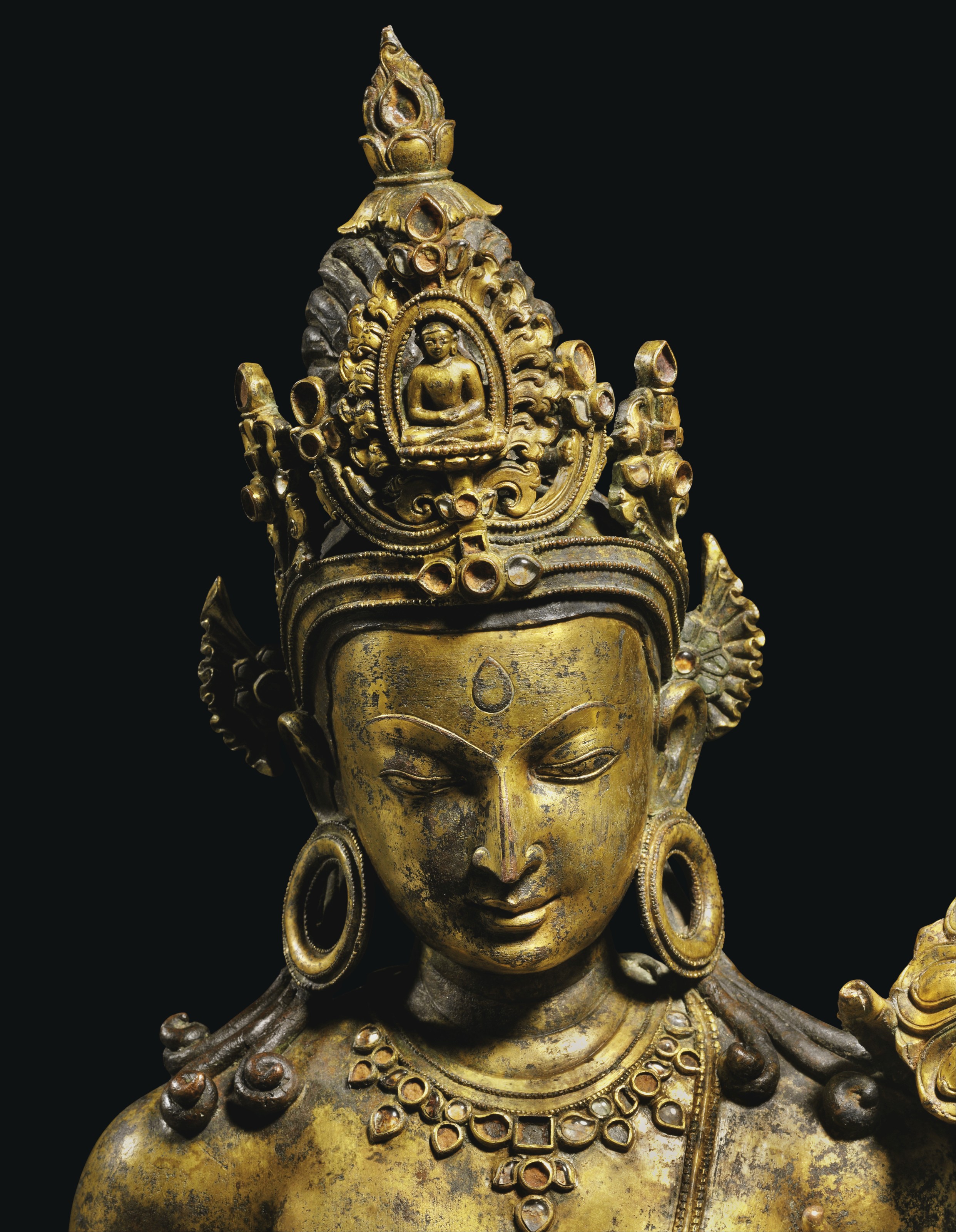
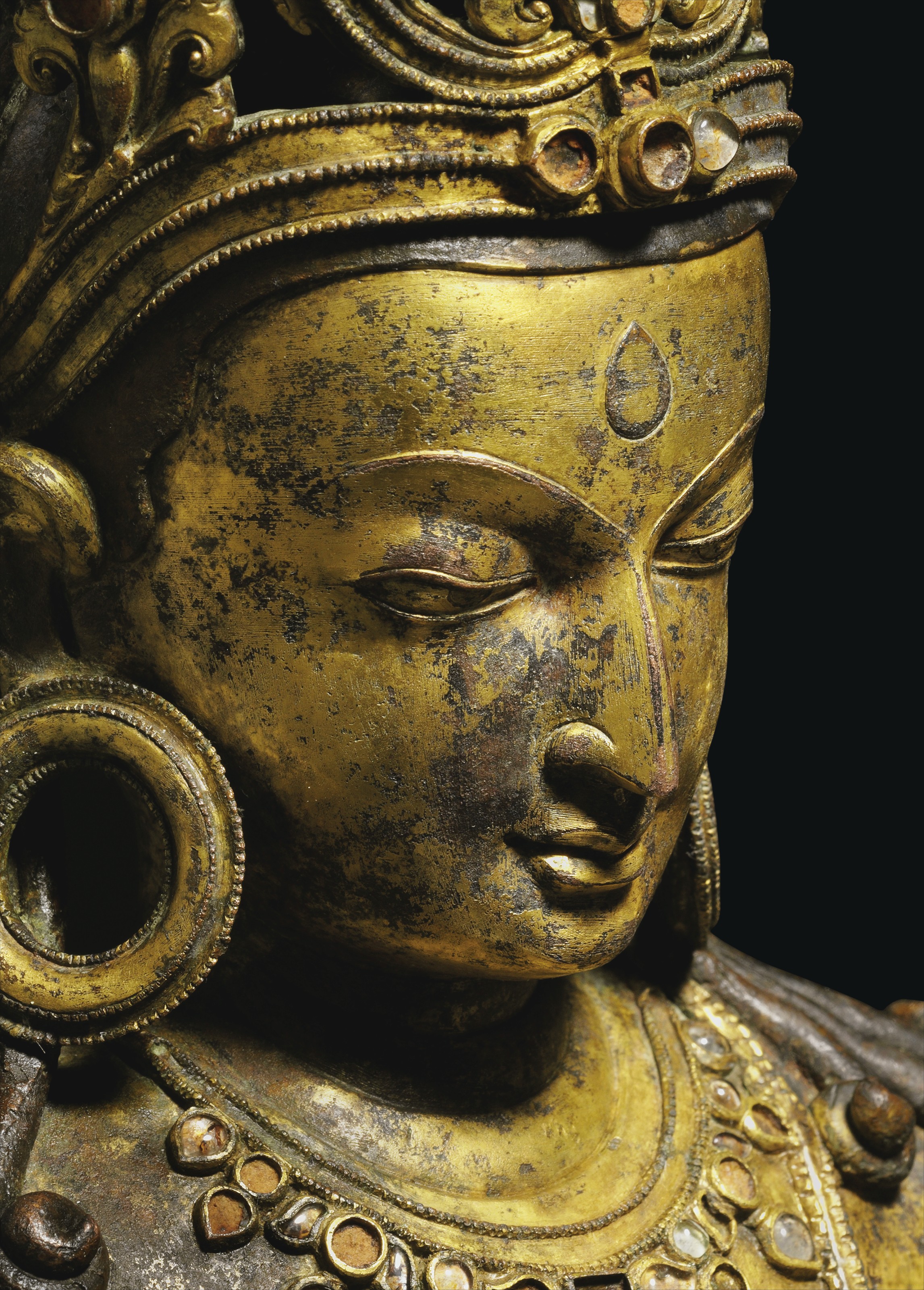 A LARGE AND IMPORTANT GILT BRONZE FIGURE OF AVALOKITESHVARA
NEPAL, 13TH CENTURY
Standing with his right hand in varadamudra and a lotus blossoming at his left shoulder, dressed in a short, thin dhoti secured by a beaded belt with pendant ribbon, adorned with the sacred thread and sash hanging across the hips, the face with heavily-lidded downcast eyes and gently arching brows flanked by large hoop earrings, the hair piled into a high chignon and secured with a foliate tiara centered with a seated Buddha
呈站立姿,右手结施与印(varadamudra),左肩侧绽放一朵莲花。身着轻薄短裙(dhoti),系以串珠腰带,垂有飘坠的缯带;身披圣线(sacred thread)及横跨髋部的圣带(sash)。面容双目低垂,眼睑厚重,双眉微弯,两侧饰有大环耳珰。头发高盘成髻,束以花叶宝冠(tiara),冠中央安坐一尊佛陀。
来源:
Christian Humann (d. 1981), New York, before 1971, named the Pan-Asian Collection by 1977.
Collection of Robert H. Ellsworth, New York, acquired by 1982.
著录:
A.R. Martin, “Robert Ellsworth is the Duveen of Oriental Art,” Connoisseur, November 1984.
A. Juliano, “Robert H. Ellsworth Treasures the East,” Architectural Digest, October 1985, pg. 108.
J. Casey, et al., Divine Presence: Arts of India and the Himalayas, 2003, p. 108-109, pl. 29.
展览:
On loan to Los Angeles County Museum of Art, 1971-1981 (L.71.29.34).
Exhibited at Denver Art Museum, 1981-82 (65.1981).
Avalokiteshvara, the “Lord Who Looks Upon the World,” is the bodhisattva of compassion and one of the principle deities in Mahayana Buddhism. He is the spiritual successor to Amitabha, the Buddha of Infinite Light, who appears here finely rendered in the bodhisattva’s crown. Although he has attained enlightenment like a Buddha, the bodhisattva forgoes his escape from the suffering of rebirth to act as a guide to all living beings until they themselves have achieved nirvana. Like the lotus which rises from its murky bed below the water to blossom in the pristine air, Avalokiteshvara has detached himself from the pain and impurities of the material world; he is enlightened in body, speech, and mind.
Worshipped in Nepal from at least the mid-6th century, Avalokiteshvara was one of the most popular Buddhist deities in the Kathmandu Valley, rivaling the Buddha himself. With time, the compassionate characteristics of Avalokiteshvara became intertwined with the attributes of local Nepalese deities. A distinct style of representation emerged from this locus of fervent worship, drawing influence initially from the Gupta dynasty and later - as seen in this work - from the Pala dynasty of Northeastern India, resulting in a uniquely Newari aesthetic. In contrast to the post-Gupta Indian tradition of depicting him seated, in Nepal the deity is almost always shown standing. The Newari style is further characterized by the lithe form of the body and the gracefully swaying hips. The folds of the dhoti, simply patterned with stippling and flower-heads, hang between the legs and are secured diagonally across the hips with a sash, while the sacred thread extends almost to the knee.
Stylistically, the present work has much in common with two related examples. The first from the collection of Nasli and Alice Heeramaneck, now in the collection of the Los Angeles County Museum of Art (P. Pal, Art of Nepal, 1985, p. 108, fig. S29); and the second, a Padmapani from the Doris Wiener Collection, sold in these rooms on 20 March 2014, lot 92. Each figure embodies simplicity of form heightened with ornamentation that is characteristic of 13th century Nepalese sculpture. The bodies stand in a graceful tribhanga pose with soft rounded shoulders, tapered waists, and elongated naturalistic limbs. Their serene expressions are accentuated by downcast eyes, arched eyebrows, elegantly rendered noses, and bow-shaped mouths. The finely cast crowns and beaded jewelry are similarly emblematic of Nepalese sculpture from this period.
Standing over two feet tall, the exceptionally large Ellsworth Avalokiteshvara embodies the elegance and grace of the finest Nepalese bronze work. The gentle sway of the solid-cast body lends the figure an emotional depth. The naturalistic rendering of the form, seen particularly on the reverse, endows the figure with presence, and the outstretched hand graciously invites the viewer to approach. His gaze, inward and meditative, suggests the deep inner wisdom of an enlightened teacher. The overall effect is one of perfect harmony of form and meaning, capturing the essence of Avalokiteshvara, the embodiment of compassion. It is not surprising that Mr. Ellsworth chose his living room mantelpiece, a prominent and central spot in his home, to showcase this superlative work.
观音菩萨,即“观照世间之主”,是大乘佛教中的慈悲菩萨,亦是主要尊神之一。他是无量光佛——阿弥陀佛的法嗣,阿弥陀佛在此像中精细地呈现于菩萨的宝冠之中。尽管菩萨如佛陀一般已证悟正觉,却为引导一切众生直至其证得涅槃,而自愿避免脱离轮回之苦。正如莲花自水底浊泥中升起,绽放于清净的空气之中,观音菩萨已然超脱物质世界的痛苦与染浊,于身、语、意皆得觉悟。
尼泊尔对观音的崇拜至少始于公元6世纪中叶,在加德满都谷地,观音是最受欢迎的佛教尊神之一,其声望堪与佛陀本人比肩。随着时间的推移,观音的慈悲特质与尼泊尔本土神祇的属性相互交融。在这一炽热信仰的中心,形成了一种独特的造像风格,初期受笈多王朝影响,后期——正如本件作品所示——受印度东北部波罗王朝的影响,从而产生了一种独特的尼瓦尔美学。与后笈多印度传统中观音呈坐姿不同,尼泊尔的观音几乎总表现为站立姿。尼瓦尔风格的进一步特征在于身体的纤巧柔韧以及髋部的优雅摆姿。短裙(dhoti)的衣褶简单地点缀以点刻纹与花头纹,垂于两腿之间,并有一条圣带斜向横过髋部系固,而圣线(sacred thread)则几乎延伸至膝部。
从风格上看,本件作品与两件相关实例颇为相似。其一出自Nasli与Alice Heeramaneck旧藏,现藏于洛杉矶郡艺术博物馆(见P. Pal,《Art of Nepal》,1985年,第108页,图S29);其二为Doris Wiener旧藏的一尊莲华手观音(Padmapani),于2014年3月20日本场拍卖售出,拍品第92号。每尊造像均体现了以装饰强化形式的简洁性,这正是13世纪尼泊尔雕塑的特征。其身姿呈优雅的三屈式(tribhanga),肩部柔和圆润,腰部收束,四肢修长而自然。低垂的双目、弯弓般的眉毛、精妙塑造的鼻梁以及弓形的嘴唇,更凸显其宁静安详的表情。精细铸造的宝冠与串珠饰品同样是这一时期尼泊尔雕塑的标志性特征。
这尊埃尔斯沃思(Ellsworth)旧藏观音像高达两英尺有余,体量异常宏大,凝聚了最精美尼泊尔铜像的优雅与风韵。实心铸造的身躯轻轻摆姿,赋予造像以情感深度。其形体的自然主义表现——尤其在背面尤为显著——使造像具有强烈的存在感;向外伸出的手掌优雅地邀请观者靠近。菩萨的目光内敛而冥想,暗示着一位觉悟导师深沉的内心智慧。整体效果呈现出形式与含义的完美和谐,捕捉到了观音菩萨——慈悲化身——的精髓。埃尔斯沃思(Ellsworth)先生选择将其陈设于自家客厅的壁炉架之上——其宅邸中一个显赫而中心的位置——以此展示这件卓越之作,实不足为奇。