12世纪日本佛画十一面观音坐像(奈良国立博物馆)
尺寸: H 169.0, W 90.0
年代: 12世纪
质地: 挂轴;绢本设色
风格: 日本
来源: 奈良国立博物馆
参阅: 外部链接
鉴赏:
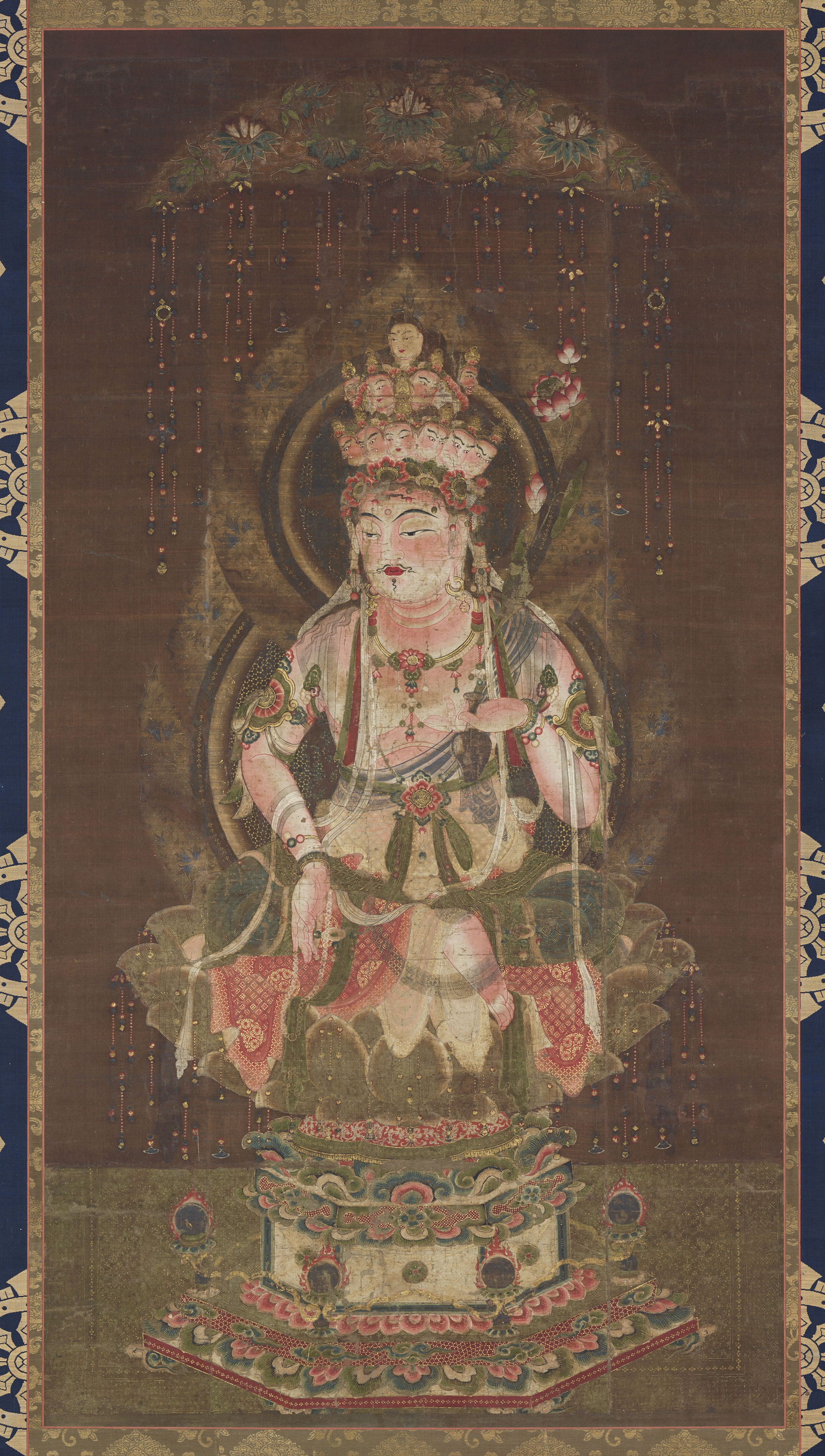 Eleven-Headed Kannon (Ekadaśamukha)
“This is one of the foremost masterworks of Heian-period Buddhist painting. Jūichimen Kannon, or Eleven-Headed Avalokiteśvara, is a splendorous vision replete with intricate decorations of cut gold leaf (”, “). There are several elements to this painting’s expression that are borrowed from the arts of an earlier time: we view the deity from an angle, rather than straight on, and the form is outlined in red and then modeled using pink shading. These are stylistic traces of the Nara period (710–794). The painting comes from Tatsuta Shingū Shrine, which protects Hōryūji Temple.”
Buddhist Art Paradise: Jewels of the Nara National Museum. Nara National Museum, 2021.7, p.332, no.206.
“This painting depicts an Eleven-Headed Kannon (Skt. Ekādaśamukha Avalokiteśvara) facing towards the viewer's left. The deity's right hand, held at waist level with a rosary around the wrist, is in the hand gesture (Skt. mudrā) symbolizing the fulfilling of desires (J. yogan'in); the left holds a vase containing a red lotus flower. The eleven heads atop the image include three with faces like those of bodhisattvas, three with angry expressions, three with fangs protruding upwards, one laughing face, and on the very top, the face of a buddha.”, “ The iconography is based on the form of the Eleven-Headed Kannon discussed in the Heart Sutra of the Divine Incantation of the Eleven Heads (J. Jūichimen shinju shingyō), translated into Chinese by the priest Xuanzang (J. Genjō, 602-664) during the Tang dynasty (618-907). Unlike esoteric iconic depictions, in which the image faces directly forward, Kannon here is turned slightly diagonally suggesting the artist's attempt to create a more naturalistic space. Kannon is not portrayed in formal meditation posture but with his right foot relaxed. This stylized pose, as well as the ornate details of the large floral canopy and the aureole that resembles openwork carving, make this painted image appear to be a rendition of an actual Buddhist sculpture.”, “ The body of the image is painted in a light pink hue with a dark cinnabar outline creating a soft, rounded effect. Delicate cut gold leaf (J. kirikane), overlaid on the ground patterns and the main motifs, adorn the intricate layers of his robe. Decorating the dais and canopy are designs created in cut gold leaf and gradations of silver arranged like bamboo leaves (J. sasa rindō). This motif of bamboo leaves and that of the chrysanthemum rings (J. kikka danmon) in cut gold leaf are thought to have been introduced from Song dynasty (960-1279) China. Painted silver, with the lotus stem visible within, the vase that Kannon holds resembles Song glassware. Sumptuous and splendid, these elements typify the gorgeous forms characteristic of Buddhist painting of the Heian period (794-1185).”, “This work was passed down until modern times in Hokki-ji Temple. Located nearby is Hōryū-ji Temple, which owns fragments of Heian period Buddhist paintings that display a similar pattern of strong gradation of pigments. This raises the possibility that the Eleven-Headed Kannon took its inspiration from classical paintings like those on the walls of Hōryū-ji's Golden Hall.”
十一面观音(Ekadaśamukha)
此为平安时代佛画的至高杰作之一。十一面观音周身装饰以繁复精细的截金,华美庄严。本画在表现手法上多处承袭古风:菩萨像取斜向视角而非正面,身形以朱线勾勒后施以粉色晕染,均可见奈良时代(710–794)样式之遗风。本画传为法隆寺镇守龙田新宫旧藏。
——《佛教美术 paradise:奈良国立博物馆珍宝展》,奈良国立博物馆,2021年7月,第332页,第206号
本画十一面观音面向左方。右臂垂于腰际,腕挂数珠,结与愿印;左手持瓶,内插红莲。头顶十一面中,包括三面菩萨面、三面嗔怒面、三面獠牙上出面、一面笑面,最顶为佛面。其图像依据为唐代玄奘(602–664)所译《十一面神咒心经》中所述之十一面观音形相。与密教图像中正面端坐的样式不同,本画菩萨身形微侧,可见画师对自然空间表现的探索。菩萨未取跏趺坐姿,右足自然舒展。此种程式化的姿态,加之饰有繁复花纹的巨大华盖与透雕般的光背,使本画宛如将一尊佛雕像再现于绢素之上。菩萨身施淡粉色,以朱砂勾勒轮廓,线条柔和圆润。衣袍层层叠叠,地纹与主纹之上覆盖精妙的截金纹样。台座与华盖上饰有截金及银泥晕染而成的笹龙胆纹样。此种笹龙胆纹样及截金菊花坛纹,被认为源自中国宋代。观音手持之瓶绘有银泥,瓶身透明可见莲茎,仿宋代玻璃器之风格。诸般元素富丽堂皇,堪称平安时代佛画华美风格的典型代表。本画近代以来传于法起寺。邻近的法隆寺藏有平安时代佛画断简,可见相似的强烈晕染纹样。由此推测,本画十一面观音或受法隆寺金堂壁画等古典绘画之影响。