17世纪明代铜大日如来坐像(纽约苏富比)
尺寸:高33 inches
年代:明代 17世纪
质地:铜
风格:中原
来源:拍卖会
成交:237,500美元(2016.03)
参阅:纽约苏富比
鉴赏:
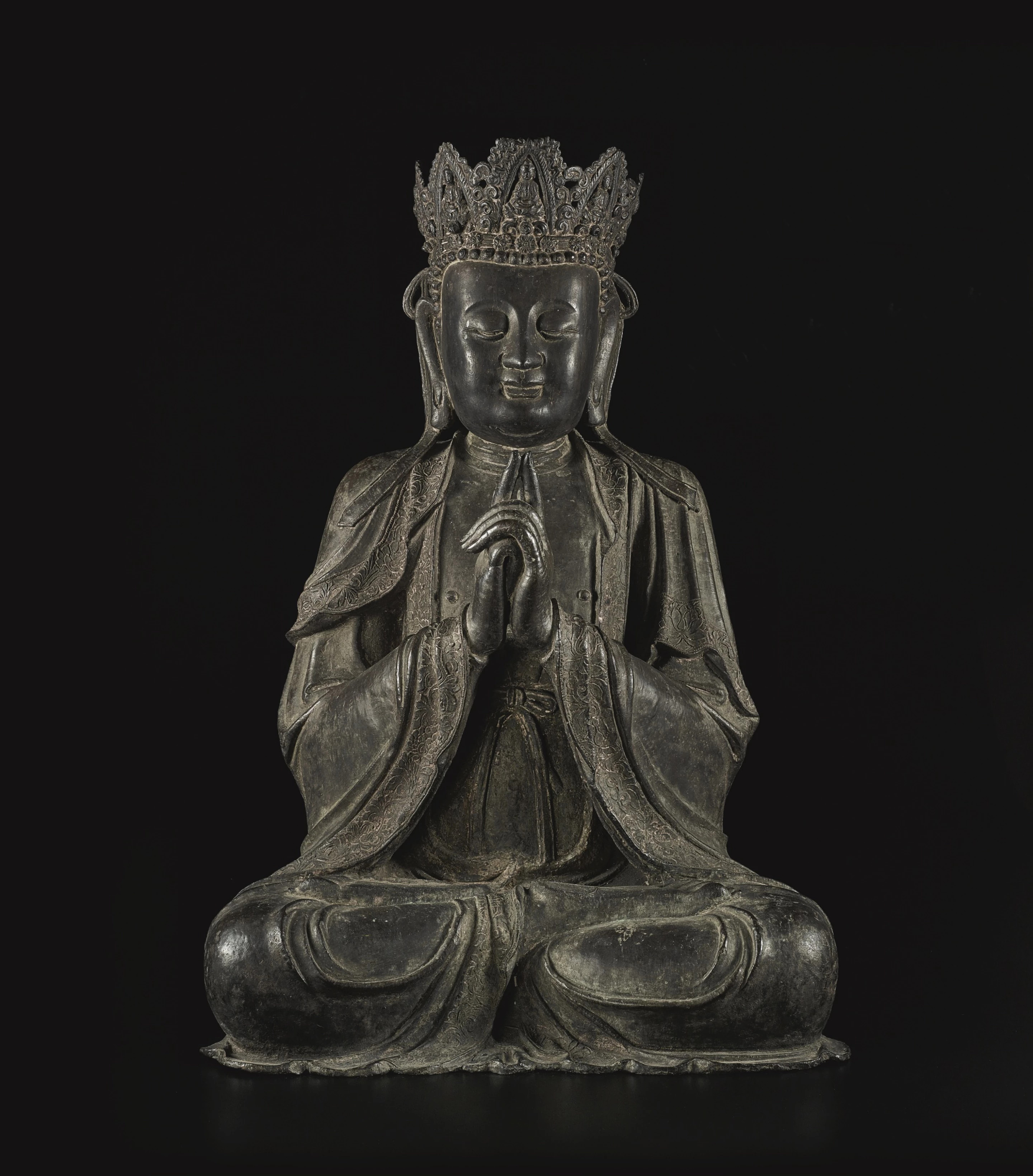 A LARGE BRONZE FIGURE OF VAIROCANA MING DYNASTY
Bronze
Height: 33 inches
cast majestically seated in dhyanasana with hands held at chest level in uttrabodhimudra, wearing loose robes with dense floral-scroll borders, the exposed chest above the sash-tied antaravasaka, the regal face with crisply cast downcast eyes and gentle smile flanked by pendulous ears, beneath the elaborate openwork Five Dhyani Buddha crown, encircling the ushnisha covered with whorls of hair
Condition
The sculpture missing the top and two tips of the front of its crown as well as several hair 'curls' at the back and the lower section of one of the ribbons trailing from the headdress. There is a long filled split across the upper back and a split to the hem of the gown at the front center of the base. The surface with wear overall and scattered nicks.
Catalogue Note
Vairocana is considered a celestial or primordial Buddha, and represents the dharma body of the historical Buddha. Vairocana is also seen as the embodiment of the Buddhist concept of sunyata, emptiness, and is one of the Five Dhyani Buddhas, which represent the five qualities of the Buddha. In this respect, Vairocana represents the Buddha's all-encompassing wisdom.
This concept is represented by the uttrabodhimudra displayed by the present figure. This gesture represents supreme enlightenment and together with the vajramudra and dharmachakramudra is one that is specifically associated with Vairocana.
The Five Dhyani Buddha crown on the present figure also points to this figure being a representation of Vairocana as one of the five, the other four being Aksobhya, Ratnasambhava, Amitabha and Amoghasiddhi. When depicted together, Vairocana is often placed in the center.
Smaller Ming dynasty gilt-bronze figures of Vairocana have sold in our Hong Kong rooms, 25th April 2004, lot 333, and 8th April 2011, lot 3048. Two other related figures were sold at Christie's Hong Kong, 1st June 2011, lot 3770, and Christie's New York, 15th September 2011, lot 1383. A massive 16th / 17th century figure of Vairocana, acquired in North China in 1920 is currently in the collection of the Royal Ontario Museum (no. 921.31.30).
The present figure of Vairocana is one of the larger ones still extant. Timothy Brook, The Confusions of Pleasure: Commerce and Culture in Ming China, University of California Press, 1999, pp. 155-156, notes that during the Ming dynasty bronze Buddha statues were often seized by the authorities and melted down for weapons and coinage.